Showing posts with label Alfred Stark. Show all posts

Monday, February 23, 2009

Printsy Interview - Erin Nolan

'Cave Point Park' - pejnolan on Flickr
Name:
Erin Kathleen Nolan, aka pejnolan
'Splinched' - pejnolan on Flickr
Brief Bio:
I moved often when I was a child. As a result I was shy. Artwork was something I could do that didn't require other people. It was also an ice-breaker when I had to find friends at a new school. I didn't receive formal education in art until I attended college. There I blossomed and knew that having a career in art was my goal. It took awhile to achieve that dream. Currently I am a graphic designer/creative consultant for OC Imageworks by day and an artist by night. I have been married for 19 years and have a high-school age son - both of whom are the loves of my life. We have our dog, Gracie and a cat, Crystal. We also have a stray cat that claimed us as his family. His name is Robert, Bobert, Bob, Bobby, Robierto del Feline.

'Poker Animals' - pejnolan on Flickr
How did you get started in printmaking?
I am a printing noob. I've only been working with prints since the summer of 2008. My brother, Al Stark (aka dakokichidekalb), has been making woodblock prints for years to use when constructing Japanese inspired kites. His work is wonderful. I kept watching him work, listening to him talk about the woodblock process and watching his eyes light up as he spoke about the block he was working on. Eventually I wanted to try it out for myself. I started out with wood my brother supplied, but my hands just aren't that strong, so I switched to linoleum block.
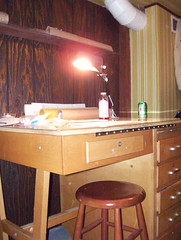

Describe where you work:
I work in a basement studio that I rent in a house. I use a drafting table as a workbench. On the opposite wall I have a metal cabinet and an old library bookshelf. There, my supplies are organized by type and stacked in plastic boxes. Everything has a place and I do my best to clean
up each item and put it away before I leave the studio for the day. That way it is fresh and clean - and inspiring - when I walk in next time I work.

What's your favourite printmaking process?
So far I've only made linocut blocks. There is so much to learn about papers, inks, barens, brushes. It will be awhile before I feel I can move on to something else.

'Linoleum block and original sketch' - pejnolan on Flickr
What's your creative process for any given print?
Being a graphic designer, I scan in a sketch or photo reference, then manipulate it in Photoshop to find what might work well as a composition. I print out a copy to 100% size. Next I will transfer the design onto a sheet of Tengucho paper. During the transfer, I alter the sketch further. Next the Tengucho is turned over so that the pencil side faces the block and adhere
it to the block with rice paste. After allowing it to dry 24 hours, I return to the drawing and adjust anything using a Sharpie marker.

What do you enjoy most about printmaking?
So much of myself goes into each piece that I found it difficult to part with it after a sale. I love the idea of being able to share my artwork without giving it away entirely. I guess I'm a bit selfish that way.

'Man-Child hand-lifted linocut' pejnolan on Flickr
What's your favorite part of the process?
Lifting that very first proof after carving! There is hopeful anticipation that wells up inside. It is the suprise and excitement of what might be - as if I were a child again opening gifts on Christmas morning.

What's your least favorite part of the process?
Clean up. I hate washing ink down the drain. I feel like I'm being wasteful.

'Three Raccoons Dancing on My Roof' - pejnolan on Flickr
What are your inspirations?
Beauty is everywhere: it is in the natural, organic forms found all around us. I use personal life experiences, memories, and stories as my inspiration. Many of my pieces are related to Door County, Wisconsin, USA. Al Stark is my printwork instructor and mentor. The energy of the linework in Van Gough's drawings currently has my attention.

How has your work changed and evolved since you started?
When I started I didn't have proper tools. I used an X-acto blade - cutting one side at an angle, then cutting the opposite side. I used silk-screen ink because it was what I had on hand. I'm learning more every day.

'Twin Lambs' - pejnolan on Flickr
How doyou get past creative slumps?
Oh! This one is hard! Sometimes I'll go weeks without being productive, then BAM! I have a conversation with someone, or go for a walk and something strikes a chord. Then I feel like I can't keep up with everything I want to get done. Basically, I allow myself those times when it just isn't working. The downtime is like sleeping: you're creative body needs it to refresh, renew, and repair itself.

How do you promote your work?
Etsy is my primary source of promotion. I also enter juried exhibitions and shows. Art Calendar Magazine is an excellent resource for this. Every week I search the internet to find new opportunities. There are Flickr groups to join and print exchanges to work on. I regularly attend my art groups: The Kishwaukee Valley Art League and The Makers Art Group. Moo cards are handed to all interested persons. Currently I'm working on a series on 100 prints for Art-O-Mat.

'One more try' - pejnolan on Flickr
Any other comments or advice for others who want to try making hand-pulled
prints?
Don't wait until you have the education, proper tools, etc. If you want to try printing, or try anything in life, do it today! Action equals productivity. Productivity equals satisfaction. Satisfaction equals happiness.

Great interview, Erin, thanks so much!

Sunday, February 8, 2009

Printsy Interview - Alfred Stark

dakokichidekalb on FlickrName: Alfred Stark, dakokichidekalb (Japanese for "kite crazy")
Etsy: dakokichidekalb.etsy.com
Flickr: flickr.com/photos/dakokichidekalb

Bio:

I discovered printmaking when I discovered Japanese kites. About five years ago, I finally decided to finish that unrequited fourth grade box kite assignment. Not really knowing how to make a box kite anymore than I did some twenty four years ago, I decided to take a trip to the local library. There I discovered a very influential book titled The Art of the Japanese Kite, by Tal Streeter. In this book I saw the most beautiful, delicate and improbable looking paper kites ranging in size from a small postcard to being several stories high. I was intrigued by their varying size, form and imagery. The images were so graphic and bold. Anyhow, to make a long story much shorter I made a box kite, it flew, and I quickly began trying to figure out how to make and fly Japanese style kites. It wasn't long before I discovered that many of them were block printed. This led me to look up books on Japanese block printing. I found one titled Modern Japanese Woodblock Prints, by Helen Merritt. This book really opened up my eyes and I immediately fell in love with moku hanga. As an added bonus, Helen Merritt turned out to be a regular customer at the local hardware store where i work. Anyhow, I quickly began to buy books on Japanese kites and prints and to experiment making both.

dakokichidekalb on FlickrWhats our favorite printmaking process?

I quickly discovered a book on Moku Hanga by Keiko Hiratsuka Moore. This book really laid our the process very well for me and helped my get started. I also take the time to pump Helen Merritt for information at the hardware store whenever I can. Through Mrs. Moore's book and Helen Merritt I was introduced to the work of Unichi Hiratsuka. He was a modern Japanese block print artist who pioneered the whole do it yourself moku hanga techinique throughout most of the twentieth century. His black and white imagery cuts to the core of his subject and is just about the coolest stuff I've ever seen. Anyhow, the strong, yet free flowing black and white style of Unichi really inspires me. Despite what I've heard, I think it's really hard to do black and white prints well. Its hard to simplify and maintain the essence of the subject while making the white of the paper come alive with the black. Right now printing in black and white is what I'm most interested in trying to figure out.

dakokichidekalb on FlickrProcess-wise I try to keep things simple. For a typical print I either draw from life or use a photo image I have taken myself. This image gets transferred to thin tengucho paper which is then glued down to a maple or cherry block. This image is carved out and printed by hand using a brush or brayer, a baren, water or oil based ink and Japanese paper.

dakokichidekalb on Flickr
dakokichidekalb on FlickrWhat is your work about?

I try do do prints only from nature. I love to go out and find little images of the natural world which seem to resonate with my somehow. I try not to think about it too much. If I see a particular flower, weed or bird I like I'll do a print of it. Maybe after I do a whole bunch they will start to come together as some sort of narrative, but for now I'm happy just to explore how images from the immediate natural world might translate into black and white prints.

dakokichidekalb on FlickrAs far as the whole art thing goes, I guess I'm more interested in the process of making nature prints than in wondering if they are art or not. I've heard my kites derided as "craft". I don't care that much, my favorite art magazine is American Craft so I guess it makes sense.

What do you enjoy the most about printmaking?

The thing I like most about printmaking is being able to work and re-work an image many times at the same time or several months apart. It's so cool to be able to use an image which I have carved again and again in several different ways. I can sell a print but I never have to part with the basic piece. I like the idea of being an old man with a lifetime of woodblocks on a shelf somewhere.

dakokichidekalb on FlickrWhat do you like least about printmaking?

I love to share my prints with others. The idea that I can make an image and have several of them all over the country is amazing. I tend not to number my prints as editions. I know this goes against the status quo of the print community, but I feel that if a thousand people want one of my prints then they should get one. If only ten want one then that's fine too. I'm not likely to flood the market with my current income anyhow. I make a few prints, and if I sell them all and I still like the image, I'll make a few more. The idea of a limited edition is a nice one, and seems appropriate for many situations, but for me it just seems silly. It's important to me that I be able to do what I want, as much as I want with any of my prints. I don't want anything "exclusive" about my work. The idea that I'm supposed to limit what I do is somebody else's rule from a completely different world than mine. The fact is I'm really limited as far as the number of prints I can make anyhow because I'm basically poor.

dakokichidekalb on FlickrHow do you get past creative slumps?

When I can't think of what to do next, I stop trying and go for walks. Having a digital camera helps. I just go out and start taking pictures of whatever. Flickr is a great website for handling creative slumps.

How do you promote your work?

Etsy is my primary means of promoting my work. I feel so lucky to have found a place to put my work where so many people from so many different backgrounds will see my work. I honestly feel like I wouldn't be doing block prints any longer if I hadn't discovered Etsy and Flickr. I mean, having the chance to share work with others is a huge incentive. I don't rely on the feedback so much, it's just nice to know someone saw something. If they like it that's cool, if they think it sucks that's fine too.

dakokichidekalb on FlickrI have to say the best thing so far about Etsy is finding other artists out there who do block prints. There are some very, very good printmakers on Etsy who blow me away with their work. I've noticed that some of my favorites are right here on Printsy! Thanks to Etsy, my wife and I have a house full of original art work that we'd never have been able to afford otherwise.

Inspirations:
John Porcellino, king-cat.net
The poetry of Mary Olliver
Unichi Hiratsuka, modern master
Tal Streeter, The Art of the Japanese Kite
Onchi Koshiro
Thich Nhat Hahn
Henry David Thoreau
John James Audubon
Thanks, Al, for the great interview, and for introducing us to the art and craft of the Japanese kite!