Printsy member Mariann Johansen-Ellis (mariannjohansenellis) makes amazingly thorough and instructive printmaking videos. In her 7 part series, she shows how to make an etching complete with hard ground, soft ground and aquatint. Below are the first two videos showing the hard ground stage.
She goes on to explain soft ground in part 3 and part 4, and aquatint in part 5, part 6 and part 7.
You can also read the Printsy interview with Mariann here.
Showing posts with label etching. Show all posts
Showing posts with label etching. Show all posts
Monday, January 28, 2013

Sunday, November 13, 2011
Interview with Jenni Desmond

I’m 26 and a freelance artist and illustrator. I live in a blue house near the sea in the quirky city of Brighton, UK, and share a studio there with 5 other artists. I’ve just finished a Masters in Children’s Book Illustration and before that did my degree in English and Art history and taught in France for a year. When growing up I always dreamed of being an illustrator but it didn’t seem a possible career choice at the time so I put it in the back of my mind. Slowly though, I realized drawing and illustrating was something I was incredibly passionate about and I enrolled in a couple of short courses and became obsessed, working 18 hours a day until I realized it had become part of my identity and my oxygen, and so I decided to go with it. Since then I’ve had several exhibitions, love making products to sell on etsy, do lots of commissioned work and am forging a career as a children’s book illustrator and would also like to develop my work more for interior design. I still tend to ‘work’ night and day and I love every minute of it.
Why do you like to print?
Printing gets me out of my comfort zone (pen) and I love the messiness and freeness it brings. Print changes the tone and texture of a line, making the line more sophisticated and interesting, and I love the spontaneity printing can often bring to your work- you never quite know how it’s going to come out!
What is your favorite print medium and why?
Overall, I most enjoy printing techniques that give you texture, tone and room for expression, so I think for me it is etching. It keeps a spontaneity and freshness to your work because you have to draw straight onto the plate with little room for mistakes. It is also a slow and meticulous process which requires quite a lot of perfection and patience to get right. The sensation and smell of the hot wax, the acid bath that can ruin your plate in seconds, and the big press that makes you feel straight out of the middle ages I find all incredibly satisfying and fun. I really like the final outcome of an etching, the quality of the line can be beautiful, and you can get some really interesting tonal qualities, especially when adding aquatint.

I’ve only been printing for about 3 years so I’m very new to it and am discovering new techniques and methods all the time. I’ve started doing a lot of monoprint recently, and love printing onto textile. I am interested in creating work that doubles as being functional, and not solely decorative.
What inspires you?
A big one is music- I always listen to music when I work and what I listen to depends on the mood I am trying to create in my work. I am also inspired by pattern in nature, interior design, psychology, stories, and find that some of my best ideas come when I’m cycling or running outside. I think it is also very important to constantly come out of your comfort zone and see and experience lots of new things.
How do your promote your work?
Blog, facebook, twitter, word of mouth, exhibitions, magazines, emails…

We are having an open studio in Brighton next month (note - this interview was published after Jenni's open studio) so I’m getting work ready for that at the moment and I am working on book illustration. I am also developing lots of ideas at the moment for some new exciting printed products to sell in my shop over the next few months…watch this space!
Tell us one random fact about yourself
I have a mole wedged between my toes which is called ‘the rabbit poo’ - unfortunately it does looks like that.

Thursday, November 10, 2011
Tutorial: Coarse Aquatint
Aquatint is a technique used in copper and zinc plate intaglio printmaking to create tone. In a traditional studio, this is frequently done using a fine powdered resin which forms an acid-resistant dot cover on the plate, applied using a dedicated aquatint box. You get a reliably even tone throughout the image. In safety oriented studios, some artists substitute the powdered resin with spray enamel or spray paint.
Etchers who've worked exclusively with aluminium plates may not be familiar with this process because aluminium is 'self aquatinting,' in that if you place a large exposed surface of aluminium in the acid, it will not bite out the entire surface (thus creating an open bite) but rather bite out the metal in a grainy matrix which can hold ink.
Note: this tutorial has been written for those who have previously used some kind of aquatint, rather than for the complete beginner. However, if you belong to the latter category and nevertheless want to read on and find yourself confused, please do ask in the comments!
As the name suggests, this tutorial covers some aspects of the application of, and results that can be achieved with, a coarse aquatint. It's different from a 'fine aquatint' that the tone is more irregular and broken, and you can apply it without having to build yourself an aquatint box.
You need:
• Respirator / dust mask
• Lump resin / aquatint ground (this may be called something different depending on your location)
• Ziplock/plastic bag
• Wine bottle (empty) or a rolling pin which you never plan on using for food preparation again
• Jar
• Cheesecloth
• Old newspaper
• Heat gun
0) Powdered resin is bad for your health and loves to stick in your lungs. If possible, invest in a respirator, but at the very least wear a dust mask. Work somewhere like the garage or shed, where wind isn't going to blow the powder around, but which is away from fabrics and cushions. Cover your working surface with plenty of newspaper for easy clean up afterwards. When heating the resin, work in a very well ventilated area.

1) Put enough resin to fill your jar into a layer or two of ziplock bags.

2) Cover it with a cloth, and using your wine bottle/rolling pin, crush the resin into a powder.

Before rolling and after rolling:

3) Pour the powder into the jar. Cover it with 2-5 layers of cheesecloth (depending on the size of the holes in the cheesecloth and how much powder you'd like to escape) and secure with a rubber band.

4) Place your degreased plate (resin doesn't stick to oil!) on the newspaper. Hold the jar over it and tap to let the powder fall lightly on the plate.

4.1) Remember that resin expands when heated, so don't overdo it or the acid will have nowhere to bite.
4.2) If you need to cover large areas with tone, you are more likely to get an even coverage if you hold the jar up high to lightly work larger areas of the image instead of trying to do small bits at a time. Note that this will also cause the powder to float about more, so protect your clothing and workspace extra carefully.
4.3) The powder is not attached to the plate at this stage. Be careful not to breathe on it or to let your movements disturb it.
A corner covered in resin:

5) Carefully heat the resin from underneath with a heat gun. You'll know it's attached to the plate when it becomes transparent. Don't inhale the fumes.
6) After the plate has cooled, you will be ready to proceed in the same way as any other aquatint: block out the white areas; etch; clean off with methylated spirits; proof!
It takes a while to get the hang of exactly how much powder coverage there needs to be for the effect you're after. It is possible to get quite even results:

Or you could embrace the irregularity, in which case you get something like this:

(Work is entitled Gathering in the Domain, 2011)
Etchers who've worked exclusively with aluminium plates may not be familiar with this process because aluminium is 'self aquatinting,' in that if you place a large exposed surface of aluminium in the acid, it will not bite out the entire surface (thus creating an open bite) but rather bite out the metal in a grainy matrix which can hold ink.
Note: this tutorial has been written for those who have previously used some kind of aquatint, rather than for the complete beginner. However, if you belong to the latter category and nevertheless want to read on and find yourself confused, please do ask in the comments!
As the name suggests, this tutorial covers some aspects of the application of, and results that can be achieved with, a coarse aquatint. It's different from a 'fine aquatint' that the tone is more irregular and broken, and you can apply it without having to build yourself an aquatint box.
You need:
• Respirator / dust mask
• Lump resin / aquatint ground (this may be called something different depending on your location)
• Ziplock/plastic bag
• Wine bottle (empty) or a rolling pin which you never plan on using for food preparation again
• Jar
• Cheesecloth
• Old newspaper
• Heat gun
0) Powdered resin is bad for your health and loves to stick in your lungs. If possible, invest in a respirator, but at the very least wear a dust mask. Work somewhere like the garage or shed, where wind isn't going to blow the powder around, but which is away from fabrics and cushions. Cover your working surface with plenty of newspaper for easy clean up afterwards. When heating the resin, work in a very well ventilated area.

1) Put enough resin to fill your jar into a layer or two of ziplock bags.
2) Cover it with a cloth, and using your wine bottle/rolling pin, crush the resin into a powder.
Before rolling and after rolling:
3) Pour the powder into the jar. Cover it with 2-5 layers of cheesecloth (depending on the size of the holes in the cheesecloth and how much powder you'd like to escape) and secure with a rubber band.
4) Place your degreased plate (resin doesn't stick to oil!) on the newspaper. Hold the jar over it and tap to let the powder fall lightly on the plate.
4.1) Remember that resin expands when heated, so don't overdo it or the acid will have nowhere to bite.
4.2) If you need to cover large areas with tone, you are more likely to get an even coverage if you hold the jar up high to lightly work larger areas of the image instead of trying to do small bits at a time. Note that this will also cause the powder to float about more, so protect your clothing and workspace extra carefully.
4.3) The powder is not attached to the plate at this stage. Be careful not to breathe on it or to let your movements disturb it.
A corner covered in resin:
5) Carefully heat the resin from underneath with a heat gun. You'll know it's attached to the plate when it becomes transparent. Don't inhale the fumes.
6) After the plate has cooled, you will be ready to proceed in the same way as any other aquatint: block out the white areas; etch; clean off with methylated spirits; proof!
It takes a while to get the hang of exactly how much powder coverage there needs to be for the effect you're after. It is possible to get quite even results:
Or you could embrace the irregularity, in which case you get something like this:
(Work is entitled Gathering in the Domain, 2011)
Saturday, August 13, 2011
Friday, August 12, 2011
Wednesday, August 10, 2011
Sunday, August 7, 2011
Friday, August 5, 2011
Tuesday, May 31, 2011
Degreasing... with soy sauce.
Hello Printsy!
I'm Niki, one of your new blog contributors. I work primarily in etchings and am based in sunny Sydney, Australia. I'll hopefully be writing some tutorials and posting international printmaking related competitions which you can be part of. I most definitely don't know everything or even half of it, so if anyone has a tutorial to share, please do share it!
The studio I print at has taught me some 'safer' techniques which generally replace the more harmful chemicals with common household alternatives. The upside of this, aside from the obvious health and safety benefits, is that I can now do a lot of my printmaking at home, therefore paying less studio hire (and travel) fees. Being printmakers, you probably know all the steps already, but what I hope to add are alternative methods for you to try. So with that in mind here is the easy first step:
How to degrease your plate
without ammonia and whiting.
Degreasing your etching plate is important when applying a ground, aquatint, or sugarlift because it allows the medium to stick to the plate. This is traditionally done with ammonia and whiting.
If you don't like the smell of ammonia (it is like rotten fish), what works equally well is household grade powder cleanser like Ajax and soy sauce. You can actually use powder cleanser by itself, but it takes a lot more wiping effort.

You apply it in the same way. Add powder, add soy sauce, and wipe with a clean, grease free rag. Rinse with water.
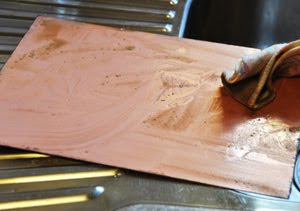
You'll know when your plate is degreased because the water should stick to the entire plate instead of blobbing up.

The end!
I'm Niki, one of your new blog contributors. I work primarily in etchings and am based in sunny Sydney, Australia. I'll hopefully be writing some tutorials and posting international printmaking related competitions which you can be part of. I most definitely don't know everything or even half of it, so if anyone has a tutorial to share, please do share it!
The studio I print at has taught me some 'safer' techniques which generally replace the more harmful chemicals with common household alternatives. The upside of this, aside from the obvious health and safety benefits, is that I can now do a lot of my printmaking at home, therefore paying less studio hire (and travel) fees. Being printmakers, you probably know all the steps already, but what I hope to add are alternative methods for you to try. So with that in mind here is the easy first step:
How to degrease your plate
without ammonia and whiting.
Degreasing your etching plate is important when applying a ground, aquatint, or sugarlift because it allows the medium to stick to the plate. This is traditionally done with ammonia and whiting.
If you don't like the smell of ammonia (it is like rotten fish), what works equally well is household grade powder cleanser like Ajax and soy sauce. You can actually use powder cleanser by itself, but it takes a lot more wiping effort.

You apply it in the same way. Add powder, add soy sauce, and wipe with a clean, grease free rag. Rinse with water.

You'll know when your plate is degreased because the water should stick to the entire plate instead of blobbing up.

The end!
Sunday, October 17, 2010
Niki Bañados
 Links to Niki's Etsy site, website, and blog are at the bottom of this interview.
How did you get started in printmaking?
I did one printmaking subject at university, as an elective. Our class took on the role of custom printers, under the name Cicada Press. We got to edition the works of well known local artists – and this responsibility of course meant we had to get proficient, fast! Aside from editioning other people’s work, we also got to do a couple of our own images. I loved etching immediately because it is forgiving of (or should I say it complements) my messy, finicky drawing style, so when uni was over, I looked for a studio where I could continue doing it.
Describe where you work.
I do my printing at an open studio called Warringah Printmakers Studio. They support safe practices which means there is not a drop of acid to be found, and we etch with copper sulphate. It’s good to know I’m lowering my chances of developing diseases later in life because of the processes, but it’s also frustrating sometimes because it’s not as stable and predictable as acid. Still learning!

Etching on zinc. There’s enough possibilities with it that I haven’t felt the need to experiment further… yet.
What's your creative process for any given print?
First the idea gets drawn in a notebook. This usually happens within 30 seconds because I’m terrified I’ll forget it. A few months later I’ll stumble across it again and if it still looks attractive, I will look up some images on google, or photograph my own, to use as a reference for drawing. I then draw straight onto the (hard grounded surface of the) plate.
What do you enjoy most about printmaking?
Others find the long etching process tiresome, but it’s what I like best. I like seeing the physical reaction of the acid bubbling the plate away, watching the plate get shiny as the ink is wiped off, and peeling the paper away from the plate.

Peeling the paper away from the plate and realising how many mistakes you’ve made! Getting dry hands from constant washing is also annoying. The rest is fine. I even enjoy cleaning the plate off.
What are your inspirations?
Other etchers. They show me how much I still don’t know and how much I could possibly do if I spent more time at it. Also I like the MCA in Sydney, and all the little galleries in the side streets that line Oxford Street (also in Sydney). These don’t directly reflect in my work either in subject matter or style, but are useful as a reminder to me to keep making art.
How has your work changed and evolved since you started?
I’ve only just started! I will definitely be looking into some evolution, but only once I’ve gained enough level-up points.

By looking at what I know and working from that, even if it’s not immediately creative or exciting. It can be helpful to just have a starting point from which better things can emerge, especially because I tend to get ideas by working, rather than by sitting around moping.
How do you promote your work?
Etsy, facebook, flickr. At the moment I don’t have enough actual content, so I’m focusing my efforts on that. Later I’d like to have a stall in one or a few of Sydney’s many markets, and to promote my work via word of mouth through the people I know.

Everyone knows what sculpture and painting and photography is, but no one knows about printmaking! Why not!? Show your friends and family, take the time to describe some of the work that goes into it, and what makes it unique. Imagine a world where people no longer get printmakers mixed up with inkjet and laser printers.
Niki’s Etsy Shop
Niki’s Blog
Niki’s Web Site
Sunday, May 9, 2010
Printsy Interview - Bridget Farmer
 Website: www.bridgetfarmer.com
Etsy: bridgetfarmerprints.etsy.com, bridgetfarmerbooks.etsy.com
Blog: bridgetfarmer.blogspot.com
Brief Bio
I grew up in Belfast in Northern Ireland, studied Design and Applied Art in Edinburgh, Scotland, then went traveling and ended up discovering printmaking and meeting my partner in Australia. This led to staying in Melbourne, Australia for four years longer than I meant, studying an MFA in printmaking at RMIT and getting a scholarship at the Australian Print Workshop. I have now moved back to Belfast with my partner for a couple of years.
How did you get started in printmaking?
While at art college I learnt how to make monoprints, but the extent of the printmaking world was still unknown to me at this stage as I was studying jewellery and silversmithing, not printmaking. During my degree I realised I wasn't really a jeweller, but I loved all the portfolio work we had to do, so I decided to take that further.
 When I arrived in Melbourne I found the Australian Print Workshop and enrolled on a weekend course. I loved it! and from then on I was hooked. It was like a whole new world of possibilities had been opened to me. I had always liked drawing and this was a perfect way to take my drawings further.
Describe where you work.
At the moment since I've just moved back home I'm working where ever I can. It's not ideal, but I keep an image in my head of the studio I'm longing to one day build when I get back to Australia! It's going to be huge and light and lots of shelves and a lovely big old printing press!
 What's your favourite printmaking process?
I feel I'm still a novice really, I know there is so much more to learn, so I'm not really sure what my favourite process is. I do love the fine lines achieved with acid etching and the other possibilities such as aquatint and sugarlift using the same form of technique. I want to look more into these, play around a bit, experiment.
I feel I should also explore non toxic printmaking. I've always turned my nose up at it, yet my dream is to build an eco house and live as green as possible. This doesn't make sense! How could I live in an eco house with a toxic studio? So I think I need to readdress this!
What's your creative process for any given print? (eg. sketch first? Pre-planned or free-form?)
I find it very important to go out drawing first. I have to draw from life, although often 'life' is in the form of a dead stuffed bird in the museum. I also like drawing live birds and dogs down at the beach or in a park. Drawing from life (even a stuffed bird) gives your drawings life. I don't think you can quite get the same sense from a photo.
 I then use my sketches as a basis for my prints. I have an outline of an idea of what I might want the print to look like but I'm always open for happy accidents. I'm not too precious about the results, sometimes I wish it was slightly more out of my control!
What do you enjoy most about printmaking?
I think it's got to be that moment, just after rolling the press, pulling back the blankets and peeling off your print and seeing it for the first time. Even if editioning, each time I lift the paper it's exciting.
What's your least favorite part of the process?
Sometimes I get frustrated at how long the process takes. I don't experiment as much as I should as a result. Also, of course, the cleaning up.
 What are your inspirations (other artists, people, places, events, etc.)?
When I started printmaking I'd just arrived in Australia and I just couldn't get enough of all the birds. They were all so foreign and exotic looking to me and I hadn't a clue what they all were even though I knew most common birds in the UK. So in the beginning I used printmaking as a way to get to know these birds, you'll see all my earliest work depicts Australian birdlife. I looked at how others depicted these subjects and I love looking through links on other peoples blogs and finding new artists and printmakers dealing with similar subjects.
How has your work changed and evolved since you started?
I've only really been printmaking for 4 years and most of that time was learning different techniques, so I don't feel I've evolved a great deal, except in the number of different techniques achieved.
 I have however started to really get into making books. I like the craft aspect of this, constructing, thinking in 3D, learning book binding, thinking about cover as well as the content. I find it challenging in a different way. I love ending up with a precious object, rather than an image for a wall.
How do you get past creative slumps?
I hate that feeling, sitting at your desk, knowing there should be something you could do, but nothing happening. I think the best thing to do is leave your desk. Go out. Look at exhibitions. Read peoples' blogs. GO DRAWING!
 How do you promote your work?
I have a blog that I try and post on regularly, I take part in the etsy forums, and occasionally I twitter. But I find the best ways are normally through exhibitions and word of mouth. I was part of a few exhibitions in Melbourne before I left and as a result had some local newspaper articles written about my work. This led to people phoning me up and coming round to my house to see my prints and buying. I think it all just takes time to get known. I don't help it by moving countries every 4 or 5 years!
Any other comments or advice for others who want to try making hand-pulled prints?
There are lots of print workshops around, find out if there is one near you and see if they have any courses. They may seem expensive but it is well worth it and most of the time the price includes all the materials. Once you have a basic knowledge of how the process works there are lots of things you can do at home. I've just bought a mini press for about £300 and I intend to make collagraphs, which are non toxic and made of many materials you'd find at a local DIY store. Don't feel daunted by all the chemicals and acid, they are not necessary!
 Also by working at a print workshop there will always be other people around. I learnt mostly from other workshop users. It's good to feel part of a little printmaking community, everyone helping each other. For me, enrolling on that printmaking course back in 2006 was the best thing I ever did!
Sunday, January 17, 2010
Printsy Interview - Stephanie Mercado

Website: www.stephaniemercado.com
Etsy: www.stephaniexristine.etsy.com
Blog: paperdollsteph.blogspot.com
Flickr: www.flickr.com/stephaniemercado
Brief Bio:
I am an artist born and raised in Boyle Heights, east of Downtown Los Angeles. I am a creator of things, whether it be painting, printing or sewing. I come from a family of tradesmen, musicians, and creative types. Although I did not have access to art in my youth, I was encouraged by my mother to draw, by my grandfather to sew, and by my grandmother to knit.
I stumbled upon painting when I saw an instructional video on PBS at the age of 15, and decided to pursue art ever since. I received my Bachelor of Fine Arts Degree through California University Long Beach ten years later, and I am currently making art full-time.

How did you get started in printmaking?
I started printmaking by accident. While I was at school pursuing my bachelor's degree one of my classes was canceled and the only class available was a printmaking survey class. Since I needed a certain number of units, I decided to stay enrolled in the class and instantly fell in love with the medium, the diversity and the range of work one can create with printmaking.
After having exhibited a series of prints I created at school, a patron became interested in my art and donated a press she was no longer using to me. I am very fortunate to have made such a good and generous friend.

Describe where you work.
When I received the Press I did not have a studio and I worked from home. I recently got a studio in Downtown Los Angeles, but due to it's weight my press is still in my bedroom and I think I prefer to keep it there. The area where I print takes up a quarter of my living space, but it does not bother me because it reminds me that I have to keep busy, and that I have to keep making things. I became accustomed to working with portability and ingenuity in small spaces, and having a place to work away from home in addition to a place to work while I am home, allows me to make art all of the time.
Therefor, the studio in downtown is primarily my painting and sewing studio, and my bedroom at home is my printmaking studio. One day I would like to have a large space where I can live, work and exhibit all at once.

What's your favorite printmaking process?
At the moment, my favorite printmaking process is Dry-point because of its portability of process and unpredictable printing quality. I really enjoy the immediate mark making and the variation in line and tone one can obtain through those marks, in addition to the level of detail one can achieve. Dry-point prints also have a line quality that is similar to ink drawings and may at times be appear a little deceiving and ambiguous at first glance.

What's your creative process for any given print? (eg. sketch first? Pre-planned or free-form?)
My creative process primarily revolves around reading and research. When I am working on a body of work, I am constantly thinking about elements and ways to convey particular ideas. When I have an idea, I usually sketch what I am thinking, and the sketch determines whether or not I will make a painting or a print. Sometimes, I make a painting from a print, and sometimes I make a print from a painting. Although the themes are similar, or one idea is used in two different mediums, the image is never the same.

What do you enjoy most about printmaking?
The most enjoyable aspects of printmaking for me are the process and the range one can achieve using various mediums within printmaking. I like carving blocks, scratching Plexi-glass, cutting paper, inking plates, and watching a series of prints hanging to dry. I also like seeing the diversity within each print, and contributing to the variation by watercoloring, drawing, or silkscreening over some of the prints. I like to make ideas come into fruition, to see prints formed and to see them change.

What's your least favorite part of the process?
Aside from cleanup, I'd have to say that framing is my least favorite part of completing the printing process. Seeing the work framed is rewarding, but taking the time to frame the work always seems more daunting than making the work itself.
What are your inspirations (other artists, people, places, events, etc.)?
My inspiration is society. I see everything around me, and I question everything.. I wonder why things are the way they are, and whether or not they will ever change. From those thoughts and emotions I turn to art, music, film and literature. Artist, musicians, films and writers are secondary sources of inspiration that help my thoughts and creativity to grow. For example I am currently making art focused on socio-economic issues and the housing market, and researching Bruegel's work, the history of Wallpaper, and Doll Houses.

How has your work changed and evolved since you started?
I have become more care-free with my work since I started. I used to waste a lot of time wondering whether or not an idea was worth pursuing. Now I just make the work and I have fun with it.

How do you get past creative slumps?
I usually get past creative slumps by flipping through old sketch books, going to the museum or by going to the library. Sometimes I take a couple of days off and do nothing for a couple of days. Not working for a couple of days usually does the trick and I am eager to get back to work the following day. My hands need to be constantly working on something, for my mind to be at peace.

How do you promote your work?
I try any means necessary to get the work out there. I am on a few social networking sites in addition to my own website. I also have promotional postcards that I leave everywhere I go. I enjoy going out and meeting people, and any time they ask for a business card, I always have one handy.
Any other comments or advice for others who want to try making hand-pulled prints?
Appreciate them for what they are and don't worry about making them too perfect. Imperfections give them depth and personality. Oh, and... good luck!
Sunday, November 22, 2009
Printsy Interview - Mandy Laschon

Website: mandylaschon.com
Etsy: mandymayl.etsy.com
Brief Bio
Human culture is like folklore ever changing and ever forgotten, replaced by something newer and better or even just different. The forgotten, the replaced is what I find compelling; to dig up the past with its richness and understand its roots. Words, icons, and beliefs are just some of the ideas that hold such tradition from which to pull concepts that I relate.
I find myself listening to phrases very literally, in everyday conversation. As humans we have made metaphors into figures of speech. For one to say “ push the envelope” doesn’t mean to find an envelope and to push it; everyone knows that. By illustrating our creative forms of speech and phrases we shed new light on what the words mean. The idea of taking phrases literally has led me to seeing symbols or iconography literally, as well. The image of an animal or object can have many literal meanings, and even more captivating symbolic meanings. Through the years we have lost the symbolic meanings and in some cases gained new and different ones.

How did you get started in printmaking?
I went to college for a Fine Arts Degree but they didn't offer an emphasis in Drawing so I took a printmaking class and fell in love with it. My drawing/printmaking professor help me along my relationship with printmaking.
Describe where you work.
I work in an alcove of my home, a dormer window to be exact and it is a cozy creative place.
What's your favourite printmaking process?
I have a heart for intaglio, but it is easier for me to do linocuts at home.

What's your creative process for any given print? (eg. sketch first? Pre-planned or free-form?)
I listen to music or read, sometimes just a phrase pops into my head and the image grows from that.
What do you enjoy most about printmaking?
All the tedious time consuming processes.
What's your least favorite part of the process?
I know the least about lithography my master professor was a traditional printmaker.
What are your inspirations (other artists, people, places, events, etc.)?
All music, my Catholic faith, and books.

How has your work changed and evolved since you started?
I have since college read more about traditional printmaking and now my work in echoing a less contemporary look.
Recently I have spent some time as a missionary in Honduras. This beauty in the people's true true faith when they have nothing is amazing. This will shape my art in the future. The heart of the people that will give you everything when they have nothing. The hope they have when it truly seems hopeless. Maybe even the colors and images in thier art.
How do you get past creative slumps?
I draw little silly illustrations, and listen to more music
How do you promote your work?
I have a website, I use ETSY.com and I submit to art exhibitions and publications several times a year.

Any other comments or advice for others who want to try making hand-pulled prints?
Read all the old books in the library about printmaking they have the BEST advice.
Sunday, October 18, 2009
Printsy Interview - Claudia Hershman
 Etsy: claudiahershman.etsy.com
Utrecht Artists
Birmingham Society of Women Painters
Blog: claudiahershman.blogspot.com
Brief Bio:
Born and raised in Detroit, Michigan. Attended the University of Michigan, majoring in painting and ceramics. Graduated with a Degree in Design and a teaching certificate. I taught elementary art for 2 years before starting a family. I have taken post graduate classes at The College for Creative Studies in Detroit and the Birmingham Bloomfield Art Center. Art, in one form or another, has always been a part of my adult life.

How did you get started in printmaking?
Serendipity!!! I have only been printmaking for a few years. I had done pottery, painting and worked in Polyform clay, making jewelry. I was away from art for several years while working in advertising sales. I read Drawing on the Right Side of the Brain and it stimulated me and challenged me to see if I could hone my drawing skills. I signed up for a class because I thought that being confident in drawing was the most important first step in working in any medium. I drew in charcoal and pastels for a couple of years and began to feel that my eye was getting sharper and I was getting more confident. To me, the most important part of making art, is training your eye to really “see” what is before you. I went to a class on photo transfer, and thought I might be able to draw and color on my transfers after I printed them. That led to a printmaking class, to learn how to print. The first thing we did was collagraph prints, and I fell in LOVE! They were so much fun, spontaneous, and exciting. A couple of years after I started making prints, as I looked around at the art work that I’ve collected, I realized that I had always been drawn to this medium, and most of the artwork I own is etchings or screen prints!

Describe where you work.
I have a home studio in my basement. I added lighting that simulates daylight, and it’s a cozy and warm space to work in. I have music and a TV for company and I share the space with my grandkids when they come over. My goal is to pass on my love of art to them. I am fortunate to have a good friend who is a genius at making anything, and he made me a wonderful big work table. In addition, he built an extension to a flat file that doubles as an inking surface. Another printmaker friend told me about a press for sale on line, and I was lucky to get an old Japanese school press for a very good price. I also formed a group of 7 other artists and printmakers, and we meet once a week. Working together stimulates us all, and allows for the sharing of ideas, techniques and lunch! In addition, I continue to take classes at a local art school, to connect with printmakers and continue to grow.

What's your favourite printmaking process?
I love making collagraph plates and dry point etchings. Plates can be made from a variety of materials, like the tops of Styrofoam food containers and matt board. I also use industrial plastic for the dry point plates. I like the idea that the same plate can look totally different by the way it’s inked. Also, some of the printmaking processes allow you to work in a painterly way, which combines my love of painting and line.

What's your creative process for any given print? (eg. sketch first? Pre-planned or free-form?)
I am more into free-form. I think about a broad concept and then try to abstract it. I like to let the work lead me. I also like to rework pieces that I think were not successful. Sometimes my best work comes from a piece that didn’t work the first time. I find there is less pressure when working with a piece that is not too precious. I also discovered that I am most comfortable working in a small format. Most of my prints are smaller than 8x10”. I have done images for mini print competitions that are as small as 1x4”. It’s challenging to make an image that is interesting in a small size. In today’s economy, the small size also makes the work more affordable. I also spend a lot of time looking at images that provide a jumping-off point for me. I have moved away from trying to reproduce an image of something, into a more abstract, whimsical way of working.

What do you enjoy most about printmaking?
What I like most is that there are a lot of techniques to choose from. The process also has many steps, and that variety keeps me from getting bored. Each step of making a print is exciting and absorbing. When you get tired one process, you can try another. I find that inking the plate is a real challenge, and makes a huge difference as to how the final print looks. Sometimes I like to just work with a brayer and different colors in a spontaneous way, making a lot of prints quickly. (It keeps me from getting too enmeshed in details.) Some of the prints don’t work, but sometimes there are wonderful, surprising results. These are unique prints that you can’t duplicate. Printmaking reminds me of the excitement you feel when you open a kiln after firing a load of pottery... the magic of the unexpected!
What's your least favorite part of the process?
Cleaning up oil based inks! I solved that problem, and the problem of the toxicity of the solvents, by working with water miscible oil paints. I also don’t like doing large editions of the same plate, inked the same way, in the same colors. I am most excited by spontaneous accidents.

What are your inspirations (other artists, people, places, events, etc.)?
I love the work of Hundterwasser, Paul Klee, William Kentridge and Richard Jerzy. I love COLOR and am very attracted to it and affected by it. I look at work on the internet, go to galleries and art fairs. Looking is inspiration. The smallest detail can be a jumping off point for a print.

How has your work changed and evolved since you started?
My work has grown from dependence on concrete visuals to experimentation with color, line, and shape. Printmaking has helped me to work looser and more spontaneously. Because of the move away from concrete images, my work has taken on a more abstract, mysterious quality. As I learn new techniques, my options increase for each print. When I was painting and drawing, I was more tied to the image.
How do you get past creative slumps?
I read, look at other art, talk to artists and just start working on something to see where it will lead. I try to start with a vague idea of a theme and go from there. I look at how children work and take inspiration from their total faith in what they produce and how they break all the rules we learned in art school. I also collect pictures of work I like to refer to when I am in a slump.

How do you promote your work?
I am on Etsy, a member of Printsy, I enter local shows and competitions, talk about it to other people and email new images to my mailing list. I send thank you notes to buyers with images of my work, and invite them to view my work online too. I put a variety of images of my prints on my business cards to remind people of what my work looks like.
Any other comments or advice for others who want to try making hand-pulled prints?
Try it! It’s fun, versatile, interesting, varied, and there are so many possibilities. You don’t have to be dependent on drawing to make an interesting print. There are great classes in many local art schools or community colleges. The world is your oyster in this medium. (Can you tell that I love it?)
Subscribe to:
Posts (Atom)