Web site: www.celiahart.co.uk
Blog: purplepoddedpeas.blogspot.com
Etsy shop: www.magiccochin.etsy.com
Flickr: www.flickr.com/photos/magiccochin
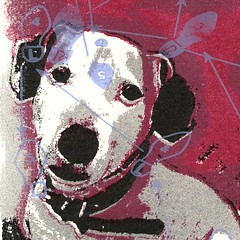
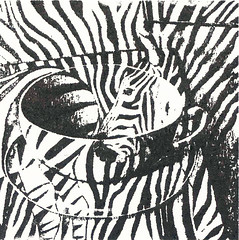
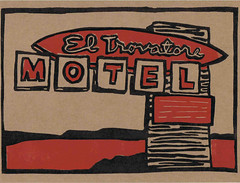
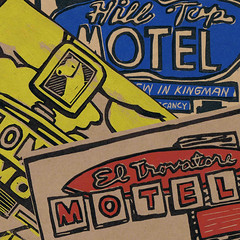
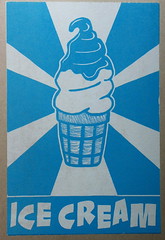
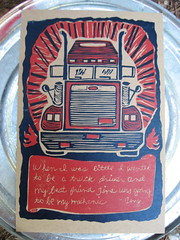
I had a look at Celia’s work on the internet, part on her etsy shop, and also on her web site, from which you can access her great blog with all kinds of wonderful links. I was very impressed with the images that Celia makes in lino. Having had a look at her blog also, I especially would love to see the purple pods up close. They look just great.
Celia, you work as a full time artist and illustrator in Great Britain, tell us a bit about what that is like? Where you work, if Brits are supportive of art, and what is your normal workday like?
There are so many niche markets for art and illustration that it’s impossible to generalise, so I can just tell you about my own experience:
After leaving Brighton College of Art and Design with a degree in ‘Visual Communication’ (that’s graphic design, illustration, typography, photography, advertising, information design, packaging, etc) I did some freelance page layout design and illustration work for Cambridge University Press. I was ‘passed on’ to another big name in educational publishing, Longmans (now swallowed up by the vast media group, Pearson plc). A full time job soon became available for Longman Education and for the following eight years I designed and commissioned illustrations for books for UK schools. I also learnt to use desk top publishing – from it’s birth! Starting with a Mac in 1985. I was involved with producing the first textbooks using dtp rather than conventional typesetting and page make-up. Whole sectors of the publishing and printing industry were wiped out over the following five years.
Waves of redundancies are commonplace in UK publishing houses, and in 1991 I found myself unemployed, but with a sizable redundancy payment and a plan – it had been obvious for a number of years that remaining ‘in-house’ as a designer meant management rather than hands-on designing, so this was my chance to set up a studio and work freelance.
My next challenge was to convince editors that I could supply both page layout designs and illustrations – once you get pigeon-holed it’s very hard to escape! I submitted samples of illustrations for projects and after they had been approved, I admitted that I had done them myself. I built up a list of clients who needed illustrations integrated with design – illustrated diagrams, maps, worksheets and teachers’ material. I enjoy the research that such projects require and attention to detail.
Nine years ago I moved, with my husband, to a small village just east of Cambridge (my ‘home town’), just over the county boundary in Suffolk. With a studio at home I could now work on my own creative projects side by side with my publishing projects and after years of being a chameleon adapting to each new commission, I found my own ‘voice’. I could also indulge in my passion for gardening, in particular growing heritage vegetables. I joined Cambridge Open Studios and enjoy opening my studio to the public, taking part in the joint exhibitions and getting to know the other artists. The historic university city of Cambridge attracts knowledgeable art lovers who enthusiastically support local artists.
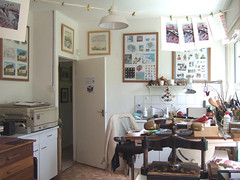
My working day depends on whether I have an on-going publishing project – these arrive out of the blue (or rather, attached to an email) so my workload can change from light to overload in a click! I usually go into my studio attached to our house, at about 8.30am and work until late morning either at my computer or at a large drawing board in my studio overlooking the garden. Then I try to take a lengthy break which includes lunch and a ‘gardening work-out’ or a walk along the footpaths around the village. I’m back in the studio at about 2pm and work until about 5pm when the cats (my studio assistants) remind that it’s time to get the evening meal prepared. If I have a looming deadline I’ll get back to work while supper cooks and sometimes return to work after eating, if work is under control I can relax.
Printmaking in general, and for you linocut in particular, how did you discover it, and why did you choose lino?
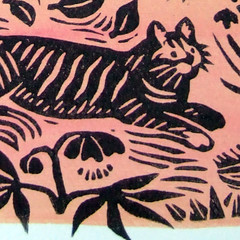
I did some of printmaking at art school and particularly enjoyed the technical side and mix of precision with chance. From time to time I did small prints at home for Christmas cards. I love lino because I particularly enjoy carving the blocks, I use tools made for me by my late father who was a master joiner. In the past year I’ve started to experiment with woodcut and taking prints from wood grain to combine with linocut. I’m learning to be more experimental, years of working fast and accurately to deadlines have trained the ‘just for play’ side of creativity out of me and I need to rediscover it!
What do you print with? Do you have a press? Do you prefer water-based or oil-based inks? Do you have any favorite papers?
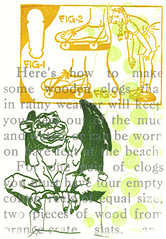
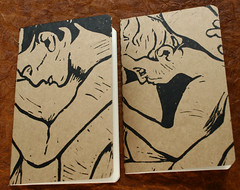
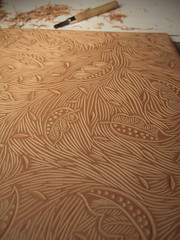
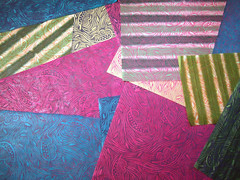
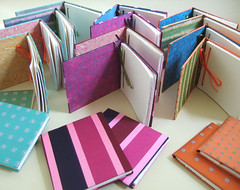
I don’t have a press, my prints are literally hand pressed. I use either a Japanese baren or a large wooden spoon! Sometimes for a lighter impression I’ll just use my hands. I’ve developed my own system of registering the prints, which works for me (it’s something I think every printmaker needs to sort out for themselves rather than following a prescribed technique). I used water based inks until 2007, and still like the chalky opacity they have; after a course at the Gainsborough House Print Workshop in Sudbury where we used oil based ink which is cleaned up using vegetable oil, I invested in some inks from Intaglio Printer in London. I like to add extender to give the pigments a translucent quality. I usually use BFK Rives printmaking paper, which has a lovely velvety finish. I also love using Japanese paper – the thin strong papers are so easy to print onto by hand. I discovered some vivid coloured Indian khadi paper in a local art supplies shop which I print with overall decorative patterns which I use as end-papers in hand bound journals.
 |  |  |
I’d say have a go and don’t worry if that you don’t have a press or exactly the ‘right’ tools – improvise! But always use warm lino (you’ll get to know what is just the right temperature) and always take care to cut away from you so you don’t stab yourself.
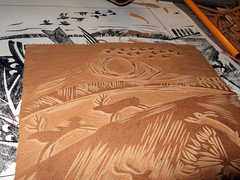 I see on your blog that you transfer images you have changed in size on your computer, to your lino block, can you tell us a bit about how that is done?
I used to trace down the designs with either carbon paper or chalk on the back of tracing paper. I then discovered that you can transfer the design from a photocopy or laserprint (it has to be printed with powder toner not ink) by painting paint-stripper gel onto the reverse side of the paper and burnishing it down onto the lino. As I usually finalise my designs in Photoshop it’s easy to print out the design for each plate as a black laserprint and then transfer this to the blocks. No worries about remembering to do the design in reverse as this process handles it for you!
You have some absolutely lovely Christmas ornaments on your blog, how did you make them, and will we be able to buy them on Etsy for Christmas?
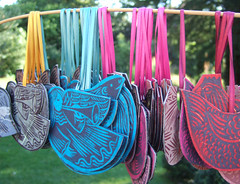
I sometimes have a stall at local Art & Craft Fairs and while it attracts attention having some large framed pictures, it is the small relatively cheap gifts that sell. I had bought some cute animal felt cut-out tree decorations when I visited New England, I love getting them out each Christmas and also like that they can be used as decorations at any time of year. So I devised these – the image was printed on bright colour khadi paper glued onto card. I then printed scraps of silk fabric with my pattern lino blocks and stuck the silk on the reverse of the card with a ribbon to loop for hanging. They sold very quickly, I was so surprised when people made a beeline for my stall and announced they wanted the tree decorations they’d seen on my blog! Yes there will be more this year – and not only the bears, angels and hens, there will be some new designs too.
 Working as an illustrator, which involves a lot of digital work, do you think traditional printmaking has a future in the face of digital printmaking?
In the last couple of years I’ve seen lino and woodcut feature on book jackets, packaging and in editorial illustrations more and more. There is so much interest in 1950s and 60s design – a time when printmaking was also popular and I think this has had a great influence on today’s illustrators. I think a lot of illustrators like to combine the traditional techniques with digital work – and afterall, most clients will require a digital file as finished artwork.
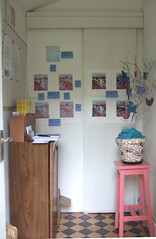
There is a problem of definition for printmaking and ‘limited edition’ or ‘original prints’. Most people don’t understand the technical printing processes and therefore find it confusing when some prints are priced much higher than others. At my last studio open days I pinned up a display showing the sequence of printing one of my designs – people commented on the amount of work involved! And they then spent longer looking at the prints.
 Do you have any tips for Etsy printmakers and other Etsy sellers on how to market yourself as an artist?
I’m an Etsy novice, so I’m only just learning the ropes myself. I’ve found that my blog has been the best marketing tool, I’ve put a direct link from my main web site to my shop (i.e. my Etsy shop). Visiting other etsy shops and blogs gets people coming across you and your art.
Do you find Etsy and Printsy to be useful for you in your working life? Would you like to change anything?
Looking at other printmakers work via Etsy and Printsy is so exciting – how else would I have come across their work apart from looking in galleries on trips abroad? I think there’s a great opportunity there to get my work known outside my niche in publishing or in Cambridge and to see what’s going on creatively around the world.
I decided to use my blogging name ‘Magic Cochin’ for my shop’s name; the name is now evolving into a ‘brand’ for the gift items I sell at Craft Fairs – watch out for more from Magic Cochin next year! (The original ‘Magic Cochin’ was one of my first hens – a wonderful Black Cochin hen who we named Queen Victoria.)
Getting back to your work, I can see where the inspiration for the plants and animals come from living in English countryside, but the Japanese prints, tell us a bit more about them?
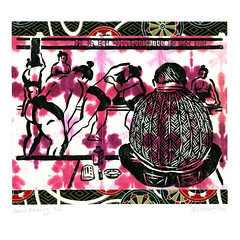
I’ve been fascinated by Japanese prints from schooldays. ‘The Great Japan Exhibition’ in London in 1981 was a huge influence. More recently a major Hokusai exhibition in 1992 and Hiroshiga in 1997 renewed my enthusiasm for Japanese printmakers. In 2003 we spent two weeks travelling round Japan, staying in ryoken and eating traditional Japanese food. I loved every moment of the trip from the frenzy of the Ginza district of Tokyo to the temples of Takayama. I came home with luggage stuffed with Japanese paper and full of inspiration for block prints. I used some of the Japanese paper for a series of prints ‘Memories of Japan’. The two that are in my Etsy shop are ‘Karaoke Bar in Yudanaka’ which is from a sketch from memory of an evening spent watching a group of businessmen unwind in a bar! And ‘Sumo Training’ another image saved to my ‘mind’s eye’ after visiting a sumo stable in the backstreets of Tokyo, to watch a training session.
Since then I’ve been trying to learn more about individual Japanese printmakers – the Fitzwilliam Museum in Cambridge has an amazing collection, the exhibition of prints by Yoshitoshi in 2005 was outstanding, he uses all sorts of virtuoso techniques like blind embossing and burnishing the black pigment to give a high polish (both effects that do not reproduce well in catalogues). You can now view the exhibition online. Last year I was lucky to buy a print in a local auction and spent many happy hours researching the printmaker – Hirosada, and the subject – the hare from the animals of the Japanese zodiac.
 You are a member of Cambridge Open Studios, tell us a bit about being part of a community like that?
Cambridge Open Studios was formed over 30 years ago by a handful of artists, I joined in 2000. Now there are over 300 members and this year 275 of them opened their studios for free to the public during four weekends in July. We (the artists) used to ‘run’ the organisation ourselves but it’s a full time job to organise so many people and such a large scale event plus Christmas shows and various exhibitions. We now pay a part time administrator and rent an office/gallery which shows members work. Members must do their bit to help run the organisation and can only opt out and pay an extra fee instead after three years membership. Tasks range from organising hanging the Launch Exhibition at the end of June to stuffing envelopes, so all skills are catered for! At first the fact that I was ‘commercial’ set me apart, there’s a degree of snobbery in the art world. But once I’d become a regular participant I felt part of a lively group and it’s fascinating to take time out to visit fellow artist’s studios each year and to swap experiences after the open days.
 And - It looks on your blog like you are an avid gardener, and cook, any favorite recipe you would like to share with us?
I think that’s an understatement! Gardening is in my genes, I helped my grandparents grow flowers and fruit to sent to markets, before I went to school. I started my own vegetable garden twenty years ago when many traditional vegetable varieties were still available and one of my favourites was the Purple Podded pea. When we moved to our present house which has a large area perfect for growing vegetables and fruit I wanted to grow those purple peas again, but I discovered that new legislation meant that the varieties I could buy had dramatically reduced and Purple Podded peas were no longer available. I joined the Heritage Seed Library and now grow and save seed for some unusual peas and beans, this year these include four varieties of pea with purple pods! Hence the name of my blog.
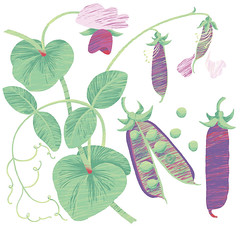 After finishing work in my studio I love to be able to walk out to the garden to pick fresh vegetables and herbs. There’s a
 favourite muffin recipe on my blog.
And last , - if you could take one piece of art with you to your deserted island, what would that piece be?
What an impossible question! Just one – there are so many to choose from! Could I be cheeky and ask for the full set of Yoshitoshi’s ‘Hundred Aspects of the Moon’, I haven’t seen all of them yet, but the ones in the Fitzwilliam Museum’s collections are awesome.
If you make me choose just one it would be ‘Moon and Smoke’
Thanks for a great interview!