Sunday, March 29, 2009

Printsy Interview - Julie D'Arcy

'Dandelion' - jvdarcy on Flickr
Etsy: jvdarcy.etsy.com
Blog: juliedarcy.blogspot.com
Flickr: flickr.com/photos/13626372@N05/

Brief Bio

While I do have some formal artistic training, it is not my primary field. Nonetheless, art has always been a part of my life. My mother is a painter and my father a journalist and self-proclaimed ‘failed cartoonist’ so I have been creating art of some sort for most of my life. When it came time to decide what to study in school, I was torn between science and art, but in the end chose science. I obtained a Bachelor’s in Chemistry and a Ph.D. in Biochemistry, and have worked in academic research and in biotechnology. During my time as an academician, I took some art classes from community organizations where I lived, as well as some tuition-free classes from the Universities I worked for. Amongst my mad skills are life drawing, jewelry fabrication, and intaglio printmaking.

How did you get started in printmaking?
I took a class at a museum in Rochester, NY, but only had a chance to do a couple of projects. When I first moved to New Mexico, I worked for the University of New Mexico and was able to take classes from anywhere in the University for free, so I decided to try printmaking again. The University has a wonderful printshop where I took basic printmaking from a very talented and enthusiastic graduate student. We got to do at least one project each of linoleum block printing, reductive 3-color woodblocks, etching, aquatint, soft and hard ground techniques in etching, and lithography. It was a great experience, and our instructor also showed us the beginnings of open bite techniques.

Describe where you work.
I have a small studio in my house with a huge skylight in the ceiling to let in lots of the New Mexico sunlight. It contains my computer (on which I spend far too much time), ridiculous amounts of supplies, and several drawing areas. I currently do not own my own press, but one day…

'Christmas lino' - jvdarcy on Flickr
What's your favourite printmaking process?
I enjoy the three dimensional part of printmaking, which I suppose is, in principle, intaglio. I have created embossed images out of acid-etched zinc plates, linoleum blocks, and collagraph materials. In addition to those images created without ink, I am also fond of using open bite techniques to give things interesting edges.

'Christmas card' - jvdarcy on Flickr
What's your creative process for any given print? (eg. sketch first? Pre-planned or free-form?)
I will usually create a fairly detailed drawing, as close to the final size as I can, that way I can transfer it directly to my plate. The ideas for a print come from everywhere. Sometimes it is nice to have some forcible inspiration, like an assignment, to get started. In the first class I took at University of New Mexico, our reductive woodblock assignment changed between the first time the instructor assigned it and the second. First she said to make a still life, then she said make it a landscape, and thus “Still Life on the Highway” was born.

'Still Life on the Highway' - jvdarcy on Flickr
What do you enjoy most about printmaking?
I like the multi-media approach of it. You can acid-etch metal, then manipulate it further by hand, you can carve a sculpture into a linoleum block, then you get to work with paper and ink. Printmaking lets you do a little bit of everything.

What's your least favorite part of the process?
Wiping down a delicate plate! It is sooo time consuming, and allows no cheating!

Oh yes, that and building a ground on a mezzotint plate!

What are your inspirations (other artists, people, places, events, etc.)?
I’d love to say I’m inspired by nature, but not really. I get inspired by other artists often, as well as science and just good old imagination. Some of my favorite artists are Salvador Dali, James Christensen, Daniel Merriam, Patrick Woodroffe, and Andrew Wyeth.

'Green Man' - jvdarcy on Flickr
My subject matter varies widely, but I really love expressing the three-dimensionality of forms either in two dimensions (chiaroscuro) or in actual three-dimensions in the absence of color.

How has your work changed and evolved since you started?
I have never had a unified style and I really don’t like to do the same thing twice. Therefore, often my work will evolve during the course of a single work.

How do you get past creative slumps?
I go back to my day job!

'fishy fishy' - jvdarcy on Flickr
How do you promote your work?
I have some folks in the Forums I hang out with called the More Meaningful Gifts BNR, and the originator of that group has started a Ning Community called My Handmade Registry, where users can go and build wish lists for handmade items from Etsy. I also have a blog where I talk about unusual art media, which has a few followers. Other than that, I have not had very much time to promote lately. I have a twitter account, as well as linkreferral.com, which, when I actively use them, do seem to bring me some new traffic.

Any other comments or advice for others who want to try making hand-pulled prints?
Many universities and private institutions have some great classes in printmaking that allow students to try lots of different methods without spending a lot of money. Any place where you can find a press to use to try out new things is a good thing. There is such a wide variety of techniques, printmaking is the sort of thing you never stop learning.

Sunday, March 22, 2009

Printsy Interview - Annamie Pretorius

'St. Colmcilles Birds' - inugie on Flickr

Etsy: inugie.etsy.com
Art Fire: ThatThinLine.artfire.com
Website: www.ThatThinLine.synthasite.com
Flickr: flickr.com/photos/26552526@N06/

Brief Bio:
I live in Swords, just North of Dublin, Ireland, with my husband and three kids, aged 6 months, 4 and 5 years. Both my husband and I are South Africans. We lived and worked in the Johannesburg area for a good few years before moving to Ireland in 2002 in search of 'greener pastures'. We've settled here now, got the house, the cars, the kids and even a dog. I'm an architect and I work part time for a local County Council's Architects Department (mornings). In the afternoons I'm home with the kids, cooking dinner, cleaning the house etc. Then, after 8pm and once the kids are in bed, I'm a printmaker! It's a busy life; I wear several different 'hats' each day and love all of them (excluding cleaning!).

'Irelands Eye' - inugie on Flickr
How did you get started in printmaking?
As a young girl my parents showed me their wedding invitations. It was a lino print, with their initials entwined in a beautiful design, done by my dad, who was an architect too. He printed all the invitations himself and was ever so proud of it. I still have a small piece of the lino he used, now dark brown and very brittle. I always liked relief prints and etchings, and as a student I started playing around with small lino and drypoint prints. In 1998 I did a short course in Graphic Art with the Arts Department of the Vaal Triangle Technicon in Klerksdorp, South Africa. This covered the basic printmaking techniques of relief, etching and collagraph. I loved it, but had little time for my new hobby. After moving to Ireland it took me 5 years to get to a point where I had the time, the money and the space to take printmaking up again. I discovered the world of the online printmaker, etsy, wetcanvas, some online art suppliers and never looked back.

Describe where you work.
I'm lucky to have a small studio in our house. There's an old door on trestles for printing and a desk for the computer and drawing, a little baby press and a homemade print-drying contraption. It's nice and warm, just big enough and within earshot of the main living area. I love working there.

'Rainbow roll' - inugie on Flickr
What's your favourite printmaking process?
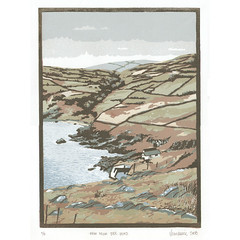
In 2007 I started doing reduction linos after reading the tutorials on Ian Phillips' website and enjoyed doing it so much that I did a workshop with him in Wales in 2008. I seem to have the right temperament for this nerve wrecking technique, as well as enough patience, logic and a rather steady hand.

'Registration' - inugie on Flickr
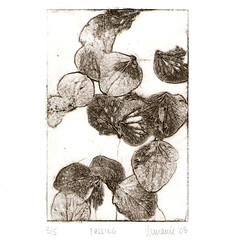
Although reduction linos are my current favourite, I have been experimenting with etching (zinc and copper sulphate), drypoint, collagraph and foilograph over the past year too. I'm hoping that I may get a little better at some of these if I keep practicing. I still have so much to learn and hope to do a few more workshops and short courses over the next few years.

'Falling' foilograph - inugie on FlickrWhat's your creative process for any given print?
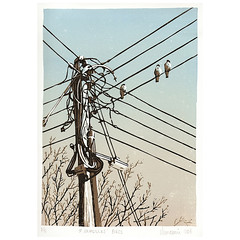
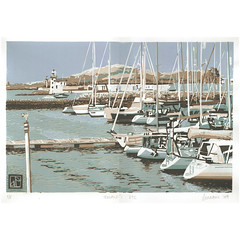
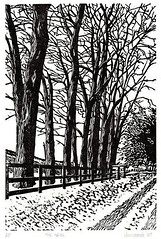
I normally use one of my own photos as a reference for a new print. I have hundreds of photos of boats, trees and telephone poles. I seem to be drawn to things that will give me hours of pain cutting ridiculously thin and complex lines. Browsing through these photos often ends up in a print, or I'll go out and take the photo I need for a specific print I have in mind.

I use Photoshop to simplify the reference image, change the composition as required, reduce and change the colours to generally get a feeling if it will work as a reduction lino. The simplified version is printed and transferred to the lino with carbon paper or grease pencils on tracing paper. I think this process will evolve though as I gain more confidence. I recently started a sketchbook and I hope to do a few prints without the help of photos soon.

'Torr Head' - inugie on Flickr
What do you enjoy most about printmaking?

The place my mind goes while I'm cutting the lino, the way time stands still and flies simultaneously, the surprise when you lift the paper, the smell of the ink, the ritualistic inking and printing, inking and printing. It's very addictive, my little treat at the end of each day!

What's your least favourite part of the process?
Cleaning.
What are your inspirations?
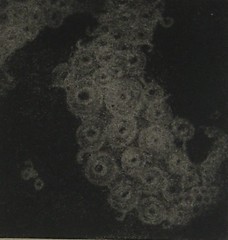
I love the way a small detail of something we see every day, can be beautifully abstract. I love looking up at things, viewing it from unusual angles. I love the silhouette of trees against the sky. I love patterns and rhythms and detail. I love thin lines. My way of looking at the world has not really come out in my work yet.

'the naul web' - inugie on Flickr
How has your work changed and evolved since you started?
It has evolved from really just playing around for years, to taking it much more seriously over the past two years. I'm still experimenting and the learning curve is very steep, but I'm slowly gaining confidence and like to think that the best is yet to come.

How do you get past creative slumps?
I don't mind slumps, as I need time to do other things around the house too. So when the creative juices dry up I just don't go into my studio for a while – I know I'll get back into 'it' again. I also need times not staying up till 2am making prints! When I feel the need to print again I just browse through my old photos for inspiration. Joining print exchanges also forces me to print – there's nothing like a deadline to get me going!

'Bosbokstrand' - inugie on FlickrHow do you promote your work?
Etsy, ArtFire and my website. I recently had some Moo cards printed and will start handing them out… promise.

Any other comments or advice for others who want to try making hand-pulled prints?
Remember how we did potato prints as kids – same thing really! Read some tutorials, watch some videos, join wetcanvas and start printing. Oh, and most importantly: Fingers behind the tool!
Sunday, March 15, 2009

Printsy Interview - Imogen Duthie

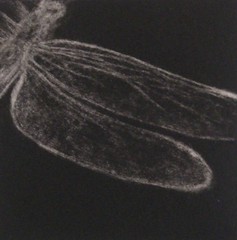
'Wings' - mezzotint on FlickrName: Imogen Duthie

Etsy: mezzotint.etsy.com
Flickr: www.flickr.com/mezzotint

Brief Bio
I live in Barcelona with my partner and work at home as a translator. I have always been interested in art in some way or other and, when I was a kid, I was into oil painting, pastels and charcoal, and took quite a few lessons. However, after I decided I would not study art, for some reason I abandoned the whole idea for a very long time. I went on to study Archaeology at University (some of my linocuts are inspired by archaeological field drawings, for instance “Hachures”) and have worked variously as an archaeologist, an English teacher and now a translator. I do printmaking in a workshop in the town centre, where I have learned the basics and made a bit of progress in the past couple of years. I started off taking classes from printmaker Rosa Brugulat (who unfortunately has very little presence on the Internet, despite my offers to help!), and now I basically experiment by myself when I get a chance.

'Hachures - Linocut - Dark blue' - mezzotint on Flickr
How did you get started in printmaking?
I had always loved the idea of printmaking, but knew very little about what it involves until I started doing some lessons. When I first came to Barcelona, I poked my nose into Rosa’s lovely shop, on a narrow little street in the Gothic quarter. I was attracted to the gorgeous prints hanging from the walls, and to her very large, old-fashioned looking press. When I moved again to Barcelona a couple of years later, one of the first things I did was fix up some etching classes with her. She taught me some of the basics of printmaking – a bit of hard ground and soft ground etching, aquatints, linocutting, how to cut my own paper, how to mix my inks and so on. She also taught me a bit about her specialty, viscosity printing, which she refers to as “the Hayter technique”. She also introduced me, albeit via a book of hers and not personally, to the idea of mezzotint, and I got hooked.

Describe where you work.
I mostly prepare the plates at home and then go into the workshop, generally at the weekend. I am thinking of getting myself a small portable press because I think I will be more productive. As I am currently concentrating on linocuts and mezzotints, I can easily work on the plates at home. I wish I had a little studio of my own, but living in Barcelona, things aren’t cheap!

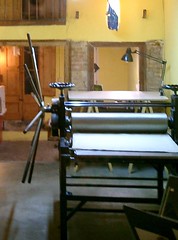
'The press at E-tres' - mezzotint on Flickr
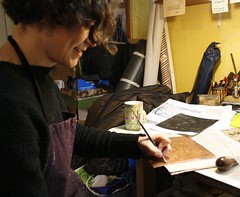
'At work mezzotinting' - mezzotint on FlickrPlease describe the process of mezzotint for those who might not be familiar with it.
With mezzotint, you prepare a plate by creating a finely grained texture all over the plate with what is known as a mezzotint rocker. It requires going over the plate in several directions with the rocker, until you reach a texture so dense that if you were to print it at that point, you would get pure black. Then, with scraper and a burnisher you flatten certain areas in order to create your design – the flatter you get them, the whiter they will be. It sort of works the opposite way to “normal” etching, because you work from black (through grey) to white.

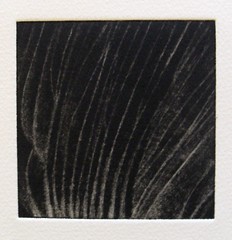
'Underside of a Mushroom - original mezzotint' - mezzotint on Flickr
What drew you to mezzotint specifically? Why choose that method over other printmaking or specifically, other intaglio methods?
I think what drew me to mezzotint was that it looked like a very old-fashioned kind of printmaking, and one that takes patience. I like that it takes a long time to finish a plate, and I feel very much like I am “making” something. I also absolutely love the tones it gives – the range of greys and blacks is just lovely, and I like the textures that come out of it. I have basically taught myself mezzotint, as no one I know has done it themselves; I am sure that there are many things I do that wouldn’t be regarded by experts as “the right way” to do things, but I take delight in exploring and enjoying. Also, mezzotint was originally used for very precise portraits, and printmakers used to very carefully plot the whole picture onto the plate – there are a few Japanese mezzotint artists now who also create incredibly precise, technically stunning, pieces. However, what I love is actually its “smokiness” rather than its precision. I like not being too precise with lines – I like leaving that side of things to linocuts. With mezzotints I like a bit of blurriness, a bit more like some of the effects you get with aquatint.
'Tentacle' - mezzotint on FlickrDescribe using the viscosity method in printmaking.
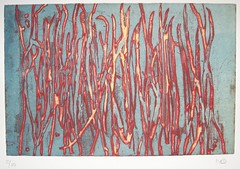
Viscosity printing is great fun, though it can often be quite frustrating if you want to be specific about where the different colours go! Basically it involves printing one plate with 3 colours in one go. Certain areas of the plate should be left in acid for quite a while so as to create different levels on the plate. When it comes to printing, you ink up your plate in the normal way, choosing one colour for the intaglio (in this case red), and then you choose two other colours to apply on the plate with rollers (the rollers need to be big enough so as to not go over the plate twice, otherwise it doesn’t work, as it smudges). The lighter colour is applied first with a hard roller, and the ink should be made quite oily and runny. In the case of the print here, the ink was pale yellow. Then, the third and final ink, in this case an aquamarine blue is applied with a softer roller, and has no oil added at all. The different oil contents of the inks and the different hardness of the rollers mean that the inks repel each other, and the different colours enter different bits, creating very interesting results. It requires quite a lot of patience, but it is very rewarding.

'Untitled' - viscosity print - mezzotint on FlickrWhat's your creative process for any given print? (eg. sketch first? Pre-planned or free-form?)
I don’t sketch at all. With linocuts I might vaguely plot things down on the plate with a pencil, but it often gets rubbed out pretty soon, and I end up doing free-form mostly. I know what effect I want to get, but I am also quite interested in exploring what happens when I get started, and I am open to changing my mind.

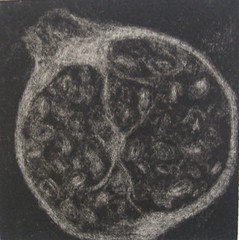
In the case of the pomegranate, I looked at some photos, and then created my own pomegranate on the plate as I went along.

'Pomegranate' - mezzotint on FlickrWhat do you enjoy most about printmaking?
There is something very special about making an image on a plate and then transferring it to paper, and I am not entirely sure why that is more appealing to me than simply drawing or sketching it. I think I love the moment where I carefully lift the print off the plate to see how it has turned out.

What's your least favorite part of the process?
To be honest, I can’t really say I have a least favourite part. I guess perhaps cleaning up and tidying up after myself!

What are your inspirations (other artists, people, places, events, etc.)?
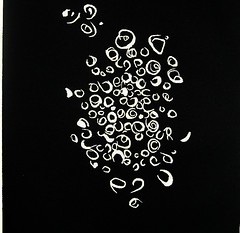
I think I am inspired by organic patterns – I wasn’t particularly aware of this until recently, when I realised that a lot of the things I do have repetitive patterns resembling what I think of as very primitive life forms (or also deep sea life). I often like the idea of doing close-ups of a world that extends beyond. And in terms of other artists, I adore Goya and Rembrandt and Picasso – traditional, perhaps, but I every time look at them I think how on earth...?!

'Energy' linocut - mezzotint on FlickrHow has your work changed and evolved since you started?
Well, that’s fairly simple really – it actually took me quite a while to do things I actually liked. I would often look at a print I had done, and think, “I am not sure why I have done this, it’s not me at all!”. I am very happy that I have managed to teach myself the basics of mezzotint, and I feel like I am getting better. I am definitely more confident.

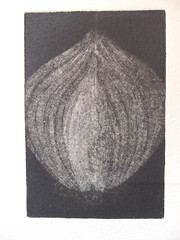
'Half a Red Onion' - mezzotint on FlickrHow do you get past creative slumps?
I have so little time to do etching that fortunately I don’t have creative slumps, just not enough time to do everything I want to do!

How do you promote your work?
Etsy is my only online shop. I also have a basic Trunkt account – but I haven’t really been prepared to invest much more money in it, because I do so little. However, the workshop is also a shop, and some of my prints are selling there. I have also made myself some little Moo cards, so I am now feeling a little more entrepreneurial, but I have a long way to go...!

Any other comments or advice for others who want to try making hand-pulled prints?
Be patient, don’t be worried if your first attempts look awful (mine certainly did), and enjoy it. I couldn’t live without it now.