Showing posts with label monotype. Show all posts
Showing posts with label monotype. Show all posts
Thursday, August 4, 2011

Sunday, January 10, 2010
Printsy Interview - Bonnie Murray

Website: bonniemurray.com
Blog: bonniemurraypaintings.blogspot.com
Etsy: bonnimurrayart.etsy.com
Facebook: www.facebook.com/pages/Bonnie-Murray-Art/95264369678
Flickr: flickr.com/photos/bonniemurrayart
Brief Bio
I grew up on the North Shore of Long Island. My college years started with Dickinson College in Carlisle, PA moving briefly to UNC-Greensboro and finishing at Washington University in St. Louis. I currently live in St. Louis and am concentrating on my artwork full time.
How did you get started in printmaking?
I started working with printmaking in high school. Initially I worked with linoleum block prints and moved on to etching. While first at UNC-G and then at Washington U. I learned printmaking techniques including lithography and collagraphy. My exploration with etching and block printing continued as well.

Describe where you work.
My press is set up in the walkout basement of my home. The windows are large and provide considerable natural light. There is a separate area where I soak my paper and another where I mix inks. I usually ink up my plates seated on one side of the press bed. Often part of the prep work is done in my painting studio.

What's your favorite printmaking process?
I love creating monotypes because the process combines both painting and printmaking into one, but I would have to say my true favorite process is collagraphy. There is something special about developing a collage with all kinds of textures on a plate, inking it up and printing it out. The outcome can be so unpredictable and the possibilities are endless. Another reason that I love the collagraph is that I have created a process that allows me to print many colors at one time with only one plate.

What's your creative process for any given print? (e.g. sketch first? pre-planned or freeform)
Often I work from some of my oil paintings that I think would lend themselves to the printmaking process. Other times I work from photographs my sister, Kathryn Murray, has given me to work from. Or if I have something particular in mind I do a lot of research, then do drawings and simplify the shapes. When working in this way my next step is to do some quick monotype sketches to try to work out the color before moving on to the final collagraph.


What do you enjoy most about printmaking?
Making the black and white plate is probably the most fun. Part of it is that I am working on something new and there is something enjoyable about choosing the textures for each shape within the composition. Many times the plate looks good as it is prior to rubbing the black ink on it.

What's your least favorite part of the process?
Cleaning up would have to be it.
What are your inspirations?
Great colorists such as Van Gogh & Matisse were the inspiration for my early work. Later I became attuned to the work of such artists as Vuillard & Bonnard who are renowned for their color and patterned work. A more recent source of inspiration has come from my sister's photographs of rural landscapes in Virginia. I am very lucky that Kathryn regularly provides me with moody and interesting photographs.

How has your work changed and evolved since you started?
Both my painting and printmaking work has tended toward still lives. My early work was predominately about pottery and reflections and their inter-relationships. These provided a good avenue to explore color and play with spatial relationships. Other subjects have developed over the years, most recently, as mentioned above, I have been drawn to painting and developing monotypes of rural landscapes.

How do you get past creative slumps?
I guess I am lucky in that regard. Slumps don't seem to happen often. If one occurs I switch from painting and try something new with printmaking or if I am printing I go back to painting.

How do you promote your work?
For many years I have worked with numerous galleries and art consultants who have placed my work in many residential and corporate collections. My family has been very supportive. My sister and my parents are always looking for opportunities for me to show or be placed in a gallery setting. Periodically I am included in shows in some of my galleries. I continue to enter national shows & have hung many shows in places such as hair salons, yoga centers and restaurants and have done very well. Now I am trying to take advantage of the internet using tools such as a blog, Etsy and Facebook. Obviously there are lots of other opportunities out there on the internet. I just haven't gotten there yet.

Any other comments or advice for others who want to try making hand-pulled prints.
I would suggest taking a class at a community college or a local artists' guild. I know the St. Louis Artists' Guild has a nice printmaking studio and if you are a member you have access to the facility. Beyond that, don’t be afraid to invent your own technique or follow a direction that may not have been fully explored in class.
Sunday, October 25, 2009
Printsy Interview - Jeffrey Heft

Website: brainplay.net
Etsy: heftart.etsy.com
Flickr: www.flickr.com/photos/30703292@N07
How did you get started in printmaking?
I first encountered printmaking as a freshman at the Maryland Institute College of Art.
Describe where you work.
I work in my home. I have a 10 x 12’ room with a Charles Brand press (12” x 24” print bed), a 10 drawer flat file, a banquet table work area, a small set of drying racks some book shelves and storage shelves for materials.

What's your favorite printmaking process?
When I began printmaking I really enjoyed working a metal plate using acid, burin, scraper, and burnisher – basically sculpting a relief that would print the way I wanted. Intaglio can be a very indirect, slow, and technically demanding process. I still enjoy the involvement it takes to create an image that way but recently I have been working a bit more immediately with monotypes. I also create linocuts and collagraphs. Collagraphs, especially, are another way of sculpting the printing plate. At any given time it is whatever process or combination of processes that will work to create the image.

What's your creative process for any given print? (eg. sketch first? Pre-planned or free-form?)
This varies quite a bit. Linocuts usually start with a drawing, either on the linoleum itself or a transferred drawing from preliminary drawings made on paper or via computer. I favor Corel Painter and Adobe Photoshop when I’m developing images with the computer. Monotypes are many times a dialog with the ink, a kind of advanced finger painting, or I might start with an idea, things I’ve been ruminating over, and then work them out on the plate… but I also will work with preliminary drawings for monotypes.

What do you enjoy most about printmaking?
The finished print. A hand-pulled print on quality paper is something special.
What are your inspirations (other artists, people, places, events, etc.)?
Currently I am very interested in narrative in its many forms whether spoken, written or visual.

How has your work changed and evolved since you started?
It has changed and evolved as my interests and skills have changed. When I began it was as much about understanding the craft as it was about the content. Craft is still an interest, always will be, but now the work stems from content ideas rather than craft ideas.

How do you get past creative slumps?
There is always something to do, something to learn about, something to meditate on.
How do you promote your work?
I promote my work on the internet through my website and sites like Etsy, Flickr and Facebook, and in gallery exhibits.

Any other comments or advice for others who want to try making hand-pulled prints?
Make a mess. Suspend your judgment. Don’t be afraid to make a “mistake.” Be observant. Enjoy the process.
Sunday, October 11, 2009
Printsy Interview - Gordon Talley

Website: gordontalley.com
Bio
I was born and grew up in southern California. My first encounter with art was with illustrated books, which my sister and I would do terrible things to with crayons. I was four years old when I saw my first artist; a painter who lived across the street. It was memorable! (like the first time you see a snake...or a blimp). It was amazing to realize that somebody could do that; make art. It seemed like magic. I had excellent teachers in high school, and later, in college. By the time I graduated from high school I was already working as free-lance illustrator, as well a driving a tractor in the orchards. I don't do either anymore, but do miss the tractor sometimes. I had decided to become an artist by the time I was fourteen. I recall the work aptitude counselor actually trying to find "artist" on his list of jobs. He recommended that I become a machinist instead. "OK," I lied.
Art is the only career that I've ever known. Of course, I've had a couple hundred other jobs but have been lucky to be able to work at my art on most days over the last forty years, and plan to keep doing so.


How did you get started in printmaking?
I was fortunate to have exposure to printmaking in junior high school and high school. First it was linocuts, and then silk screening. I enjoyed both but really took to the screen process at the time, and later incorporated it into my commercial work as well as the fine art pieces that I was doing.
In the early 1970's I found a nineteenth century portfolio of etchings in a junk shop. That pretty much did it! I got every book that I could on the subject from the library, learning all that I could about etching and intaglio processes. After awhile I realized that I had to try this! I did what I always did. I went to Ventura College and audited the classes that I needed. They had a marvelous art department and number of presses. I spent every available moment that I had in the printing room. I've had ink in my blood ever since! I was also very lucky in locating an old star wheel press, which I still use.


Describe where you work.
When I'm actually pulling prints I'm generally in my garage/studio; a wood frame building put up in 1946. It's not finished off on the inside and there are lots of spiders and an occasional squirrel and the neighborhood cats. It's fairly small but houses two etching presses and a full picture framing shop. For letter press work there's a press in my kitchen. Typesetting is done nearby at what was briefly the "dining room table" but is now just "that crazy place".
Designing work could happen anywhere; sometimes at the kitchen table...sometimes in my living room. I used to work on ideas in coffee shops a lot, sometimes on napkins, but I don't go out as much now. Anywhere I can take a sketch pad is good.


What's your favorite printmaking process?
I want to say etching because it's all about process, but I've really become addicted to monotypes. They have a definite "fun" element for me. It's like skipping the entire process of etching , up to the wipe. I love wiping plates and trying to come up with just the right way for each plate. I still get plenty of duds with monotypes, but I've never spent an additional week on one trying to fix it...before deciding that it was terrible. Did I answer that question?
What's your creative process for any given print?
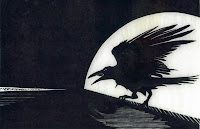
With the exception of monotypes and some intaglios, I generally plan the print. I'll do a complete sketch for etchings and any type of relief print (linocut, woodcut, etc.). With monotypes it might just be the idea of a direction; a word (bird, dark, moon, etc.). Or, I might just jump in and see if a direction develops. Often at the beginning it does require some staring...maybe some more coffee. Whatever it takes! And then the plunge in.


What do you enjoy most about printmaking?
So many things! I really love surprises; that moment when you pull the print and see what happened. Sometimes it's just what I thought it would be...very often it's not! I really like the process of the whole thing. Getting ready gets me very excited. Sometimes that's all I do, and it feels so good that I just stop there. Another thing that I like about printmaking and art in general is the never ended learning. There seems to be no end to what can be done...not that I can do it, but I love the possibilities. Oh, and the smell!
The smell of ink is intoxicating. Well, actually, I guess it literally is, but I meant that poetically.


What's your least favorite part of the process?
Cleaning up.
What are your inspirations?
Naturally I've been inspired by many other artists, and just about anything that has ever evoked a feeling. Kind of a big question isn't it? Sometimes an event will do it. The total eclipse in January of 1979 is a good example. I've enjoyed making commemorative prints for as long as I've been doing it; family members, musicians, places...it's an ever expanding list. My grandfather once told me about taking his airplane (which he built in his back yard) up above the clouds, and ended up flying with a California Condor for quite awhile. That was the inspiration for the etching of him. More recently I was inspired by the idea of ravens (again) for a series of monotypes. Dawn and twilight are big on the list. Oh, and emotional wacko-ness!


How has your work changed and evolved since you started?
I work faster now. I'm not as interested in getting everything perfect in a print. Doing the monotypes has been good for me in that way. It's such an immediately expressive form. I'll still spend crazy time on an etching, but I'm less likely to put that extra week or two of tinkering time. Is that an answer?
How do you get past creative slumps?
I've found that the best thing for me to do is simply "go to work". This is my job, and I can't expect to always feel inspired before I start. Of course it's great when I happens, but sometimes I'll be a few days into a project before I get excited. I think working on commercial deadlines helped with my ability get up and start even if I don't want to, though I haven't given any thought to designing a match book cover or cocktail napkin for a very long time!

How do you promote your work?
Up until recently I've always relied on galleries and shows, along with press releases. Etsy is my first foray into Internet commerce. I've had some very nice feedback and met some wonderful people in the process. I'll still do it "the old way" as well, but I am glad to be here!
Any other comments or advice for others who might want to try making hand-pulled prints?
Do it!
Sunday, September 6, 2009
Printsy Interview - Mark Michael Cullen

Websites
Flickr: flickr.com/photos/mmcullenart
Etsy: www.mmcullen.etsy.com
Brief Bio
I was born in 1966, before there were so many distractions competing for children’s attention. Drawing was important to me, so I never stopped. Most kids give up drawing at age 7 or so. For my undergraduate degree at the University of Wisconsin-Madison, I had two interests: art and writing. I cared too much about art to let educators work their full mischief on me, so I let them teach me how to write instead. I majored in English, with a minor in Art. It has always been important for me to try to keep art fun for myself. If my work somehow touches others along the way, that is a big bonus. I am thrilled when that happens.

How did you get started in printmaking?
Public school gave me an exposure to linoleum, woodblock, and drypoint. Later, I learned silk-screening, lithography, letterpress, and etching. I was repelled by lithography and copper plate etching, because it was too complicated. I prefer homegrown simplicity.
Describe where you work.
Sketching can take place anywhere. The preparation of the printing plate takes place at the humble kitchen table. To print, I head out to the Pine Bluff Studio, which features an expansive view of undulating woodlands and cornfields. The topography is hilly, and outcroppings of limestone cliffs punctuate the landscape. Glaciers did that eons ago. A friend and I have a Conrad Etching Press out there.

What's your favorite printmaking process?
If I had to choose, I would say I like the acetate drypoint etchings best. Linocuts are bold and graphic, but the etchings have a wispy, ephemeral quality that I find intriguing. Also, no two prints are the same, because it is impossible to remove the ink uniformly. The little smudges and chatter are so endearing and accidental.
What's your creative process for any given print? (e.g. sketch first? Pre-planned or free-form?)
I like to sketch. Sometimes, I feel the pencil just moves and I am a conduit for those impulses. It feels good to just let it all go. I even surprise myself at what comes out. Some of it is half-baked or rubbish--at least I think so--because occasionally, folks will really gravitate towards something I dismissed as unworthy. Even so, I have to be a curator. Although I would like to, I simply do not have time to make an edition out of everything. So many sketches never make it to print. When I find an image I want to pursue, I commit to it, prepare the plate, and make the 10-mile trek to Pine Bluff. When they are dry, I hand-paint them with watercolor. Or not. Sometimes, a print calls very loudly to be monochromatic. Conversely, monotype is fun because it is all Pine Bluff and very spontaneous.

What do you enjoy most about printmaking?
I like being able to give them away, sell them, or stow them in boxes. Multiples make that much more likely to happen. I tend to be possessive about paintings on canvas or items that are one-of-a-kind. Prints are much more affordable than a painting, and wall space is serious real estate for most people. Printmaking seems more democratic somehow. Printmaking is a gateway drug.
What's your least favorite part of the process?
Cleaning up after the printing is complete. Somewhere there is a guy who has other people do that for him. You know there is. Even though I do not like putting away my toys, I would not want to be that guy. That seems dangerously self-important.
What are your inspirations (other artists, people, places, events, etc.)?
I lived in Japan as an English teacher for a year. Without a doubt, that has been (and continues to be) a guiding light. It was such a privilege to drift through the floating world for a year. I am inspired by children’s artwork, animation, cartoons, Matisse, Modigliani, and of course, Japanese art.

How has your work changed and evolved since you started?
One day, my employer and I were discussing some etchings that I had done in a class. I was complaining about the chemicals, and how complicated it was. He recalled that during his childhood, elementary school art teachers used acetate to teach the rudiments of drypoint etching to kids. That conversation was a turning point for me. Owning the Cadillac of printing presses has also changed my work. It is such a luxury to run an edition of prints on the dream-machine.
How do you get past creative slumps?
One method is to get together with another visual artist. Solitude can become a very tight loop. Getting input from someone else is a great way to break through slumps. Collaborative art is fun because you have to let go of preconceptions. Try as you might, you are no longer in control. It also forces you to consider other options, and to think outside your own little box. New ideas come crashing in, and I spin off in new directions.

How do you promote your work?
This is an area that I am admittedly weak at. I am really attracted to making art, and not as concerned about promoting it. Sales have happened over the years, and I was published in a magazine with national distribution. I even made it into the collections at a couple museums and art libraries, but it has been more kismet than an active pursuit. The advent of the Internet has made networking a lot easier, and I dabble at making myself visible. Esty is wonderful to me, because people manage to find my work simply by cruising and roaming about. This is going to sound naïve and Betty Crocker, but I think I prefer it that way. It is exciting and fun to imagine how they arrived at making their purchase. I am less interested in herding people. I like the idea of free-range patrons of the arts.
Any other comments or advice for others who want to try making hand-pulled prints?
Stay open, and try new things. Destinations are over-rated. Your journey is the real story. The artworks are merely signposts along the way.
Sunday, August 2, 2009
Printsy Interview - Sarah Gillikin
 Etsy: sarahgillikinarts.etsy.com
Flickr: flickr.com/photos/36347450@N07/
How did you get started in printmaking?
Surprisingly, it was my drawing teacher about 2 years ago. She always encouraged us to experiment with different medias for our art books. One day she showed some examples of her most creative past students, and breifly mentioned a process that resembled mono printing. I got the specifics on how to do what she was talking about, and went out and started doing it. Then a couple months ago I wanted to make a series of prints for my friend's birthday present, but knew that the way I was doing mono prints would not provide enough detail for the images. So I went to my local art store (Art Things in Annapolis!) and bought the things I needed to do some lino blocks. I had no idea what I was doing and gouged one of my fingers pretty bad within the first 5 minutes! But I really like carving things. I even made a sort of little stamp out of a scrap piece of 2x4 just to see how carving wood was different than linoleum.
Describe where you work.
I work in my apartment. All over really, the nice thing is that I can carve the blocks anywhere (although it produces a mess of little "chips" to clean up). Then when I print, I usually just do it at the table. Since I'm still beginning, I don't have all the tools...still very much an amateur.

What's your favourite printmaking process?
Well, since I haven't done all the types, I'd have to say that the linoleum is good for now. I like it better than the mono prints because of increased definition. But the monoprints are way faster. Eventually I'd love to do wood.
What's your creative process for any given print? (eg. sketch first? Pre-planned or free-form?)
I usually don't make any art unless I have an idea in my head. Working on art definitely comes in spurts. When I come up with an idea, then I get really excited and go out and buy just enough equipment to get me by, and start at it. Then I could go a little while without any real inspiration. Some times I sketch first; I have found that especially with painting, it's important to do a trial run on paper before moving to canvas, because often the image in my head is harder to translate than I thought.
What do you enjoy most about printmaking?
The carving is fun, but the finished product is the best. I feel like you don't really know what it's going to look like until you actually print it.
What's your least favorite part of the process?
Putting the mounting device on the illustration board that I used for matting.

What are your inspirations (other artists, people, places, events, etc.)?
Definitely nature. I am a stereotypical treehugger. I'm always raising my voice at my friends or even people that I don't know about trees, recycling, plastic water bottles, diapers, and other environmental issues. So naturally I use a lot of nature in my designs. Kind of a tribute to the beauty and work the environment does to keep us alive.
How has your work changed and evolved since you started?
Well, for me it's hard, because I haven't really found one area of art that I am exclusive too. I kind of have my hands in a variety of areas. I make paper, journals, sew, print, graphic design, paint, make sculptures (they are coming to my etsy shop soon), etc. So it's hard for me to look at my work from before and compare to now, because in the past I might have been doing something completely different. Although, I have noticed that the fact that I keep coming back to nature is a consistent thread through all my work.

How do you get past creative slumps?
I'm not sure if any of the things I do actually get me out of a slump, it seems like when the ideas come they come and when they don't they don't. But I read design magazines (I have a degree in graphic design), blogs by other artists, articles here on etsy, I try to draw out or write down concepts that I get so I can come back to them. I collect interesting items, like sticks (I think they're interesting), packaging paper from the dental office I used to work at because I noticed that it had polka dots on it, seeds from a magnolia tree, things like that. I have plans for all the stuff I collect, I just haven't seemed to hash out exactly how I want it executed.
How do you promote your work?
That is an area that I've been working on lately. I finally uploaded my pictures on flickr, I donated some prints to an auction, I'm working on a blog (but being a designer I have to create the layout first), I have my etsy shop on my Facebook page, and I try to upload new items into my shop whenever I can to keep me in the public eye.

Any other comments or advice for others who want to try making hand-pulled prints?
You don't have to take a class in a specific area of art to be able to do it. It helps sometimes, but you don't have to. Just get some supplies, watch a video if you must, and try it. Enjoy the fact that alot of times in art you can't mess things up. There is something very gratifying about making things with your hands.
Sunday, July 19, 2009
Printsy Interview - Lori Dean Dyment

Website: web.me.com/jfdyment/Lori
Etsy: DeanDymentStudios.etsy.com
Flickr: flickr.com/photos/ldeandyment
Artfire: http://DeanDymentstudios.artfire.com
Blog: ldeandyment-soiwasthinking.blogspot.com
How did you get started in printmaking?
I attended Emily Carr Institute of Art and Design and saw a fourth year student demo silkscreening when I was in first year. I had planned to do graphic design when I entered (the profession that was the safest to pay the bills) and I ended up doing a painting and printmaking major. I was frustrated with the painting instruction I was getting and decided to make use of the printmaking equipment while I had it. A fellow printmaking student was doing reductive monotypes and showed me some techniques. I was hooked right away as it was a wonderful halfway medium between oil painting and the technically intense intaglio. I have been doing monotypes on the same steel plate for over sixteen years now.
Describe where you work:
The extra bedroom in our apartment is the studio that I share with my husband who is a painter. I have a custom press that I keep on a sturdy desk. My mother in-law gave me the press as a wedding present and it has worked really well. Like most artists, I feel like it’s too small and cramped. My work table is stuffed in the closet and is way too low for me to work standing up which is what I need to do when working on a monotype. My studio wish list also includes proper lighting because I end up in the studio once the kids are asleep. However, I’m really glad that I can work in my pajamas if I want to and that I don’t have to commute to some industrial area while paying a fortune in studio rent. You take what you can.

What is your favorite printmaking process?
I have to say that reductive monotypes are my favorite although I also really enjoy linocuts, drypoints and collographs. I feel monotypes are closer to painting and so very immediate and spontaneous. I love all the happy accidents that happen when I start pulling away the ink. The beautiful and velvety blacks are a big draw too. I’m finding that I’m trying hard to leave larger areas of untouched ink just so I can see a fully printed black. I use Charbonelle intaglio ink and it’s just beautiful.

 What’s your creative process for any given print?
All my work is based on drawings in my sketchbook. I go through spurts of drawing and then I go through my images and decide if any are worth working on in a print format. If the drawing is not detailed enough then it won’t make a very good print. I used to rely heavily on reference material for inspiration but as of late, I’m creating images that just come to me and are more intuitive. I’m really enjoying the variety of work I’m doing.
What do you enjoy most about printmaking?
This is a tough one. I really like creating the image on the plate and coming up with a little story to go with it while I’m doing it. But I also really enjoy seeing what the monotype looks like once it has been printed. The paper is white and my plate is grey, so along with the oil content of the ink, the pressure of the press, and the dampness of the paper there are quite a few variables to make the final print a surprise.
What’s your least favorite part of the process?
Besides cleaning up I have to say that I don’t really enjoy inking up and wiping plates or hand rubbing linocuts.( I’m trying to figure out how to do that on my press)

What are your inspirations?
I’m inspired by so many different things but I seem to gravitate to animal and nature imagery and anything to do with children. I just love looking at children’s books and I would love to make a career of illustrating for children someday. I still remember some of the books I read when I was younger based on the images only. I’m finding plenty of inspiration from other artists work now that I’m more present online. Nothing makes me want to create than seeing wonderful artwork.

How has your work changed and evolved since you started?
I had a harder time coming up with imagery when I was in art school and was afraid of what people thought of my work and if it was “commercial” looking or not. Over time I have found that my list of goals, images and ideas surrounding my artwork has grown exponentially. Now that I have very little time to create I have so many ideas to work on. Now I’m starting to work on the same image but in different mediums to see how things turn out. I’m also trying to work on things as a series which is something I would never do before. It always seemed boring or obsessive compulsive to me.
How do you get past creative slumps?
Whenever I haven’t been in the studio for awhile I get really nervous and start finding other things to do, like the laundry. I find that if I just start drawing in my sketchbook without any expectations that I will loosen up and things will just start flowing. The flip-side is that once I start working regularly in the studio, other things like my job seem frivolous and a waste of valuable time. I end up craving to be in the studio even more.

How do you promote your work?
At the moment I’m trying to get more of an online presence because that seems to bring me the most viewers for the lowest cost. I recently had a gallery show and it cost me a mini-fortune in mats, frames, time off, etc. I’m showing my work on Etsy, Artfire, Indiepublic, RedBubble, Imagekind, HandmadeByMe, Fickr, my blog and a couple other artist community sites. It’s been great for connecting with other artists and so many people are willing to provide help or advice if you need it.
I hope to get involved in a local Etsy sale if it fits with my work. I’m still coming up with plans to provide my work in a way that’s affordable to my target market. Stay tuned for art pendants, digital prints, cards, magnets, and buttons.

Any other comments or advice for others who want to try making hand-pulled prints?
Experiment with low tech methods such as linocuts that are hand rubbed before investing in too many tools. I have a lovely mezzotint rocker that is just collecting dust. My other suggestion is to take a printmaking course at the local art school where you’d get a feel for the tools, equipment and techniques.
Monday, June 29, 2009
Printsy Interview - PlateInkPaper
 Etsy: PlateInkPaper.etsy.com
Website: www.finemist.net
Flickr: flickr.com/photos/plateinkpaper/
Brief Bio
I’ve lived most of my life in the wonderful Pacific Northwest. After college, my creative life petered out for a while as I earned a living. I still have a day job, but in the last 10 years or so have found a way to bring back front and center something that is (and always has been ) necessary for me – art.

How did you get started in printmaking?
I’ve always stuck to painting until about six years ago. It’s interesting that for years I always was drawn to printmaking. To me there was something mysterious and magical about the process. Etching especially seemed so specialized that for a long time I assumed it wasn’t something that one could really just pick up on one’s own. Then I finally decided to change that thinking, and took the plunge. I scoured bookstores and sales for printmaking books and started to grow a collection, learning terms and processes. I started out with linocuts, because those were the easiest to do at home with minimal equipment. Soon after, I found a community studio that had an etching press and ferric bath. Now I was actually doing etching, which to me was amazing!

Describe where you work.
I print both at home and I also have been a member of a print co-op in town. Most of my printmaking time is spent in a converted bedroom in the house. In a very limited space I have an inking table, shelves, a sink, flat files, a ferric bath, and of course a press. Purchasing a press took a lot of saving, but it was one of the best things I’ve ever done for my art. I still go to the co-op to use the aquatint box or when I need more room to spread out.
 What's your favourite printmaking process?
I spend most of my time between etching and monotypes. Etching appeals to the geek in me because it is somewhat technical and has that industrial feel of working on copper, running it through the press etc. Monotype is a different animal, and really is the bridge between painting and printmaking. Monotypes can allow a much more spontaneous approach to image making. I also enjoy relief printing, but lately I haven’t done as many woodcuts or linocuts as I did in the past.

What's your creative process for any given print?
I generally start out with a mood that I seek to create. I will reference old photographs for images with people. I use the photographs not for directly taking that picture and re-creating it, but rather as a starting place. I may create something that is quite different, but again, the photos really just help get the ball rolling. For linocuts or woodcuts I’ll have the design worked out before I start. With monotypes or etching, once I start the piece, it can change direction as I go. I feel my way along as I work.

What do you enjoy most about printmaking?
Just about everything about it – the process of each kind of printmaking, the fact that printmaking makes you think differently about how an image is created, the smell of the inks, the paper, working the plate, working the press, the weird terms used, and the camaraderie of a print shop, and between printmakers.
Another benefit of printmaking is that it has these built-in spaces in between creating (measuring and cutting down paper, creating damp packs, etc.) that gives me time to think in a non-direct way about what I’m doing. Some printmakers have referred to this a meditative part of the process. It can be, or it can be like how things occur to when driving or some repetitive task. It’s that time in between active art making that sometime allows you the space to think a bit differently about your work.

The last thing I love about printmaking (a long list, I know!) is the fact that printmaking allows people to own art at affordable prices. Years before I made my first print I had half my house filled with framed prints from a local print co-op where some fantastic artists worked.
What's your least favorite part of the process?
Clean up (of course). Also, needing to sometimes admit that a project isn’t meant to be, and move on.
What are your inspirations?
I am drawn to industrial architecture, the natural world, old photographs, 19th and early 20th century science books. I love the mystery in life, and when I find it I try to bring it in to what I do.

How has your work changed and evolved since you started?
I'd like to change the question a bit and say that the process of learning printmaking has changed how I create art in general. The fact that printmaking makes you think a few steps ahead, including how the image is constructed, has allowed me to slow down a bit. I don’t hurry my way into a piece. It may be that I’m able to think of, and create an image fairly quickly – I often still do. But printmaking has given me a bit of discipline to think through various paths the image could take, and to be patient. That has helped all aspects of creating art.

How do you get past creative slumps?
I try to do other parts of the work when I’m not able to create. I’ll tear down paper, prepare plates for future use, or read about something that interests me – other artists, printmaking, history, science, etc. I try not to see it as down time, but rather part of the process – those things I read about most likely will become part of the creative compost can produce a future print or painting.
How do you promote your work?
This is an area where I need to put more time. I admit I do not promote my work like I should. Besides Etsy, I maintain a presence on Flickr, and have a website. That’s about it…I need to watch and learn about promotion from others who are doing a much better job of it than I!

Any other comments or advice for others who want to try making hand-pulled prints?
Yes - don’t wait as long as I did to start! Do a bit of research to learn how, or take a class. While it can have you banging your head against a wall at times, it is also very addictive and rewarding. There is a lot of free information on the web these days - read up, learn, grab a brayer and go forth!
Subscribe to:
Posts (Atom)