Sunday, June 29, 2008

Printsy Interview: Ele Willoughby

Interviewed by:Leanne Graeff

Name: Ele Willoughby

Websites
Etsy: http://minouette.etsy.com
Blog: http://minouette.livejournal.com/
Flickr: http://www.flickr.com/photos/22611996@N02/

Recent Exhibition: "Toronto vs. Nagoya Art Fight" at the CREATORS MARKET in Nagoya, Japan, June 14 to 15, 2008.

How did you get started in printmaking?
I'm actually a physicist by training. My 'day job' is as a research associate in marine geophysics - which means I build instruments, go to sea, gather data, analyze and make computer models of the results, to try to learn what is below the seafloor. I've always loved art and art history on the one hand, and math and physics on the other. I decided that I could not pursue the physics on my own, whereas the art did not necessarily require a PhD.

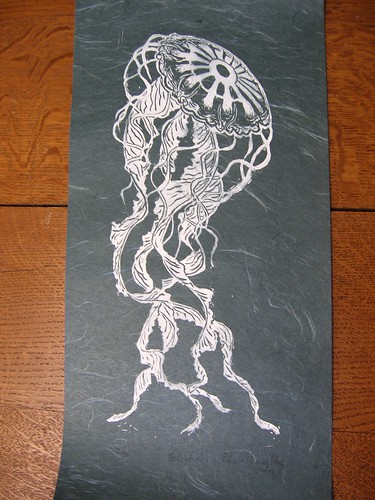
I got started printmaking as a child. I had the good fortune to attend courses at the Art Gallery of Ontario, here in Toronto, from the age of about 8 or 9 (I am currently 34). I learned screen-printing, etching, lino printing and some more exotic methods for mono prints, embossing, etc. I have prints I made 25 years ago! The great thing about starting at such an age is that things like registration, or never ever carving towards oneself becomes quite intuitive.'Jellyfish' - the.minouette on Flickr Also, we regularly viewed their collections and shows. We had access to great resources that otherwise I would not have had. It is hard to believe they let children operate the press, or more to the point, use knives and carving tools, but they did (though we were not allowed near acid baths). I pursued classes there for ten years, and always took art classes in school.

While pursuing a doctorate in physics, I had less time to study art, but did screen printing on my own time. I found all the left-brained work for my job, left me craving the balance of art making for the right-brain. I would take courses in my spare time, in things like bronze sculpture or hand paper-making (which influences my choices for papers). In the last 5 years, I really started to focus on relief printing. Linocuts were something I could make in my own home, and I could choose to use strictly water-based inks, and avoid any potentially more harmful chemicals. I went to "Woodblock Printing Boot Camp" to learn Japanese moku hanga techniques (and they weren't kidding about the Boot Camp). I've imported what I learned and applied it to my lino work.

Wow, your career seems very interesting and challenging. Do you find that your imagery is influenced by your day job?
Yes, mainly in that I like to portray animals (amongst other things), and observing ocean life is a fringe benefit of doing fieldwork at sea. Also, my first woodblock print is really a metaphorical depiction of how it feels to do my job. I 'Little Boat, Big Ocean' - the.minouette on Flickrspend months building equipment (from the electronics, to the large deployment packages weighing hundreds of pounds) and lower them to the seafloor, hoping they'll come back safely, and do what they were intended to do. They spend hours, in maybe 1.2 kilometer (~3/4 of a mile) water depth... far from me on the surface. What I've really learned is that I am not in charge; the ocean is in charge. Sometimes things are lost, or there are gale force winds, or something corrodes, and it is not your fault and there is nothing you can do. I must never underestimate the ocean.
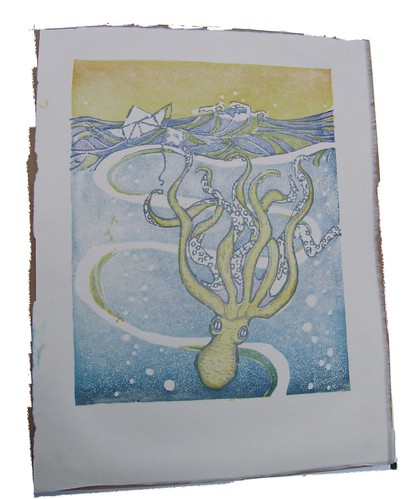
For the record, I've never seen any giant octopi, though I have see squids having a feeding frenzy, bioluminescent invertebrates, large sharks, many birds, lot of whales (especially orcas, humpbacks, right whales), porpoises, dolphins and other creatures at sea.

Where do you do most of your printing?
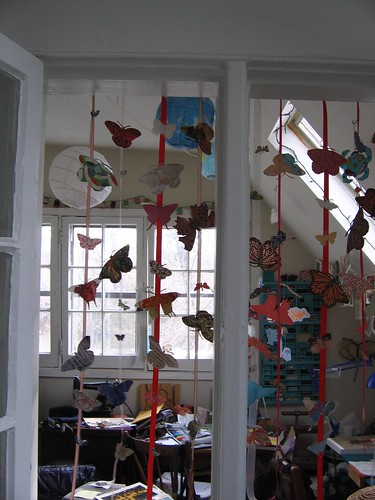
'butterflies are...' - the.minouette on FlickrI do most of my printing in my home. I have, what I affectionately call, 'the microstudio'. Our apartment is on the third floor and the roof is slanted. The microstudio was once the porch, but is now closed in. I have a few tables as work surfaces, some storage for supplies, a bookshelf (for inspiration and information), a solid chair for when I'm carving. I have hung lines on the slanted ceiling with mainly postcards of art for inspiration- this doubles as drying rack for prints. I have quietly encroached onto the living room, with a large shelving unit hidden in a corner- this contains my paper, prints, shipping and packing material.
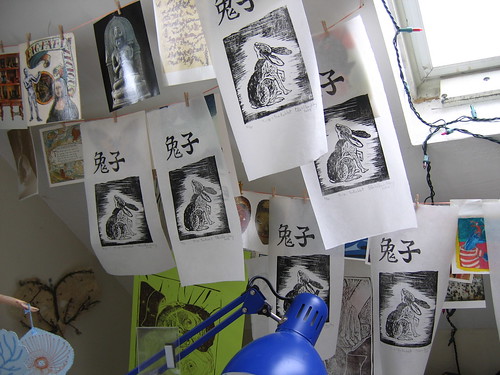
'reproducing like rabbits' - the.minouette on Flickr

What is your creative process?
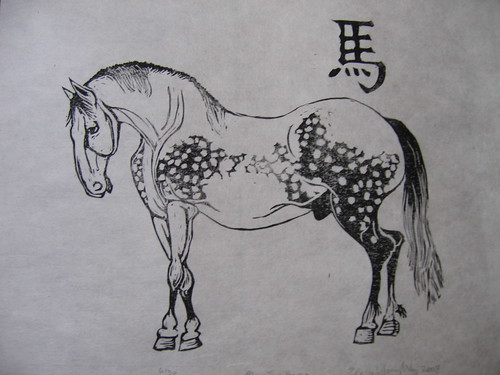
I'm usually up to something- things come in series. Currently, I'm completely a series of 12 Chinese Zodiac prints. I'm also printing panels on fabric for an alphabet quilt, as a personal project- so there are prints which are a by-product of this process. Generally, I print things from nature (mainly animals) or myth (which often includes composite creatures, which are at least part animal). I tend to look at a lot of images to gain an understanding of anatomy or structure (these can include photos or other artworks) and a sense of how an animal typically moves (which is both anatomy and 'personality'). 'Ma: The Horse' - the.minouette on FlickrFor the Chinese Zodiac prints, I'm also learning the associated Chinese characters, and looking at a lot of Asian art, to try and reflect that influence. For instance, I selected to make the horse a little rotund as that is how they are generally depicted in Chinese art. I mull these images over for a while and then draw. Sometimes I sketch (particularly if I need to work out the balance and composition), but sometimes I draw directly onto the lino. Often they evolve as I carve and make sporadic proofs, so the end product is not exactly as imagined or drawn.
What inspires you?
Nature, particularly animals (extant and extinct), myth, legend, fairy tales, the unexpected, literature, science. Colour! Illustration. I like to play with scale and achieve a gentle surrealism simply by changing relative proportions. I love to travel (basically anywhere not immediately dangerous) and this includes going to sea.

I love art history- all of it. Favorite artists include great printmakers like Albrect Dürer, Goya, Rembrandt, Honoré Daumier, Joan Miró, Odilon Redon, M.C. Escher, Japanese masters like Hiroshige, Hokusai, and ukiyo-e in general. As well as a near endless list of painters sculptors, and artisans. (Those mentioned are just those who made prints, off the top of my head).
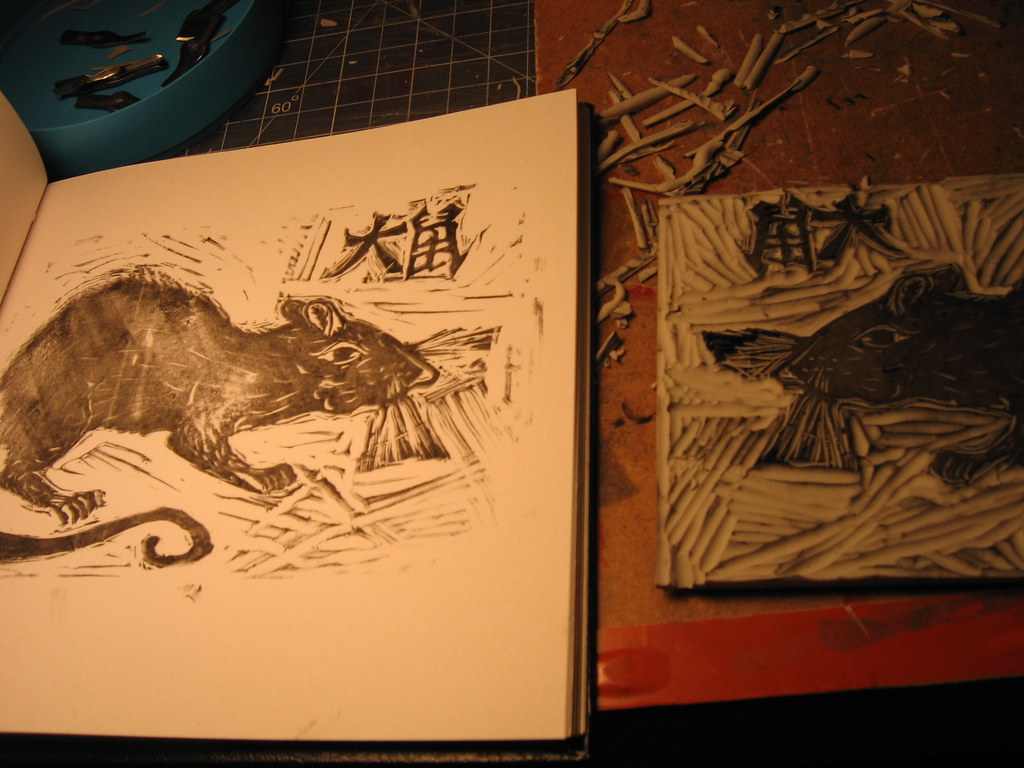
'Da Shu...in progress' - the.minouette on FlickrWhat do you enjoy most about printmaking?
The way creating a print is a process and allowing the thing to change as I work. I love the carving, and (obviously) that I get multiples, which is kind of magic.

What is your least favorite part of the process?
Physically burnishing a print, and when something goes wrong.

How has your work changed and evolved since you first started?
Well, I can spell my titles correctly now! ;) Since I started so young, there are some things which have obviously changed a lot (I worked more with geometrics and patterns as a child, and my compositions are now much simpler, often a single animal in a blank field). But some things are surprisingly constant, in hindsight. Most recently, I'm conscious of how I choose to work with a single block, avoid reduction prints, use my moku hanga bamboo-leaf-tied barren even for lino, and work on Japanese washi paper (especially kozo, or mulberry). These are new habits for me.

How do you get past creative slumps?
This really isn't a problem for me, possibly because art remains a passion without being my 'job'. I do have creative slumps as a geophysicist! These generally lead to self-proscribed art therapy. But even if I am unhappy, I have boundless ideas for things to create. I can't keep up with my plans for art.
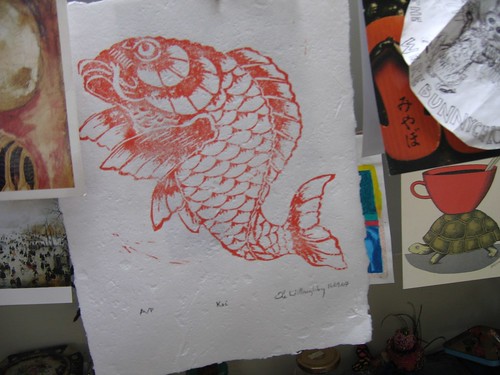
'Koi lino print' - minouette on FlickrHow do you promote your work?
Well, I haven't been selling the art for very long. But, I make sure to share it with people (on my blog, on craftster.org, on flickr, on etsy), to network (street teams are wonderful for this), and to take opportunities when I see them.

With all of your experience, do you have any advice or comments for others who may want to try printmaking for the first time?
Every teacher has something different to offer. There is no right way. Gather the information you can from any means available and get in there and try it. As an experimentalist and as artist, I believe in learning through doing.

But do take responsibility for your own health- be aware of safety (especially with knives, carving tools, chemicals, inks, solvents and cleaning products). Do not be intimidated and know that you can request a Material Safety Data Sheets (MSDS) from manufacturers. If in doubt ask. It is possible, but not necessary to place yourself at risk for art.

Thanks Ele, it was a pleasure getting to know you and your work!

Wednesday, June 25, 2008

Etsy Printmaker Interview: Amie Roman

Name: Amie Roman (ploverwing on Etsy)
Location: West Coast of Canada
Interviewed by mizudesigns

Website: http://www.amieroman.ca/
Blog: burnishings.blogspot.com
Squidoo lenses on printmaking: All About Printmaking, Printmaking Artists on the Web

My parents kept me entertained from an early age by providing newsprint and crayons to encourage my expression and imagination. As both of my parents were in the biological sciences, I was immersed in nature from the start. While I'm very artistic, my degree is in conservation biology. I've taken lots of courses to develop my artistic skills, and I currently hold AFCA "signature" status with the Federation of Canadian Artists.

I have been greatly influenced by my grandmother, Caro Woloshyn, also an AFCA. I was surrounded by her art - growing up, our house was always full of her original watercolours of glassware, old farm equipment, and still life subjects. I share much of my taste in subject matter with Caro. Other influences and inspirations include J.F. Lansdowne (especially his study sketches), Chris Czajkowski, Suzanne Northcott and Robert Genn.

I was introduced to printmaking, like most people, in high school art, but never really developed it until adulthood. Three years ago, I took an introductory relief printmaking class through the continuing education department of Emily Carr Institute of Art and Design, and I was hooked. To me, process is really key. I love the challenge of interpreting an image or an idea into a print, building the process in my mind, working within the constraints of the media, exploring ways to expand beyond them, and realizing the final outcome on paper. Printmaking requires development of precise technical skill and craftsmanship, yet provides an expressive medium for creative artistic dialogue.

My fascination with the natural world is evident in my artwork. Nature and the artifacts of civilization are my subjects. The interaction and inter-relationship of our technological heritage with nature, the irony of the competition between nature and progress, and the sheer beauty and diversity of the natural world form the content of my current work. My imagery is realistic, but my focus is often abstracted through magnification or cropping to an almost unrecognizable result. I tend to work on a small scale, because the delicacy of my work mirrors the beautiful minutiae we are surrounded by. The inherent physical restrictions challenge my skills as an artist and as a printmaker.

Primarily, I work with relief printmaking, especially reduction cut relief. I have recently discovered a material called “black linoleum”, which is really a vinyl composite of some kind. It is very smooth and easy to cut, and has similar thickness to linoleum. I carve my blocks using professional quality wood-carving tools, my absolute favourite is my 45º V-gouge. I use Faust AquaLine and Daniel Smith water-soluble inks on many different papers, although my most common include Strathmore Bristol and Rising Stonehenge for “western” papers, and kitakata and masa for “eastern”. Until very recently, all of my work was hand-burnished, but I have become the proud owner of a new mini-press, which makes life a lot easier!

The other two printmaking methods which I favour are stone lithography and acrylic monotype. I love lithography because of it's flexibility and the autographic quality of the drawn image that I'm able to achieve through that medium. Monotypes give me an opportunity to be more painterly in my printmaking approach; as I print them while the paints are still wet, there is also a lot more spontaneity involved than in the rigorous planning of reduction relief prints or lithographs. Both monotype printing and lithography provide me with opportunities to print on a larger scale.

Currently, I work almost exclusively from photographs. With my relief prints, I transfer the image directly onto the block, and then start carving. When I first started printmaking, I drafted how I thought I should print out the layers of colour in sketches; now, I just formulate that almost entirely in my mind, and usually as I'm carving the first layer, although I do work out the values before I start when I'm creating the transfer image. I'd like to incorporate more spontaneity into my relief printing, and move more into abstraction and away from the literal interpretation of my subject matter, but I find that hugely challenging.

I think the hardest thing that I face about printmaking, and what I dislike most about being an artist, is getting discouraged about lack of progress. I am a part-time artist who would love to be full-time, but I don't see the way through to that goal. I also find it hard to promote my work. While I am a member of a local printmaking gallery, Malaspina Printmakers, I don't find that there are many commercial venues for printmakers in my immediate area. Appreciation and support of art, and printmaking specifically, seems to be not as strong on the West Coast of Canada as in other parts of North America, or other countries, so it's certainly a challenge.

One of the best parts of being a printmaker is that it's almost like belonging to a secret society. If you meet another printmaker, talk immediately turns to techniques and materials. I'm just as fascinated by etching, silk screen, letterpress as I am by my own printmaking methods, and I love seeing other printmakers working and their finished product! There seems to be an almost instantaneous collegiality among printmakers that I'm not sure is there among other artists, or at least it's not the same. Every printmaker that I've met, either in person or online, has been super enthusiastic about what they do, and generally very generous with their knowledge and insights. I think we're all pretty much caught up in the process, at least to some extent, of our given printmaking media, and recognize that spark of craftsmanship in other printmakers, too.

I'm a newby (and not very active!) to Etsy; I just joined November 2007, and listed my first pieces in January 2008, and sold my first piece in March. It's great to have a venue like Etsy available, as there is an international community geared specifically towards artists and craftspeople to showcase their work and make it available to the world at large.

Monday, June 16, 2008

Etsy Printmaker Interview: Leanne Graeff


Interviewed by: VIZart

Name
Leanne Graeff

Websites

www.Leannegraeff.com
www.leannegraeff.etsy.com

Current Exhibit hanging at The Red Thread Studio
www.theredthreadstudio.com

Brief Bio
Current Life: I live in upper Bucks County PA - with my husband and two lovely children (4 and 5). I split my time between; "mom chores", interior design work ( for my husband's business - he has his own architecture firm) , and my love of printmaking and other artist endeavors.

Old life: I worked for 10 years in NYC in product development and textile design for a number of companies - including Tommy Hilfiger and The Museum of Modern Art. Traveled tons - and had an all around fabulous time meeting other designers and artists.

How did you get started in printmaking?
I went to RISD for my masters in textile design back in the early 90's. That is where I fell in love with printing. It was like a whole world of expression opened up for me . I love the smell of the pigments and how they are like cake batter when you mix them up. I love experimenting with a screen in many ways - layering transparencies etc.

I did a lot of textile printing before I had kids - then it pretty much stopped - due to.....well you know time constraints, space constraints. My image of just putting the baby in a sling on my back - and continuing to print was not realistic...

I had sort of given up even trying - and then I found Etsy. Wow - what another life changing - attitude changing event. Everyone was doing something - all different types of artwork - crafts - it was a bit overwhelming - but I was in love instantly.

I was really inspired by the printers - both silkscreen and linoblock. The process seemed similar in nature. I thought I would try to do a few lino's to see if it would be enjoyable... and it was great. I can just whip out my blocks at the kitchen counter - and my rolling pin ( very high tech) . I would love a press - as I find I have about 15% problem prints - but my method still works.

Is lino the printmaking medium you most often work in now?
I do work in lino mostly for my Etsy shop, but I am also completing some positives to be made into silkscreens for textile prints.

Is your kitchen counter where you do most of your work?
Yes, I do all of my lino printing on my kitchen counter. The light is good - and I can usually spread out ( especially if I have done a good clean up prior). The counter is a good height for my rolling pin printing method.( I will send a photo). I use my dining room table for other layouts - and for most of my carving so I can sit down.

What is your creative process for any given print? (e.g. sketch first? pre-planned or freeform? use photos?)
I usually have a photo or image that I work with. Here is an example of a portrait photo I received. I first make a number of sketches - simplifying as I work. I then transfer the image to the block and start carving. There are always small changes during the carving as well.

What are your inspirations (other artists, people, places,events,etc.)?
The two biggest artistic influences have been Vera and Andy Warhol. When I was a girl - I always loved my Vera sheets. I had the Bamboo pattern in bright green. I loved everything I saw with her name. Andy Warhol inspired me to create repeated images in another way. Flat colors and graphic styles attract me the most. As far as subjects - I really love to capture images or scenes that have a story - either just to me - or to everyone by virtue of their age and universal quality. Showing the patina of a house through a lino print just seems natural to me.

What do you you enjoy most about printmaking?
The best part of printmaking is pulling a great print. Feeling that I have captured some essence of the original.

What is your least favorite part of the process?
The worst part is not having enough time to print and create. I have two small children and a house and other work responsibilities( why can't their just be 3 uninterruped hours in every day??). I find that I just get through some kind of breakthrough and then I'm off the project for 2 or three days. It's hard to keep momentum going.

How has your work changed and evolved since you first started?
When I first started printing my silkscreens were more photography based - and I was creating textiles. Now I still create textiles - as well as lino images - but my process is really based on the sketching and painting - instead of photography and xerox manipulation.


How do you get past creative slumps?
Um... well I feel that my slumps are not due to a lack of interest or ideas - but just the lack of time to put them to paper. It does get a bit depressing at times - but then I look at my kids faces and realize that they will only be small for a short time - and I can give up a little satisfaction in my own work for a few more years.

How do you promote your work?
A. I'm not the best at promotion- but I have a blog - I have my Moo cards... which I give out regularly... and word of mouth.

Any other comments or advice for others who want to try making hand-pulled prints?
1. Don't get discouraged if your first group of prints turn out terrible - your technique and they will improve. 2. Make sure you are using the proper inks - silkscreen ink will not work for lino ( I made that mistake by accident). 3. A rolling pin does work - but get a Baren as well. 4. Experiment - you may be surprised and pleased by your trials.

Thank you Leanne. It was a pleasure to interview you!

Monday, June 9, 2008

Etsy Printmaker Interview: Ellen Shipley

Name

Ellen Shipley

Websites

Glad you asked! :) I just launched my new website after taking a class in webpage design. Just the bare bones and it takes forever to load, but it’s a start: http://ellenshipley.com/

I also have a blog , where I have most of my prints posted in a haphazard manner:
http://pressing-issues.blogspot.com

And of course my etsy shop: http://ellenshipley.etsy.com.

Brief bio

I married my college sweetheart, Bill, 35 years ago, and we have one son, Will, who just turned 25. Bill has his own medical software company, Schuyler House, and Will works for his dad as a software developer. With all this computing power, you wouldn’t think I’d have to make my own website, would you? Well, the shoemaker’s children go unshod, you know. :)

I learned to spin and weave in the middle ages. That is to say, while doing historical reenactment on the weekends in the Society for Creative Anachronism, or the SCA. We’ve been doing it since rocks were soft as they say, and I needed a hobby I could pick up and put down while chasing a toddler around a campsite in long skirts. As those things do, a hobby turned into an avocation and I now have my own weaving studio, Loominations. Until printmaking came along, it was my only obsession.

You’re probably wondering about the blue hair. :) I’m a leap year baby, and when I finally reached my 13th birthday, I did what every teenager does: I dyed my hair blue. Scandalized my son. It was great. I like to think it represents my inner child.

What printmaking medium do you most often work in?

Oh that’s easy: wood. I love making woodblock prints. I zone out while I’m carving a block; time stops and I’m in the moment. Only spinning has that effect on me. It’s zen-like. Zinc etching is a process; woodblock carving is an experience.

How did you get started in printmaking?

I came to printmaking late in life and largely by accident. I was a stay-at-home-mom with homeschooling tendencies, so when our son went off to Harvey Mudd College (ok, that’s a brag) I hit a brick wall. I was not only an empty-nester, but now I was out of a job! So before I could make a project of my hapless husband, he made a project out of me, sending for my transcripts and enrolling me in classes at the community college. The subject matter he left up to me -- kind of him. As I’d always dabbled but never had any training, I chose Art. One day they were beating the bushes for warm bodies in the printmaking class and I thought, what the hey. Like a moth in amber, I got stuck and never left.

Describe where you work

That’s the beauty of woodcut -- you can take it anywhere. I’ve taken it on vacation and off to a medieval tourney field. But mostly I work at the kitchen table. I have my own press and studio -- an add-on patio room that used to be my weaving studio -- but I just moved my loom out and it’s still a cluttered mess in there. As I’m currently working in water-based inks, the clean-up is easy, so I don’t make too much of a mess in the kitchen. I’ll eventually find a surface I like in the print studio.

I’m still settling in to working at home. Even with my own press, I’ve done most of my work at the college print lab for the camaraderie of bouncing ideas off other printmakers. It’s been very stimulating, but the college is getting cranky about perpetual students and kicked us all out recently. Talk about artistic angst!

I plan to get my studio in working order this summer and hope to have open print labs, but I’m still mulling that over. I have these two dogs...one is a sweetheart, but the other is a man-eating wannabe and I don’t want to feed his delusions. So the plan needs some work. :)

Is there a method to your madness?

I’ve always loved pattern and texture. I guess it comes from being a weaver. I can get lost in the maze. I’ve always considered tapestry weaving as painting with threads, and printmaking is like painting with carving tools. I need to manipulate the matrix.

What’s your creative process for any given print?

I usually sketch out an idea then google the net for ideas. I’m looking for images I can cobble together into a chimera. For instance, currently I’m planning an airship, so I’m collecting images of pirate ships and submarines and hot air balloons. :) Who knows what will come of it all -- hopefully an airship. I’ll make a cartoon and trace it onto the wood in chalk. Then I start carving and create the details as I go. It wouldn’t help to have it all planned out ahead of time anyway, as it’ll change a couple times while I’m working on it. It can get quite exciting sometimes when I’ve carved myself into a corner. :)

What do you enjoy most about printmaking?

That would be the carving. I usually start with the outline, then pick a feature and start carving. I move around the block at random, working on whatever calls to me. I get lost in the little details. It’s almost sad when I can’t find anything else to fiddle with.

Second best would be printing, because there are just so many variations on a theme. I hate to repeat myself, so I’m really hard-pressed to create an edition that doesn’t vary in color or technique. One of my favorite ways of inking the block is to tap in color or roll up a viscosity print. I just love to play (I think I missed out in kindergarten or something).

What’s your least favorite part of the process?

Finishing out an edition when I’m tired, tired, tired of it! I hate to repeat myself! Which is why it’s a mystery that I keep signing up for print exchanges. But I do love trading with other printmakers, so I make myself.

What are your inspirations?

For some reason I am enamored of the primordial past. My weaving harkens back to ancient bog finds and the techniques of prehistoric weavers. I have a tapestry series that deals with improbable cave paintings I call Paleo-Mythos, and I’ve carried it over into my woodcuts. I’ve carved paleo-unicorns, paleo-dragons, paleo-griffins... you may detect a fantasy theme there as well. I live in the past and the future more than the present.

How has your work changed and evolved since you started?

I would hope that it’s gotten better. I like fine lines, and better tools make that easier. I’ve also come to appreciate bolder lines and I’m trying to carve more contrast between darks and lights. But it goes against my nature so it’s a struggle.

How do you get past creative slumps?

I change projects. I’ve got so many irons in the fire! Usually they’re all coming due at the same time and I find myself juggling printing, weaving & poetry, as I’m doing right now. I’m editing a medieval poetry collection, weaving a shawl for the dye pot, and getting ready to teach a woodblock carving class (and don’t forget that airship!). Sigh - no time for a slump.

How do you promote your work?

I’ve got my website, and my etsy shop, and my blogs. I enter the occasional show and I’ve won a couple of awards. But basically I stink at it. :) Got any ideas?

Any advice to others who want to try making hand-pulled prints?

Just do it! It’s so much fun. Start with something easy and inexpensive, like linocut -- you can pick up everything you need at Michael’s. Go to http://barenforum.org/ and http://www.imcclains.com/ and http://www.dickblick.com/ and http://danielsmith.com/ for ideas and supplies. Take a class. Read printmaking books. And my all-purpose resource: google. Whatever did we do before the internet? :)

Thanks Ellen! It was a pleasure to interview you!

Monday, June 2, 2008

Etsy Printmaker Interview: Annie Bissett

Interviewed by She Rides the Lion

Name: Annie Bissett

Websites:
http://www.anniebissett.com
http://woodblockdreams.blogspot.com
http://anniebissett.etsy.com

Location:
Northampton, MA USA

Brief Bio:

I've been a commercial illustrator since 1986, mostly based in
Massachusetts with a brief 3-year stint living in Taos, New Mexico,
which was so gorgeous it was like living inside a coffee table book.
I was an English major in college, didn't go to art school, so I'm
self-taught in both illustration and printmaking. I entered the
illustration field at the same time the Macintosh computer began to
take hold in the publishing industry, so I got to learn all my
computer skills on the job at a magazine in Boston where I worked.
Working digitally has allowed me tremendous freedom in where I choose
to live and where I find my clients, but after 20 years on the
machine I wanted to find a totally un-computery medium in which to do
some personal work. An intensive workshop with Matt Brown in 2005
introduced me to moku hanga (Japanese style woodblock printing) and I
fell in love with it.

What printmaking medium do you work in most often, and what are its benefits?
Moku hanga (moku = "wood" and hanga = "print") is a simple,
elegant, portable, completely nontoxic form of printmaking that can
easily be done in a home studio with just a few carving tools, some
paper and wood, pigments and brushes, and a hand-held rubbing device
called a baren.

While the method is simple, it isn't easy and the learning curve can
be steep. I liken it to learning to illustrate on a Mac -- you can
make something that looks pretty good right away, but it can take a
long time to really master the software. Moku hanga has a distinctive
look because the water based pigments are transparent by nature, so
you can see through each color to the color beneath it. You can
create some very complex and beautiful colors with overprints. You
can also create an ugly muddy mess with overprints -- part of the
learning curve! I love the juxtaposition of using a method that dates
back to the 8th century in Japan to express modern topics and concerns.

How do you choose your subject matter, and how does your printmaking method compliment this choice?
Maybe it's because I was an English major and I'm a word-person,
but I almost always start with a title! My topics tend to be either
about my spiritual life (I'm a meditator) or about various world
situations that are bothering me. Like wars and stuff. Because the
process of making a moku hanga print is rather long, especially
compared to the speed of making a digital image, I need a topic and
image that I can spend a lot of time with for a number of weeks
without losing interest. I often choose topics that I feel a little
uneasy or unsure about, and my printmaking becomes a form of inquiry.
Two years ago I began to make geo-political prints that are
based on satellite views of places in the world that attract my
attention, mostly because I hear about them in the news. I take the
satellite views from Google Maps, which are readily available online,
stylize the landforms, then add other elements gleaned from more
online research and make my prints, which can take up to two months
to complete. There’s something very satisfying for me in using an
ancient and laborious technique to reinterpret digital imagery
gathered instantaneously from all over the world.


Please choose one of your prints to discuss in detail. Describe your
thought process as you were creating this work.


"Raping Darfur" was one of the first of these map-based prints.
I wanted to do a piece that showed the horror as well as the
complexity of the situation there, so I started with a satellite view
of the disputed land, which you can see in the tans and browns in the
final print. The rivers are white to emphasize that one of the points
of contention is control of resources such as water. Because the
invading janjaweed fighters often rape the women in Darfurian
villages as part of their attacks, I decided to make the land and the
woman's body synonymous. Oil is also an issue, so at the bottom of
the woman's garment are logos of some oil companies that are active
in Sudan.


The red rings in the middle of the print represent the destroyed
Darfurian villages. When the janjaweed attack, they burn the huts and
all that remains afterward are circular rings where the huts once
stood. The final elements, which I found online, are the black line
drawings of the jajaweed fighters on horseback and the helicopters.
There are very few photos of actual janjaweed attacks, but an
organization called Human Rights Watch has collected drawings by
children who have witnessed the attacks. The images in my print are
based on children's drawings.

The print was created with 5 wood blocks and a plastic drypoint plate
for the children's drawings.


Just this week I finished a triptych called "Three Prophets" that
looks at the three major world religions that are based around actual
historical persons (Christianity, Islam and Buddhism). Rather than
try to depict Jesus, Mohammed and Buddha themselves, I chose to
represent them through satellite views of the places where they were
born. I chose a long narrow shape so they would look like banners or
prayer flags. It was interesting to see how, if at all, the landforms
would mirror the qualities of each of the religions. I found
parallels: the watery/wind-like shapes of the Bethlehem area reminded
me of the Holy Spirit, Mecca's roads leading to the city center
emphasize the role of pilgrimage in Islam, and the perfect rectangle
of the garden in Nepal where Buddha is said to have been born echoes
the promise of enlightenment.

Thank you Annie Bissett. You have a wonderful shop and methodology and it was a pleasure to interview you.