Showing posts with label lithography. Show all posts

Sunday, January 31, 2010

Printsy Interview - Lindsey Clark-Ryan

Website: www.lindseyclark-ryan.i8.com
Etsy: www.olerattlesnake.etsy.com
Flickr: flickr.com/lindseyclarkryan

Brief Bio
I grew up on the gulf coast of Florida amongst the manatees, entirely intent on becoming an astronaut. In reality, I preferred spending my time drawing, reading, writing stories, and going to most available sports practices. Before I went to college, I realized that what I really wanted was to make artwork and write books while living on my own spaceship. This is totally feasible. I suppose I could at least get a pilot’s license.

So I went to Washington University in St. Louis, abandoned the Physics/Mechanical Engineering, and majored in Printmaking, English, and Track & Field (I’m counting that; do not challenge me). Of course, now I’m making these print/object/machine installations and reeeeally wishing I had that engineering degree. Instead, I am getting my MFA at the University of Wisconsin-Madison and counting on being able to purchase a trip into space with my life savings or grant money. I also would be willing to devote my life to movies and avocados.


How did you get started in printmaking?
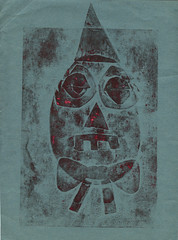
In elementary school I participated in the standard clever re-purposing of Styrofoam and root vegetables into relief matrices, but I also went to summer camps at the nearby art school (Ringling), where we did some monoprints, not that I was really aware of what I was doing. I did manage to make a pressure print of demented potato clown, which I maintain is the greatest piece of artwork I have ever created. I did a few pathetic lino cuts in high school, but I didn’t learn printmaking for reals until taking a class at Wash U in 2001. Wash U proceeded to spoil me tremendously with a 5’ x 8’ press.

Describe where you work.
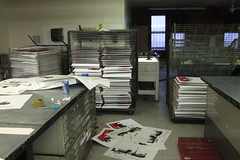
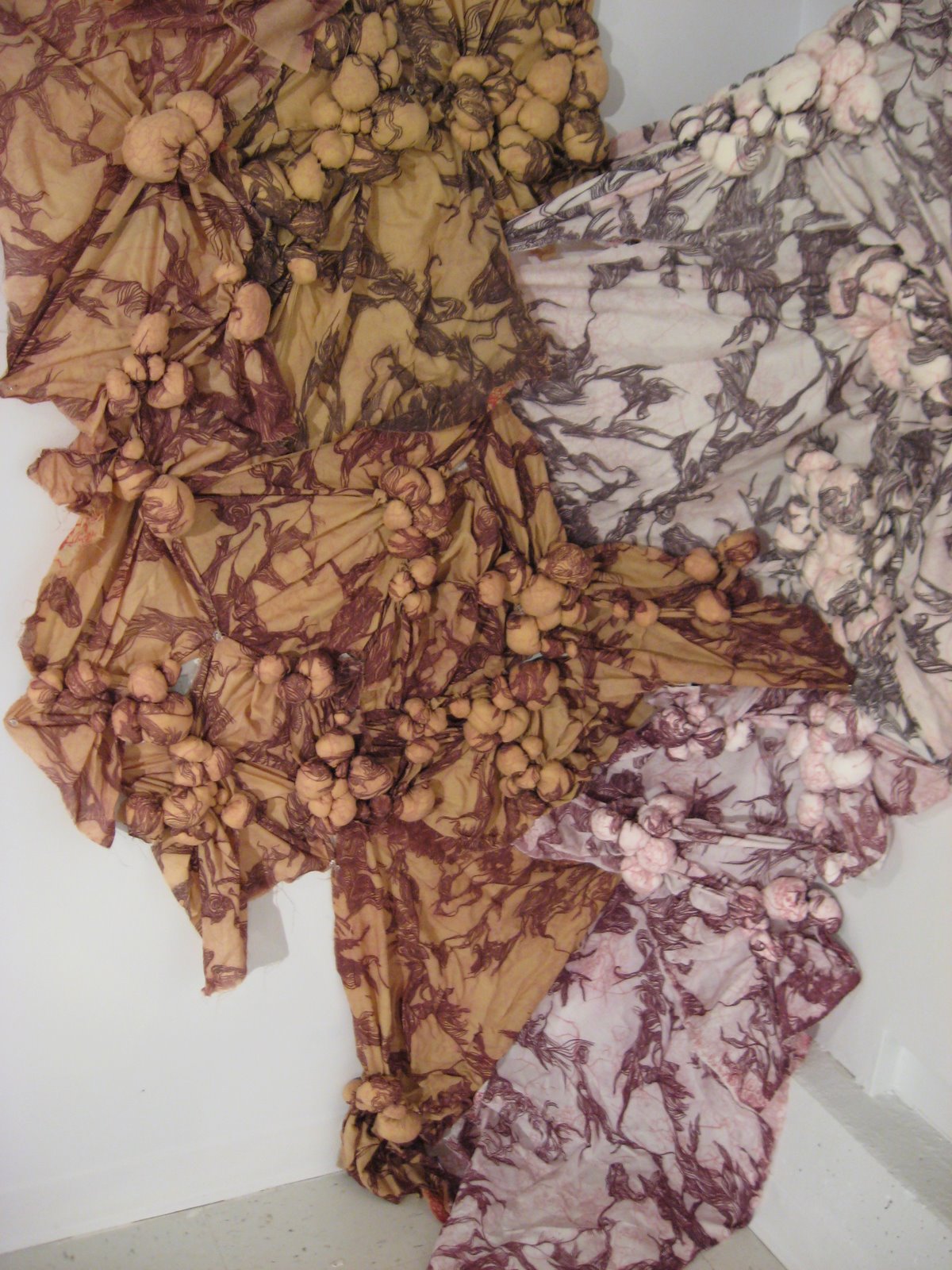
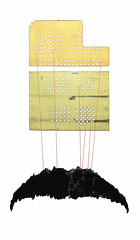
As a grad student I am fortunate enough to have my own studio and full access to all manner of printmaking studios and processes. I spend most of my time in the etching room, but I also do a fair amount of litho and letterpress. I often end up using several different processes, so it really comes down to the individual print. I’ll often make additions to the prints with various media in my studio and build associated 3D elements, occasionally blowing out electrical sockets.

What's your favourite printmaking process?
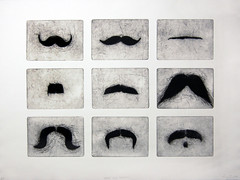
I’d say I mostly think in intaglio. Also, I love a good plate mark.

What's your creative process for any given print? (eg. sketch first? Pre-planned or free-form?)
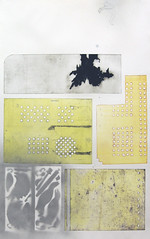
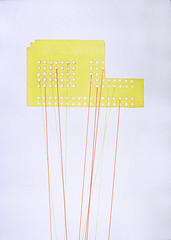
It really depends. I usually sketch out some thumbnails to work out ideas, but how much planning or drawing I do depends on what I’m working on. Given the nature of Printmaking, sometimes the image itself can be done quite spontaneously, but I’ll have to spend time getting the printing logistics in order. Recently I’ve been printing from the surfaces of found materials, reinterpreting their tactility and investigating their relationship with other elements and with the negative space of the paper. I’ve been doing this on a large scale (up to 3’ x 5’), so there are a lot of technical printing considerations involved in just figuring out how to print the crap I find in other people’s basements.


What do you enjoy most about printmaking?
I really enjoy how each process creates a certain kind of line and texture and especially how those different qualities play off one another when combined in a print. I also like the mechanical and technical nature of it that lends itself to secret clubs devoted to shop talk and drinking.

What's your least favorite part of the process?
You know how I just said I liked the technicality of Printmaking? Well, sometimes I hate it. I don’t care for cleaning, either.

What are your inspirations (other artists, people, places, events, etc.)?
All kinds of things: absurdist literature, physics, movies, running, jumping, diagrams, flying things, poster design, acrobats, machines, books, science museums, language, automata, road trips, and finding cool free stuff. It’s also great to be in a grad program surrounded by hardworking, awesome people.

How has your work changed and evolved since you started?
I have become much more focused on an overall installation and try to think about prints as the objects they are.


How do you get past creative slumps?
I go to the movies, read, exercise, or get trapped in the abyss of the internet. Sometimes I’ll stumble on an idea or solution, or I just end up leaving the back of my brain alone for long enough to begin sorting things out. Disclaimer: this isn’t really working right now.

How do you promote your work?
Pathetically.
I apply for some shows and do some print exchanges, I have my etsy store and website out there for people to trip over, and I go to the Southern Graphics Conference, but I could really be less of a pitiful wimp about everything.

Any other comments or advice for others who want to try making hand-pulled prints?
Find out if your local community college has printmaking classes. If you’re an in-state resident, you can often get several months of access to instruction and a lot of expensive equipment for a reasonable amount of money. Then again, you can always print blocks with the back of a wooden spoon or by running over them with your car.

Sunday, September 27, 2009

Printsy Interview - Melody Knight Leary

Blog:
Etsy:
MelodyKnightLeary.etsy.com

Brief Bio
Melody Leary was born and raised in southeastern Connecticut.
While at the Hartford Art School, Leary majored in art education and went on to teach high school art for the next 35 years. An artist with a lifelong passion for printmaking, Leary has shared this enthusiasm with hundreds of students. Largely self-taught, her interest in printmaking evolved over many years as she experimented with various methods including; relief, intaglio, lithography, silkscreen, collagraphs, monotypes and less toxic processes that include photopolymer techniques. Leary’s work has been exhibited throughout the northeast and juried shows throughout the country.

How did you get started in printmaking?
Believe it or not, I vividly remember my first linocut while in elementary school. Loved everything about it and wished I could do more. In high school I had the opportunity to do a couple of additional relief prints using wood & linoleum as well as monotypes and silkscreen. Every time I had the opportunity to use ink, I was happy. After college I decided to delve into the world of printmaking on my own and haven’t looked back! For me, making a print means engaging in a private discourse with the work, through its countless transformations, in an attempt to evoke for myself some unexpected vision. As a printmaker, this exchange is sometimes made visible as working proofs are successively pulled from a plate. The results enable me to see, simultaneously, the original grasping of an idea and its subsequent exploration, including the discarding or reworking of images.


Describe where you work.
I am extremely fortunate to have a 20 X 30’ studio space. My husband added it as an addition to our home and it has windows on 3 sides looking out over the treetops. It is equipped with a Rembrandt Graphic Arts elephant press that I was fortunate enough to find second had for a great price.

What's your favourite printmaking process?
It is difficult for me to choose a favorite process because I like each for different reasons. My first love was collagraphs for their rich textures and the sculptural nature of creating the plate. The graphic nature of black & white relief prints always draw my attention, numerous ways of working in intaglio are endlessly fascinating, the layering of colors and textures while creating a silkscreen is exciting, and combining any and all processes rich with layers and mystery. I am currently focusing my efforts on photopolymer processes after having taken a workshop with Keith Howard back in ’95 in Peace River Alberta.


What's your creative process for any given print? (eg. sketch first? Pre-planned or free-form?)
I start out with a general idea that I seek to visualize then use sketches to work out the overall concept and composition. I reference my photographs, not for directly taking a picture and re-creating it, but rather as a starting place. More often than not, I create something that is quite different, but the photos are just a launching point. Once I’m happy with the image I determine which print technique will be best suited to the image and what I’m trying to convey. Sometimes I jump in and work directly on a plate or surface, building as I go and other times I work from a drawing transferred onto the plate. For linocuts or woodcuts I usually have the design worked out before I start. With monotypes or etching, once I start the piece, it can change direction as I work as I leave myself open to unexpected opportunities.


What do you enjoy most about printmaking?
Everything. The smell of the inks, the energy involved in working the plate, the feel of the paper and of course the magic of the press all play a role in printmaking’s allure. Like art itself, printmaking is about discovery, experimentation and process. Ultimately, it is the process that draws me to the medium; figuring out what I want in an image and then creating the circumstances and processes to achieve that goal. Printmaking is loaded with creative problems, and part of the passion it inspires is finding the best possible creative solution to satisfy a visual problem. There are always new challenges to be met and unlimited possibilities. At the end of a printing session, it is always magical to find out what lies beneath the blankets.

What's your least favorite part of the process?
Believe it or not, getting started on a new project when I have all of these ideas and I need to decide which road to take. With so many opportunities I become so indecisive that I end up finding other things to do, like housework, yard-work, etc. However, once I step into the studio and start working, I resent all those mundane tasks that take time away from my work and end up craving all the studio time I can manage.


What are your inspirations (other artists, people, places, events, etc.)?
Nature, the environment, just my everyday surroundings and life in general are my inspiration. Sometimes I work on a piece for weeks, but I cannot explain what I am searching for, or for that matter, what is finally resolved. I can site the sources for some of the imagery, but I am at a loss to say why those resonate within me in the first place. I know I am not interested in producing an art of purely formal concerns, but neither am I at peace with work bent solely on representation; I’m caught between the formal, the representational and the expressionist content. This exchange, which is often unconscious, leads me to unexpected revelations about feelings and ideas. The essence of art making for me is that each time a viewer is engaged by a work, the creative process is regenerated through the language of the work itself, for which there can be no translation.


How has your work changed and evolved since you started?
Printmaking makes you think in steps; the development of the image, the creation of the plate, the inking process all make you slow down and consider your various options. It also teaches you to be open to unexpected outcomes and encourages experimentation as those options become more familiar. I am also much more aware of the many hazards of traditional printmaking and have made efforts to use less toxic materials, processes and techniques whenever possible.


How do you get past creative slumps?
I play around with photography and take lots of shots for reference material. Also, I turn to my sketchbook when I’m in a creative slump and find that sketching keeps me in a creative mode. Visiting museums and galleries and lots of reading also helps. You never know what will spark an idea for a new print and sometimes you just need to take a break from things and let ideas “ferment”.

How do you promote your work?
Recently, I’ve been putting my work up on various websites to develop an online presence; MyArtSpace.com, Art House Co Op, and Etsy to name a few. One of my favorites is Inkteraction, a wonderful site for printmakers. I’ve also created a blog to journal my studio work. It’s also important to participate in local exhibitions and various exchange projects.

Any other comments or advice for others who want to try making hand-pulled prints?
A print is simply an indentation or mark on a surface left by the pressure of an object brought into contact with it. Given a few stencils or some rubber stamps and ink, anyone could make a print. Start experimenting with some basic monotypes. Simply inking up objects and pressing them to a surface can produce wonderful results with a minimum of equipment. Basic relief techniques such as linoleum prints or woodcuts can be easily explored; and keep in mind that there are great books available that will guide you through a process step by step.

"The great thing about printmaking is that it brings the element of sport into artmaking." – unknown

Sunday, May 3, 2009

Printsy Interview - May Yang

Name: May Yang
website – http://electrofervor.net
etsy – electrofervor.etsy.com
flickr – http://flickr.com/photos/electrofervor
blog – http://electrofervor.net/progress

Brief Bio
I lived most of my life in Tulsa, Oklahoma before going to the East Coast to attend the Maryland Institute College of Art (MICA). I majored in graphic design, but it was there that I discovered my love of printmaking. I am now working as a freelance designer in Baltimore and always make time for any printmaking related projects. Starting in August 2009, I will be attending the Tamarind Institute Printer Training Program in Albuquerque, NM.


How did you get started in printmaking?
After being completely fascinated by printmaking in high school and never having the means to try it, I took a Screenprinting class as a sophomore at MICA. I was immediately hooked and looked forward to taking Lithography, Letterpress and Intaglio/Relief. My Senior year, I interned at the school printshop, Dolphin Press & Print, where I was exposed to collaborative printmaking and the possibility of printmaking as a profession. Visiting artists, deadlines and working on a team sometimes proved challenging, but I gained so much from the experience. It ultimately lead me to apply to Tamarind.


Describe where you work.
While I've been in Baltimore, I've had the privilege of using MICA's printshop. It's a student shop, and with fourteen classes a week, sometimes the conditions can be less than ideal. That said, where else could I get access to an abundance of equipment and be in the company of many talented and motivated artists around the clock? The space has its charm and I'm lucky to have access to so many things.

What's your favourite printmaking process?
What a hard question to answer! I love different aspects of all printmaking processes as they each bring something unique to the table. However, I'm quite fond of screenprinting. I can lay down three or four colors at a time with screenprinting, making prints like those in my Longitude series much more attainable and affordable to create.


What's your creative process for any given print? (eg. sketch first? Pre-planned or free-form?)
I start with a general idea/concept and a rough compositional sketch for most of my prints. Everything else comes together as I work. I used to sit down and plan every single detail out, which I found was hindering my art making. I felt like I had to follow the rigid plans I'd already laid out, instead of having the freedom to change what I was working on. Nowadays the way that I work allows for more freedom and spontaneity and has lead to some surprising discoveries.

What do you enjoy most about printmaking?
The fact that I can produce multiples has let me experiment even more with my prints. Monoprinting, collage elements, hand painted color; these are all things that I've tried in the past. Even prints that are less than perfect can end up as a part of a new piece at a later time. It becomes more about learning from the work you've created rather than placing it on a pedestal.
There's also something about all the meticulous steps involved in printmaking that calms me. Call me crazy, but it's almost meditative.


What's your least favorite part of the process?
Any part of the process that requires me to wait on something. I find I can get rather impatient waiting for screens to dry and litho stones to do their thing, especially when I'm working on a new project that I'm excited about!

What are your inspirations (other artists, people, places, events, etc.)?
I am most inspired by other artists. There's nothing like seeing a beautiful piece of art that puts me in the right frame of mind to work.


How has your work changed and evolved since you started?
My work has gone through so many changes through the years. When I started, I felt that I was learning about the processes, getting to the technical level I needed to be at and most of all, learning what printmaking processes worked best with what I had in mind. Don't get me wrong, I'm still learning every time I'm in the studio, but I think I'm more focused now.

How do you get past creative slumps?
I browse some blogs, go for a walk, grab a coffee with a friend. Sometimes all I really need is to clear my mind.


How do you promote your work?
To be honest, I don't think I've done a very good job at promoting my work! This is an area that I'm definitely still learning about.

Any other comments or advice for others who want to try making hand-pulled prints?
Don't get too discouraged if things don't turn out the right way the first few times (I can definitely tell you some horror stories...), keep working at it, experiment, and most of all have fun!

Sunday, March 8, 2009

Printsy Interview - Maria Doering

Name: Maria Doering

Website: maria-doering.com
Blog: mariadoering.blogspot.com
Etsy: mariadoering.etsy.com
Flickr: flickr.com/photos/mariadoering

Brief Bio
I was born in Germany in 1985. In May 2000 my family and I immigrated to the United States where I graduated from High School in Oakland, NJ and attended Hartford Art School as part of the University of Hartford, Hartford, CT. Fall 2005 I spent one semester studying and working in the beautiful Tuscan town Cortona in Italy. In May 2007 I graduated with Regents Honors, being in the top two of my class I left Hartford with a summa cum laude BFA in Printmaking and a Minor in Art History. Working on my MFA with a Print Media concentration I am currently enrolled at Concordia University in Montreal, Canada.


How did you get started in printmaking?
I took a lithography course with Fred Wessel at Hartford Art School, and within less than a month I was converted, changed my major from Painting to Printmaking right away. It was the beginning of a beautiful obsession.

Describe where you work.
Unfortunately there is no easy answer. Since I have moved many times over the past years my workspace constantly changes. Since I am an artist not only a printmaker, I paint, draw, photograph, install, write,...etc.. And each technique has its own space and time. I tend to work wherever I go, draw on the metro ride to work, sew at a friend’s house while we watch TV. For print I do the pre and post preparation work at home or in my studio at school, and the actual printing of course happens in the Print shop at Concordia University, here in Montreal. Lately I prefer working at home.


What's your favourite printmaking process?
This is a tough question. I think Lithography was my first love and my love for drawing definitely factors into that. But I wouldn’t have the patience to work on an intricate lithograph without the fun energy of doing a reductive linocut, or without the many layers of a reductive offset monotype. I think the only print technique that I don’t get along with would be Intaglio. Maybe the print-god’s were to blame for that one, maybe it wasn’t meant to be but the worst time I had in the studios was during the two intaglio courses I took.


What's your creative process for any given print? (eg. sketch first? Pre-planned or free-form?)
This very much depends on the Print technique. When I work on a linocut for instance I work with photographs and at this stage don’t even do pre-sketches. I just transfer guidelines onto my block, and start to freely chop away as I am using the photograph as my reference. Since I have printed reductively for years I know the technique well enough to not need too much planning. I also tend to mix ALL my color inks before I even start printing. I then work from that limited palette. The large color lithographs I work on tend to develop out of my obsessive drawing / sketching/ doodling, where I develop new patterns. Then create ball grain litho plates by drawing the patterns freely with autographic ink. These full sized plates I print on our Mailaender offset press which has automatic inking rollers (the most beautiful and painfree invention ever... when it works).

What do you enjoy most about printmaking?
The endless step by step, layering, the processes, the smell of the ink, the hard physical work it requires....etc...


What's your least favorite part of the process?
Really depends on my mood and the technique. In general though I love the actual printing, and am often a bit annoyed with the preparation stages.


What are your inspirations (other artists, people, places, events, etc.)?
I draw inspiration from my everyday life, feelings, emotions, issues of identity and place, belonging, the body, health...etc. I am very much inspired by the people and events around me in my life. What I have noticed recently is that I am most productive and inspired if I stumbled over a lot of questions that I can’t find an answer to. It seems that the more questions we have the more interesting our work becomes.


How has your work changed and evolved since you started?
I loved Hartford Art School for the intense techniques I was taught there. But I do have to say that I am creating much more freely and developing my own way of doing everything and anything since I have left. I do think that it becomes very apparent in the work I am producing now, when compared with older projects. I let more mistakes happen these days and let them guide me to make more energetic work.


How do you get past creative slumps?
I believe that the best way of getting over creative slumps is to produce. No matter how crappy the work is you might end up doing, it more than likely will help you to a better place. I also believe that another good way of avoiding creative slumps is to alternate techniques. If you get stuck on a print, do some drawing or painting, or go out and take some photos. It doesn’t even need to have to do with fine arts directly. I play with my hedgehog Nuffnuff, go for a walk, cook, go to the gym, clean my studio...etc... all of that can help getting back on track.


How do you promote your work?
I would say my number one promotional tool is the internet.

Any other comments or advice for others who want to try making hand-pulled prints?
As technical as printmaking is in the end, remember that you are an artist, and really anything goes! Try to work as safe as possible, your health should be your number one priority, esp. in printmaking.

Thanks for the interview, Maria!

Wednesday, June 25, 2008

Etsy Printmaker Interview: Amie Roman

Name: Amie Roman (ploverwing on Etsy)
Location: West Coast of Canada
Interviewed by mizudesigns

Website: http://www.amieroman.ca/
Blog: burnishings.blogspot.com
Squidoo lenses on printmaking: All About Printmaking, Printmaking Artists on the Web

My parents kept me entertained from an early age by providing newsprint and crayons to encourage my expression and imagination. As both of my parents were in the biological sciences, I was immersed in nature from the start. While I'm very artistic, my degree is in conservation biology. I've taken lots of courses to develop my artistic skills, and I currently hold AFCA "signature" status with the Federation of Canadian Artists.

I have been greatly influenced by my grandmother, Caro Woloshyn, also an AFCA. I was surrounded by her art - growing up, our house was always full of her original watercolours of glassware, old farm equipment, and still life subjects. I share much of my taste in subject matter with Caro. Other influences and inspirations include J.F. Lansdowne (especially his study sketches), Chris Czajkowski, Suzanne Northcott and Robert Genn.

I was introduced to printmaking, like most people, in high school art, but never really developed it until adulthood. Three years ago, I took an introductory relief printmaking class through the continuing education department of Emily Carr Institute of Art and Design, and I was hooked. To me, process is really key. I love the challenge of interpreting an image or an idea into a print, building the process in my mind, working within the constraints of the media, exploring ways to expand beyond them, and realizing the final outcome on paper. Printmaking requires development of precise technical skill and craftsmanship, yet provides an expressive medium for creative artistic dialogue.

My fascination with the natural world is evident in my artwork. Nature and the artifacts of civilization are my subjects. The interaction and inter-relationship of our technological heritage with nature, the irony of the competition between nature and progress, and the sheer beauty and diversity of the natural world form the content of my current work. My imagery is realistic, but my focus is often abstracted through magnification or cropping to an almost unrecognizable result. I tend to work on a small scale, because the delicacy of my work mirrors the beautiful minutiae we are surrounded by. The inherent physical restrictions challenge my skills as an artist and as a printmaker.

Primarily, I work with relief printmaking, especially reduction cut relief. I have recently discovered a material called “black linoleum”, which is really a vinyl composite of some kind. It is very smooth and easy to cut, and has similar thickness to linoleum. I carve my blocks using professional quality wood-carving tools, my absolute favourite is my 45ยบ V-gouge. I use Faust AquaLine and Daniel Smith water-soluble inks on many different papers, although my most common include Strathmore Bristol and Rising Stonehenge for “western” papers, and kitakata and masa for “eastern”. Until very recently, all of my work was hand-burnished, but I have become the proud owner of a new mini-press, which makes life a lot easier!

The other two printmaking methods which I favour are stone lithography and acrylic monotype. I love lithography because of it's flexibility and the autographic quality of the drawn image that I'm able to achieve through that medium. Monotypes give me an opportunity to be more painterly in my printmaking approach; as I print them while the paints are still wet, there is also a lot more spontaneity involved than in the rigorous planning of reduction relief prints or lithographs. Both monotype printing and lithography provide me with opportunities to print on a larger scale.

Currently, I work almost exclusively from photographs. With my relief prints, I transfer the image directly onto the block, and then start carving. When I first started printmaking, I drafted how I thought I should print out the layers of colour in sketches; now, I just formulate that almost entirely in my mind, and usually as I'm carving the first layer, although I do work out the values before I start when I'm creating the transfer image. I'd like to incorporate more spontaneity into my relief printing, and move more into abstraction and away from the literal interpretation of my subject matter, but I find that hugely challenging.

I think the hardest thing that I face about printmaking, and what I dislike most about being an artist, is getting discouraged about lack of progress. I am a part-time artist who would love to be full-time, but I don't see the way through to that goal. I also find it hard to promote my work. While I am a member of a local printmaking gallery, Malaspina Printmakers, I don't find that there are many commercial venues for printmakers in my immediate area. Appreciation and support of art, and printmaking specifically, seems to be not as strong on the West Coast of Canada as in other parts of North America, or other countries, so it's certainly a challenge.

One of the best parts of being a printmaker is that it's almost like belonging to a secret society. If you meet another printmaker, talk immediately turns to techniques and materials. I'm just as fascinated by etching, silk screen, letterpress as I am by my own printmaking methods, and I love seeing other printmakers working and their finished product! There seems to be an almost instantaneous collegiality among printmakers that I'm not sure is there among other artists, or at least it's not the same. Every printmaker that I've met, either in person or online, has been super enthusiastic about what they do, and generally very generous with their knowledge and insights. I think we're all pretty much caught up in the process, at least to some extent, of our given printmaking media, and recognize that spark of craftsmanship in other printmakers, too.

I'm a newby (and not very active!) to Etsy; I just joined November 2007, and listed my first pieces in January 2008, and sold my first piece in March. It's great to have a venue like Etsy available, as there is an international community geared specifically towards artists and craftspeople to showcase their work and make it available to the world at large.