Tuesday, July 29, 2008

Prinsty Interview: Marissa L. Swinghammer

Interviewed by: Annie Bissett

Websites:
mleefineart.com
mleeprints.blogspot.com

Brief Bio:
Grew up around Chicago, now living in Boston for the past five years. I've been an artist ever since I first picked up a crayon. Something I try to still do today, keeping a box of them on hand in my studio. Art school was a drag but I learned a lot after all that I didn't even realize at the time. Only seeing it years later when I finally realized my dream to be a working artist.

How did you get started in printmaking?

Printmaking was a required class at college and I fell in love and never painted again. In school it was lithography for many years until three years after I graduated I took a woodblock printmaking class that changed the direction I was going as a printmaker and as an artist.

What media do you work in most often?

Woodblock printmaking.

'Quiet Playground' - mlee.etsy.com on Flickr
Where do you do your printing, and what are your tools?

I share a studio in my house with my young daughter, often printing or carving while she plays nearby. As a result I have to keep my studio very clean, use non-toxic solvents and keep my carving tools and inks out of reach. I use blocks of shina plywood, Japanese steel carving tools, ink and my beloved printing press. These days I print every Tuesday.

'printing press' - mlee.etsy.com on Flickr
Your method is very fluid and allows you to use your blocks over again in various combinations. How did you develop this way of working?

It developed from my love of the medium combined with my short attention span. This short attention span led me a seek a way for me to make prints without doing editions yet still reusing blocks.

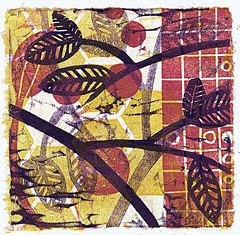
'Nature' - mlee.etsy.com on FlickrWhat are your inspirations (other artists, topics, places, etc.)?
My instructor from Mass Art Annie Silverman has been a huge influence. As have so many artists on Flickr and on blogs that I read. The walks I take around Boston with my daughter every morning are a daily inspiration.

'Overgrowth' - mlee.etsy.com on FlickrHow do you work with creative slumps?
I don't. I suffer through them and try to get myself to draw my way out. I find that if I keep a sketchbook and draw even if it isn't any good eventually I will feel inspired again.

Congratulations on the birth of your first child! How has being a new mother affected your work as an artist?

Since having my daughter in September 2007 my work has expanded to include collage and mixed media. This work allows me to incorporate scraps of prints from the past, Japanese washi paper, pages from old books, and screen printing into my work. This came in part from the lack of having large blocks of time to print and still needing to create. These days I am at least able to print once a week.

You were an early member of Etsy. How has Etsy impacted your life and work and how has Etsy changed since you started?
It has grown and then grown some more. When I joined the art category was so small I remember thinking how it was too small to attract many buyers. You didn't have to work to get seen in the same way you do now, but you needed to work to draw people to the site even harder. Etsy had a huge impact on my life giving me a venue to show and sell my art while staying at home. I have a network of friends both local and not from the site that are my daughter's adoptive Etsy aunties.

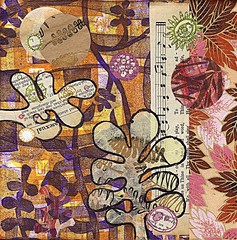
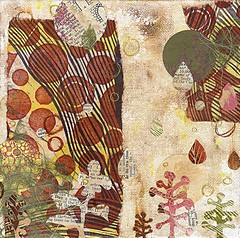
'#9 - Collage Challenge' mlee.etsy.com on FlickrAssuming a perfect world, what would you imagine yourself doing 5 years from now?
Hmm, I always struggle with questions like this because I know reality can be just as rewarding as a perfect world. But I will give it a shot. In five years I would like to have another child and still be making art and selling on Etsy while putting more attention on showing and selling locally as well. That is the direction I have been heading in this summer and I can see it continuing.

Any advice for aspiring printmakers?
Love the medium and let that love show through your work and through discussion. Defend printmaking with passion.

Monday, July 21, 2008

Printsy Interview: Kate Nydam Meberg

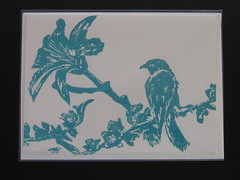
'Sparrow card - linoleum print' - Nydam on FlickrNydam Press
Interviewed by: Marissa Buschow

Websites:
nydampress.etsy.com
nydampress.blogspot.com
flickr.com/photos/nydam

Brief Bio:

Well, I was born and raised on Cape Cod, MA. Graduated from a MA State college in 2004 with a BA in Fine Arts. Since then have lived smack dab in the middle of Connecticut with my bicycle loving engineer husband.

What printmaking medium do you most often work in:

Linoleum block printing. Although the recent acquisition of a Gocco machine has made my life that much better.

How & when did you get started in printmaking:


Like others my printmaking experience began in high school. I continued on in college where I took two courses in printmaking, focusing more on etching than block printing. Fast forward to the winter of 2005 and I was feeling remiss of my old college days. Aside from the occasional watercolor painting (my other medium of choice) my art life had been laying dormant. That Christmas I made a wish list for family to shop from on Dick Blick, chock full of block printing supplies. And the rest is history.

Describe where you work:

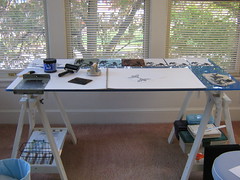
'Hooray for my new sunroom,studio' - Nydam on FlickrCurrently I have a small studio area within the sun room of our apt. But, in less than a month we will be moving into our very first home! There I will have an entire south facing (light is key for my productivity) room all to myself. My head spins with delight just thinking of how I shall organize my future space.

What's your creative process for any given print? (eg. sketch first? Pre-planned or free-form?)

Certainly pre-planned. I have never been much of a sketcher, instead I am more inclined to have a very precise and thought out drawing to work from. This drawing is always in an outline format, and during the carving stage that is when I add more dimension to the subject matter through highlights and such. So basically I am uptight during the first step of the process, which allows me to relax during the carving stage. Which brings me much happiness.

What do you enjoy most about printmaking?

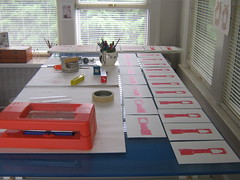
'First layer of first Gocco print' - Nydam on FlickrThe repetitive nature. There is definitely something so innately satisfying for me about doing something that involves repeating the same steps over and over. In the past I have been fortunate enough to work for other artisans (Anne C. Ross Fused Glass and Chatham Pottery) in their studios doing production. So I feel quite lucky that I am now able to devote some time towards the production of my own work.

What's your least favorite part of the process:


Cleaning up. I'm hoping our landlord does not notice the mess I have made out of our white kitchen sink.

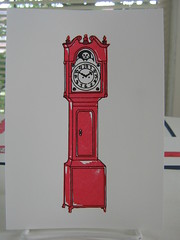
'Gocco grandfather clock' Nydam on FlickrWhat are your inspirations (other artists, people, places, events, etc.):

I find most my work is directly inspired from my upbringing. From the environment of the Cape, to the great collection of antiques found in my parent's home. Sometimes I also find myself wandering the deserted stacks of the Non Fiction section in our local library.

How has your work changed and evolved since you started:


With each print I try to push myself out of my comfort zone and challenge myself to tackle on more complex subject matter/methods. Incorporating things like lettering, numbers and the use of multiple blocks, are all things that initially I was hesitant to try. I then got to a point where I asked myself why I was limiting myself. Since then I have been breaking through the previously inflicted barriers I had set upon myself.

How do you get past creative slumps?

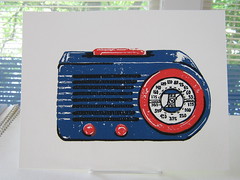
'Fada radio linoleum block print' - Nydam on FlickrYou know, if this question had been asked 6 months ago I would have said "What creative slump?!". But during April I experienced a bout with my own "artist's block" and I simply wasn't satisfied with any of my ideas/drawings. I was at first very frustrated, but after some time I reminded myself that I am NOT a machine. And it is OK to not to churn out a new project everyday. I went on a trip the next month out West and it was definitely the shot in the arm, so to speak, that I needed creatively.

How do you promote your work?


I started by entering the craft fair scene in the summer of 2005, at the South End Open Market in Boston. Then in the fall of 2006 I opened up my Etsy shop which led to my Flickr page and Blog. Since then I participated in the Bazaar Bizarre in Boston and I also sell my work online through Little Paper Planes. I think the combination of a presence online and in person is very important. The other part of that equation is customer service, which is one of my top priorities. Also, confidence is key. If you believe in your work, then others will believe in it too.

Any other comments or advice for others who want to try making hand-pulled prints:

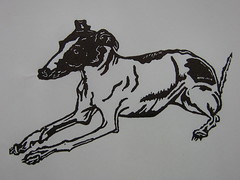
'Italian greyhound - linoleum block print' - Nydam on FlickrWhile formal art training isn't necessary, I do think participating in printmaking classes/workshops is a great experience. The dynamic of working alongside other budding printmakers is a fantastic experience. Then when you come home from class and you have further questions, I think the Printmaking group over at flickr is an excellent place to turn. Any question can be posed over in the Discussion section and many talented printmakers will offer up their experience in the matter. Easy access to knowledge at your fingertips. Can't get any better than that!

Monday, July 14, 2008

Printsy Interview: Kylie Budge

Interviewed by: Chelsea Groves
Name: Mizu Designs

Websites
www.mizudesigns.blogspot.com
www.mizudesigns.com.au
www.flickr.com/photos/kyliebudge/

Brief Bio

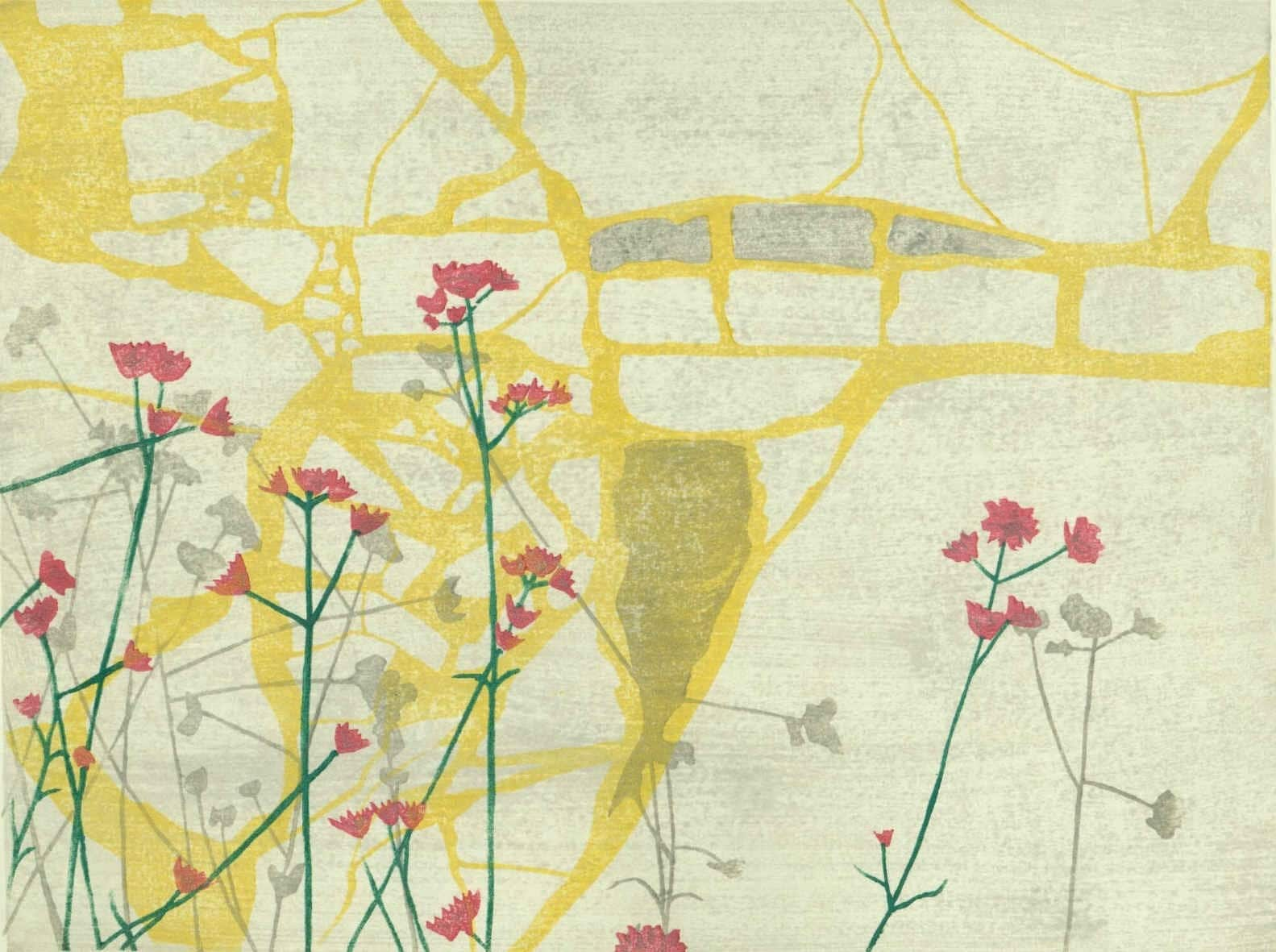
'wallflowers' - mizudesigns on EtsyI’ve been making woodblock prints since 1998 when I moved to Japan. I’d dabbled in screen printing in high school and also some lino block printing but was really struck by the beauty of woodblock prints in the Japanese moku hanga tradition. I badgered a Japanese printmaker in Kyoto to take me on as her student and she taught me the moku hanga tradition and took me to galleries and introduced me to many artists who I would never had met and seen if it had not been for her. I’ve been printmaking ever since.

What printmaking medium do you most often work in?

I usually make relief prints and most often in the Japanese woodblock printmaking tradition. I also enjoy making lino prints and have been making more of those recently. I’d like to do some more silk screen printing in the future but must say that I prefer the texture of relief printing.
There’s a 3D type element to it that you can’t really get with silk screen printing and I think that’s what I really like about it.

How did you get started in printmaking? I notice from your profile that you've studied printmaking in Japan. How did this come about and can you tell a bit about that experience?

Printmaking for me is very deeply connected to my seven lovely years living in Kyoto, Japan. Every art gallery and museum there is stuffed to the gills 'tools of the trade' - kylie budge on Flickrwith ancient ukiyo-e prints that it’s hard not to notice printmaking when you’re there. I love looking at the intricate carving work of prints by people like Utamaro.
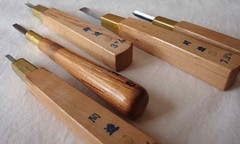
The ukiyo-e period of printmaking in Japan produced some astounding works. I soaked all of that up while I was there and really had so much inspiration around me that it’s not surprising that I was drawn to printmaking. Studying printmaking in a beautiful old city like Kyoto, that values traditional art forms, was a pleasure. The city is full of washi (paper) shops. It was easy to get my hands on rolls and rolls of beautiful hand made paper. I was spoilt for choice. And traditional carving tools and brushes as well as the baren (a flat, round disc covered in a bamboo leaf used for printing) are easy to come by as are lovely prepared pieces of shina ply for carving. Sumi, the traditional black ink, was also easily available. I was forever riding around the city on my bicycle picking up paper and other supplies for printmaking. It was so much fun to find new little paper shops tucked away in corners of the city and buy washi to take home to experiment with.
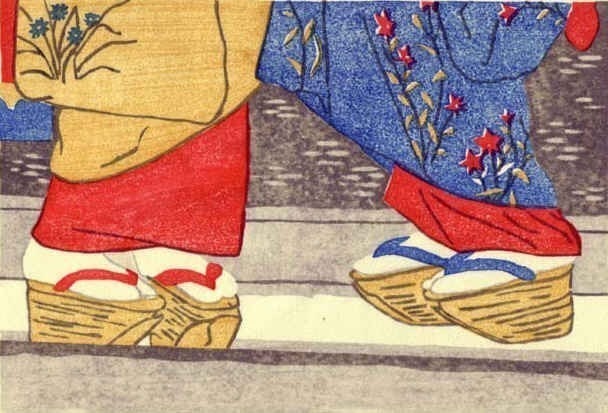
'geta girls' - mizudesigns on EtsyI was even lucky enough to visit a still functioning but very traditional printmaking studio in Kyoto where the master printmaker works in a tiny room sitting on the floor surrounded by his 4 apprentice printmakers. There is barely enough room for each of them to sit cross legged at their tables while they print but they all work extremely productively and harmoniously in that tiny space. I was amazed at their skill level. They were able to press the paper with their baren and print off a perfect image in a matter of seconds. Piles of completed prints (hundreds and hundreds) were stacked neatly beside each printer. Experiences like this made me even more
determined to design and produce prints.

Describe where you work.
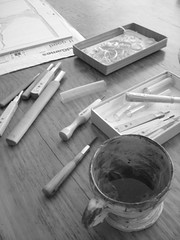
'in the studio' - kylie budge on FlickrJapanese style printmaking is small and portable which is a good thing if you don’t have much space. I work from home in a studio that’s part of my house. For the moment this suits me fine but sometimes I think it would be lovely to work in a more communal studio space with other artists.

What's your creative process for any given print? (eg. sketch first? Pre-planned or free-form?)


I usually start off with and an idea and then sketch it out a bit on paper to think about the layers and colours I might use to help me plan out my blocks. In Japan I was taught to do this very carefully and precisely but I’m a bit looser about it these days. Then I carve my blocks until I’m happy. This part can take a very long time. With printing I sometimes do a practice print to see if the colours are working together and if the blocks have been carved well enough, especially with a design involving the alignment of 5 or more blocks. In Japan I saw people printing designs with 20-30 blocks all aligned. I’m not sure I have the stamina or patience for that kind of work!

What do you enjoy most about printmaking?


I love seeing the finished print! That’s probably how most printmakers feel about things because the process of getting to that point can take a very long time and often it’s not until you actually print that you can really tell if an idea has come together well or not.

What's your least favorite part of the process?

Sometimes carving the blocks can take a very long time especially if it’s a particularly complex print. If it takes too long I can lose interest in the print and have to take a break to work on something else and come back to it later. Sometimes that’s ok, but other times I might have creatively moved on from the design and not want to finish carving at all!

What are your inspirations (other artists, people, places, events, etc.)?
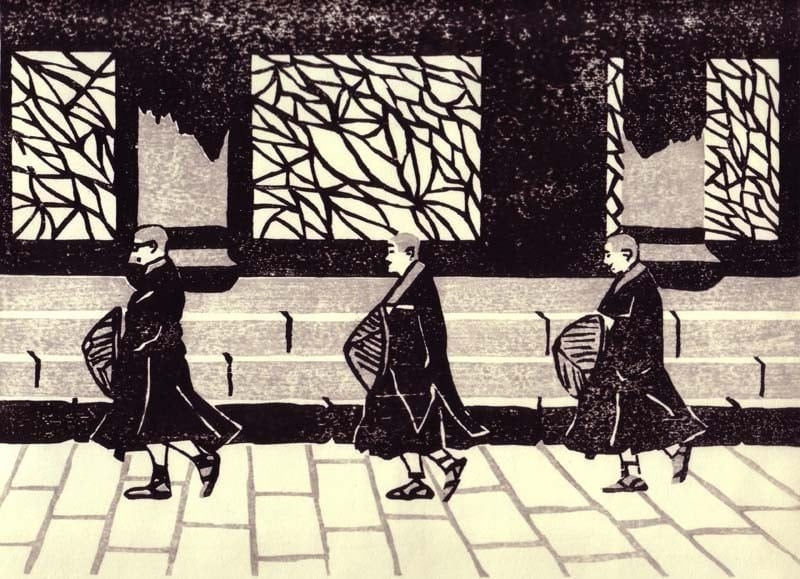
'Nanzenji Monks' - mizudesigns on EtsyI’m inspired by simple things like going for a walk down at the creek near my house, or going for a bike ride on a sunny day. I love going to exhibitions of artists who produce works on paper and wish there were more on offer. I like to see what people are making, what techniques they’re trying, the colours they’re using, that kind of thing. I love looking at what people are doing on flickr. It can be so inspiring and it’s a way to see a range of art from many different countries. Japan continues to inspire me even though I no longer live there. I also love incorporating tea and the
ritual of drinking it into my illustrations in one way or other. And indigenous Australian plant life is continually fascinating to me.

How has your work changed and evolved since you started?

When I first started printmaking in Japan I was very focused on technique and understanding it well and so I was very tight in the way I worked. I think I have learned to loosen up a little since then and am not so concerned about doing things ‘the right way’ any more if it gets in the way of exploring an idea or experimenting with process to discover a new image. I admire people who can work loosely and still make beautiful prints. I’d like to learn from them and be a bit braver.

How do you get past creative slumps?
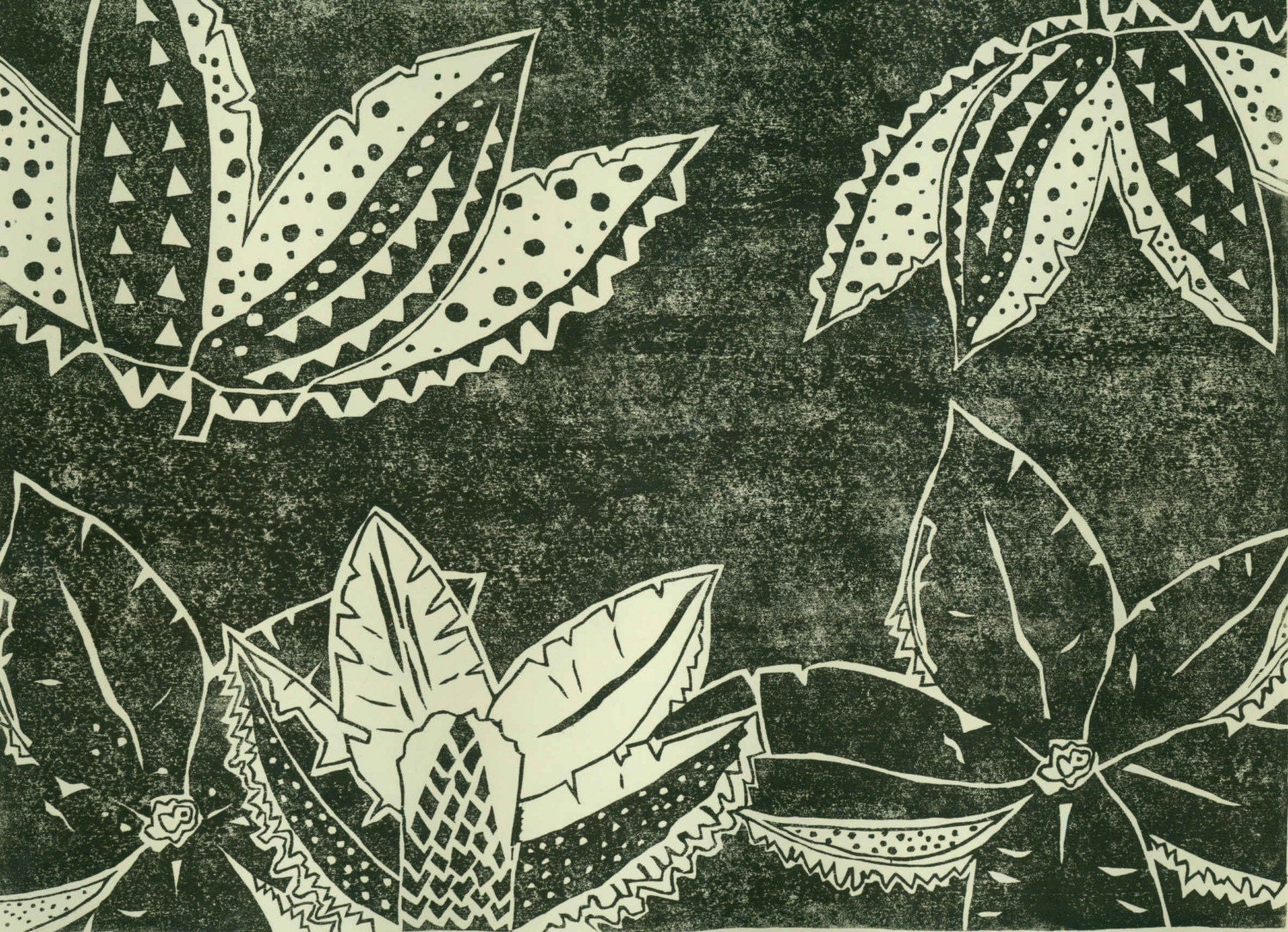
'seed pod in black' - mizudesigns on EtsySometimes it’s good to take a break from printmaking because it’s not possible to feel creative all the time. I recently had a 3 week holiday in New York and it was amazing for recharging my energy and inspiring me in a creative sense because I spent a lot of time in galleries and museums. Sometimes all we need is to step away from the every day for a while, breathe a little, and the creative slumps can just melt away.

How do you promote your work?

I have an etsy shop where I sell my work and like to blog as well but apart from that I do very little promotion. I exhibited my work in Japan but haven’t done that in Australia since returning in 2005. I’ve just put together my very first website so I’m quite excited about that. My friends
do a lot of word of mouth promotion for me, which I think is really very sweet.

Any other comments or advice for others who want to try making hand-pulled prints?

My advice to someone starting out is don’t be afraid to give many different types of printmaking a try. It may take a while for you to discover a form that you like more or feel more comfortable working with. Or you might find you like them all! Also, if you want to work in the Japanese
woodblock printing tradition be prepared for the physicality of it – it can be quite hard work especially if you’re printing on a hot day. Personally I like that about it. It makes me feel like I’ve really worked at something to get to the end point.
Monday, July 7, 2008

Printsy Interview: Lapwing Printworks - spoonergregory on Etsy

'Four Prints' - spoonergregory on FlickrInterviewed by: Amie Roman

Names: Sarah Spooner & Jon Gregory

Identity on Etsy: spoonergregory

Print studio name: Lapwing Printworks

Website: www.spoonergregory.plus.com

Etsy: spoonergregory.etsy.com

Flickr: flickr.com/photos/spoonergregory/

Blog: forwhatischatteris.blogspot.com/


What drew you into this (some would argue) esoteric art form? Especially wood engraving - perhaps it's more popular in the UK, but wood engravers are not so thick on the ground in my neck of the woods!

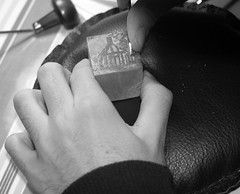
'Engraving St. Winifred's' - spoonergregory on FlickrWe were drawn to printmaking after spending all our hard-earned pennies on prints by local artists, which inspired us to have a go at it ourselves. Our interest in wood engraving was sparked by the engravings of artists like Clare Leighton, Eric Ravilious and Agnes Miller Parker who were working in the 1930s. It can be much more difficult and painstaking work than producing woodcuts or linocuts because of the hardness of the wood and the unusual way in which you hold the tools. But it’s a very relaxing and rewarding process. We’re still learning and experimenting, but hopefully in a few years we’ll be brave enough to submit something for the Society of Wood Engravers annual exhibition.

How long have you been printmaking?

We both did printmaking at school, and came back to it about three years ago.

Were you both printmakers or was it one of you that introduced the other to the art? Do you ever work collaboratively on pieces? If so, how do you co-ordinate that, or does it come naturally?


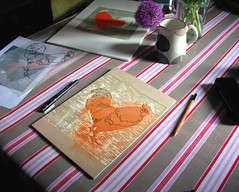
'Preparing to carve...' - spoonergregory on FlickrIt was Jon that decided to pick it up again first, and before long we were both at it, especially after we moved in together and had the space to spread out on a big table. [That sounds quite rude, but I’m not sure how to rephrase it!]

We nearly always help each other with the printing of each other’s blocks, but the designs are our own individual work, and of course we always discuss our ideas and designs with each other. I’m not sure we could work collaboratively on a project without tears and recriminations, but it would certainly be interesting to try…

I love your logo & Lapwing Printworks name; I read the reason on the Crafty Synergy blog, but I'd really appreciate if you could re-iterate your inspiration for the Printsy blog.

When we decided to set up an Etsy shop and re-do our website we decided to have a name that we could both work under. We both like lapwings, which are very common birds in Norfolk. They have jaunty little crests, and a very distinctive ‘peeewit’ call. It just seemed appropriate somehow.

You seem to use a lot of very bold, simple, bright colours & graphic shapes in your work. Is this something that's a product of printmaking & the media you use therein, or is it something that is within you and printmaking is just well suited to express it?

Woodcuts and linocuts are very well suited to bright colours and graphic shapes, which reflect our personal tastes perfectly. We’re always attracted to bright and shiny things, much like magpies. Our colourful and graphic prints are often done straight after a detailed black and white wood engraving – a fun way of recharging our printmaking batteries!

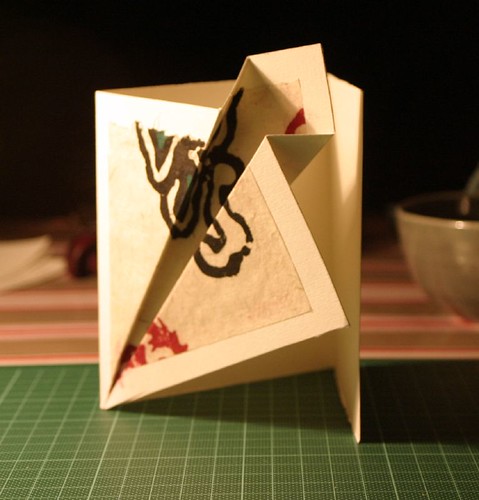
'Card' - spooonergregory on FlickrI'm very intrigued with your wedding invitation prototype referred to on your blog - have you done any more? What were your inspirations? Was it a specific commission or just a nifty idea?

The wedding invitations were actually for our own wedding in January. We knew that we wanted to make our own invitations, and saw a tutorial for these cards in a crafty book.'Confetti' - spoonergregory on Flickr They were quite fiddly to make, but we were pleased with how they turned out in the end. For our wedding we used a square of an old map on the front, with a letterpressed insert inside. We loved the striking folds on the front – much more interesting than a plain card! I’ve made more cards since our wedding, using our own block printed paper for the front. We love buying cards from other printmakers too – it can be an affordable way to buy a little piece of original artwork.

Can you talk a little about your Adana press? Please describe what is letterpress, and how it's different from just "relief printing". Do you have any interesting thoughts on letterpress lore, or what drew you to letterpress printing?

We’ve had our Adana 8x5 for almost a year, and we are still learning! We originally got it with the intention of using it to print wood engraving blocks, which are typically ‘type high’ (the same standard height as metal type). Inevitably we then became interested in letterpress and have gradually been building up a little collection of type and decorative blocks. We are slowly getting to grips with letterpress, and we’re looking forward to using it more in our work.

The principal of letterpress printing is similar to relief printmaking – only using metal type and blocks as well as hand carved blocks. There is lots of information about letterpress on the Briar Press website

Do you have trouble ever getting inspiration?


Sometimes, but a long walk in the countryside always sorts us out with plenty of ideas for several prints. Once you start looking for interesting patterns, shapes and colours in the most ordinary, everyday things around the house there are always dozens of ideas just waiting to be turned into a colourful print.

It seems wonderful that the two of you are so creative & love to work in the same medium - does it ever get competitive or challenging working together, or is it usually a pretty harmonious environment in the studio?

It can sometimes be challenging working together, but we are rarely competitive. When we are both working on our own prints at the same time we are usually too absorbed in our own work to worry about what the other one is doing (apart from getting each other another drink and a biscuit of course). We’re very supportive of each others work, and have learned to accept constructive criticism from each other!
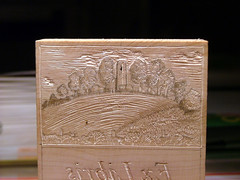
'Bookplate - a closer look' - spoonergregory on Flickr
How do you manage to get commissions?


A combination of word of mouth and luck! We have a page on our website about commissions and were approached in this way for a few bookplate commissions. Since we’ve had our Etsy shop we’ve had our first international commission for a bookplate, which was very exciting.

What are some of the commissioned works you've done?

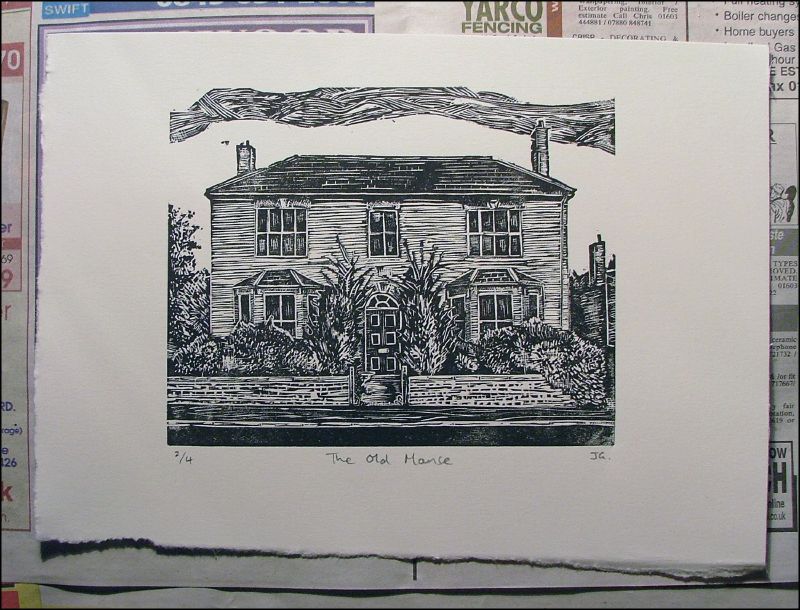
All the commissions we’ve done so far have been wood engravings. We’ve completed several bookplates, which are great fun to do because of the relationship you build up with the customer when creating something so personal and unique. We’ve also done an engraving of someone’s house and the Whippet Ale labels.

At the moment we in the early stages of another bookplate commission, roughing out ideas and sketches with our client before we come up with a final design. This particular one will be based around the landscape and poetry of the First World War – a challenging subject, but a rewarding commission so far!

'Final House Print' - spoonergregory on Flickr
Do you have any favourites? Personally, I love the Whippet Ale label you recently posted about on your blog!


We both chose different ones – Jon’s favourite is the house engraving because it was the first big engraving he did, and it has been one of the most enjoyable to work on. My favourite is the Whippet Ale labels, which is the first time that we have combined letterpress and wood engraving, and we were paid in beer.
'& with these pencils I shall do great things' - spoonergregory on Flickr
Finally, one of your recent prints "& with these pencils I shall do great things" - this image seems to capture the spirit of every artist as they sit down at their desk to work. Do you feel, for yourselves, that this is a motto, an inspiration, or a flog to get you on to work?


It is an inspiration for us – there’s nothing quite a pot of freshly sharpened pencils and a sketchbook to get the creative juices flowing!

Thanks Sarah & Jon - I was delighted at this opportunity to interview you and to get a little better insight into your work.