Showing posts with label wood engraving. Show all posts

Sunday, September 19, 2010

Eric Hoffman

Eric's site links are at the bottom of this interview.


Biography

I am a printmaker residing and working in Providence, Rhode Island with a B.F.A. degree from Rhode Island College, concentrating in printmaking, drawing, and art history.

How did you get started in printmaking?


I was a student at RIC taking an advanced drawing course with Professor Stephen Fisher. Nearing the end of the semester he mentioned that I should think about taking the introductory printmaking class the following Fall. I was absolutely clueless to what printmaking was. After a few failed attempts by Stephen to explain Intaglio etching, I just signed up and jumped in. I was in love by the second class and I’ve never looked back. I even changed my major from Art Education to the B.F.A. program to spend more time in the college’s print shop.

Describe where you work


I currently split my time between my studio/loft in Providence and the print shop at RIC. It helps being in my own space and having no time constraints during the engraving process. Being able to play whatever I want on the stereo helps too. My engravings are very small in size, and making them does not involve any toxic chemicals or solvents, so I use the RIC print shop only when I need to proof a block or print an edition. There is an old Vandercook proofing press and plenty of eccentric print students hanging around! It’s nice to bounce ideas off of other printmakers and get quick crits from both the advanced class as well as Stephen Fisher, who is still the printmaking professor.

What's your favorite printmaking process?


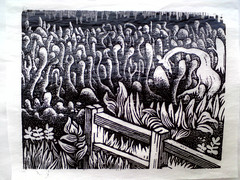
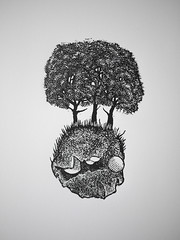
I have tried many, but I currently work in relief engraving, which is essentially wood engraving on blocks of resin instead of end-grain wood. The material I use, called Resingrave, comes in small blocks and engraves beautifully. The cost of end-grain boxwood (normally used in wood engraving) is incredibly high due to the small supply of it left. Resingrave has the qualities of very high-end boxwood at a fraction of the cost, with the added bonus of saving the little boxwood that’s left. I only use hand engraving tools, mostly small sharp burins and gravers. The process is essentially simple on the surface - it is all of the detail work that goes into each engraving that keeps me up at night!

What's your creative process for any given print?


I’m constantly coming up with ideas for images; making lists of these ideas and preliminary sketches on bits of scrap paper until my desk is piled high. Eventually this leads me to come up with a solid idea for an engraving. I tend to work from photographs, so a large part of the creative process is either photographing subject matter or finding source material and composing interesting ideas from it. This has included self-portraiture, still life, animals, skulls, flowers and nature. I’m all over the place. My work has always been more about the process of creating the prints and engravings while the themes and subjects of the prints are secondary.

What do you enjoy most about printmaking?

Physically engraving the lines into the blocks, bringing the light out of an image from a completely black space - there is something about drawing with light that works better for me then traditionally drawing with black ink on paper. If I could go back in time I would be one of the industrial engravers that just consistently produced work 40 hours a week rendering products for ads and reproducing paintings. For me it really is about the process and honing of my craft.

What's your least favorite part of the process?

Unfortunately, I have to say printing the blocks. I love the physical act of printing and making an edition, but the press I have access to overtime has been modified and is not ideal for fine line engravings. It is difficult to hand burnish prints on anything but thin paper and I like printing on really thick paper or at least having the option to print on the paper of my choosing.

Someday I will have my own beautiful press and this will all be resolved!

What are your inspirations (other artists, people, places, events, etc.)?

Stephen Fisher. His work is so beautiful and intense, and he’s a hell of a motivator. Other printmakers I admire and look to for ideas and inspiration are Barry Moser, an incredible engraver, bookmaker, and teacher. I enjoy the work of Andy English and Simon Brett, as well as G. Brender à Brandis, Gustave Doré, and Thomas Bewick.

I am also a fan of Film Noir imagery, Egon Schiele and German Expressionism, and the men and women industrial steel and wood engravers of the 19th century. Käthe Kollwitz, Jim Dine, Aubrey Beardsley, Otomo Katsuhiro, and Aaron Horkey are all huge influences as well. Music is constantly on in the studio and has a profound role in the making of my work. I am a huge fan of 1950’s – 1960’s Blue Note jazz and many other types of music.

How has your work changed and evolved since you started?


In the beginning I was very interested in mark making and experimenting with tools and materials to get interesting textures and effects. I began engraving with an emphasis on light and shadow, often making images emerging out of the pitch black, dramatically lit. In the past year I have stepped away from this extreme lighting to focus on rendered subjects intermingled with pattern, filigree, and decorative-like elements. Again, my focus is on honing the craft of engraving, so I am currently pushing ideas like “how fine can I engrave this image?” and “How can I add spatial information into this block rather then engulfing the subject in black?”

How do you get past creative slumps?


Going to gallery openings and talking with working artists and friends involved in the arts. I have many friends who are printmakers and musicians in Providence that all have the ability of sparking ideas in my head. My wife Liz is awesome at pulling me out of a slump. I think it’s a combination of her inspiring words and her ability to kick my butt when I’m moping around and watching “Law and Order” all day! John Coltrane’s “Live at the Village Vanguard” works too.

How do you promote your work?

I take full advantage of the Internet. Between Twitter, Facebook, LinkedIn, Etsy and various forums I have been able to connect with printmakers and wood engravers around the world. I have gotten advice and ideas, sold some of my work, and made some great connections that have turned into everything from print exchanges to gallery shows. I network throughout the Providence gallery scene as well, and am lucky enough to have a great group of artist friends that are constantly spreading the word around for each other.

Any other comments or advice for others who want to try making hand-pulled prints?

You should try and take a class in various types of printmaking to get a good retrospective of what you can do with the medium. Most people that ask what kind of art I make have no idea what “relief engraving” is. But everyone I’ve ever spoken with has had some kind of interest in prints, be it screen-printed concert posters and shirts to letter-pressed wedding invitations. Printmaking is fantastic! The first time you pull a proof off of a block or a plate is pure satisfaction! Building a print collection with peers, trading work with professional printmakers, and selling your work are wonderful ways of making connections and friends in the world. And the beauty is that you can always keep one of the prints you have poured your heart and soul into, even after selling or giving away as many as you can make. This medium has changed my life!

Eric’s Etsy Site
Eric’s Web Site

Sunday, May 16, 2010

Printsy Interview - Kyoko Imazu

Etsy: kyokoimazu.etsy.com, rachelscabinet.etsy.com
Blog: rachelscabinet.blogspot.com
Flickr: flickr.com/photos/kyokoimazu

Brief Bio
I’m originally from Japan and arrived in Melbourne, Australia in 2002. I studied Bachelor of Fine Art, majoring in printmaking. After graduating from uni at the end of 2007, I was completely broke so I worked in an office for 4 days a week and made works at night or on Friday – Sunday. At the end of 2009, I quit my job to become a full-time printmaker. I’m still a bit freaked out but mostly enjoying every minute!


How did you get started in printmaking?
At first I was planning to study oil painting but somehow it didn’t connect with me. Then I met the world of printmaking. I really liked how it’s all technique-based discipline and craftsmanship is very much appreciated.

Describe where you work.
I work in a little studio space at home next to kitchen. It’s probably not a good idea in terms of OH&S... I have a press borrowed from my friend/adviser Bridget Farmer while she is in Belfast. I do not have access to process room for etching etc at the moment as our Print Workshop is closed for renovation so I’m mostly doing engravings on copper and woodblock.


What's your favourite printmaking process?
I love engravings. I like to play with the idea of old and new so engraving is a perfect medium for me.

What's your creative process for any given print? (eg. sketch first? Pre-planned or free-form?)
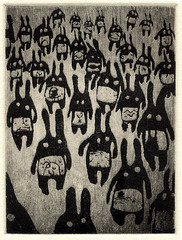
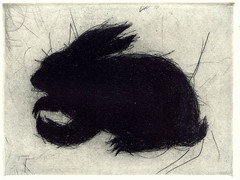
I always do sketch first – either pencil drawing or collage. For my rabbit series, I made collage from 18-19th century illustration books and cartoons or comic books.


I’m always doodling in my sketchbooks so I often use bits and pieces of images from those doodles to create prints too.

What do you enjoy most about printmaking?
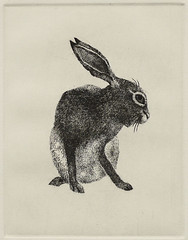
I think what I enjoy the most is the process. I love the act of engraving small lines for animal fur or dots for texture by a graver or a needle.

What's your least favorite part of the process?
Filing the edge of cooper plates! I’ve cut my fingers many times doing that. Please let me know if you have a special tip for making edges look nice and clean!


What are your inspirations (other artists, people, places, events, etc.)?
Generally I am inspired by lots of different things in everyday life. Some of those are:
  • Old illustration books on science or animal study
  • Museum / gallery
  • Shrines and forests in Japan (Sadly I can’t do this often)
  • Japanese prints, comics and cartoons
  • My cat
  • Movies especially Hayao Miyazaki films
  • Books especially by Margaret Atwood, Mayumi Nagano, Clive Ponting’s A Green History of the World is something I’d always keep in mind
  • My childhood memories
  • Silent space
How has your work changed and evolved since you started?
I appreciate Japanese prints 100 times more than before.

I used to avoid Japanese prints or Japanese art works as I felt uncomfortable people telling me the relationship between my work and Japanese art so I consciously didn’t look at them. Now it is one of the main inspirations of my work. I think it’s because I’ve become an “outsider” being in Australia for a while. That’s why I can better appreciate my own culture and arts, so it reflects on my own work too.


How do you get past creative slumps?
Read books, watch movies, going to museum and gallery, play with my cat and have a good night’s sleep with inspiring dreams.

How do you promote your work?
This is something I’m still learning how. I try to enter as many awards as possible to get more exposure. Regardless of the result, at least judges would have seen my work.


Any other comments or advice for others who want to try making hand-pulled prints?
Sign up for community print workshop to get basic skills, and the rest will just come with experience. And stay curious about medium you haven’t tried, as printmaking offers endless possibilities.

My encounter with printmaking technique few years ago is one of the best things in my life. This beautiful discipline with deep history is certainly something worth diving for!

Sunday, December 21, 2008

Printsy Interview - Nick Morley

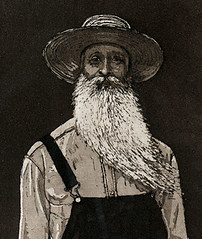
'Beards of the World (detail 2)' - linocutboy on FlickrInterviewed by withremote

Website: www.nickmorley.co.uk
Etsy: www.linocutboy.etsy.com
Flickr: www.flickr.com/photos/nickmorley/
Blog: linocutboy.blogspot.com

Brief Bio

I grew up in rural Oxfordshire surrounded by cows and lawnmowers. Then I went to art school in Sheffield, an industrial city in the north of England. At art school I made a video of Bill Clinton laughing on a 60 second loop and dabbled in painting. I spent a semester in Vancouver in my second year at art school, where I got into etching. After graduating I moved to Vancouver for a year, then London where I worked as a technician in an art gallery or five, continuing to make my own work sporadically. In 2001 I won an award which gave me free access to a printmaking studio in Oxford for one year, where I worked on a series of prints of wrestlers, then I joined East London Printmakers, where I still work. ELP is a printmaking cooperative with 30 keyholder members and 130 associate members. We run a printmaking studio and organise exhibitions, talks, events and so on. I also have a studio of my own where I draw and paint and procrastinate. That is my haven where I can let my imagination run riot without fear of judgement. Last summer I spent a month at Cork Printmakers in Ireland on a residency. I make a living from selling my work in exhibitions and on Etsy, teaching printmaking and doing commissioned illustrations. I have done two book covers so far, one for Penguin and one for Faber and Faber. This is something I want to pursue more seriously in the new year.

'W. B. Yeats book cover illustration, final version' - linocutboy on FlickrWhat printmaking medium do you most often work in, and why?
I make etchings, linocuts, woodcuts, wood engravings and screenprints. I like them all, and when I'm bored of doing one I switch to another! I draw all the time, and drawing is what connects all the work, as well as the fact that I tend to work in series.

How did you get started in printmaking?
I did some on my Foundation Art and Design course before I went to art school proper. I fell in love with etching and the richness of aquatint. I think etching attracts a certain kind of personality! Someone who is quite methodical and careful. However, I know a lot of really experimental, messy etchers, so maybe not... Anyway I fit into the former category.

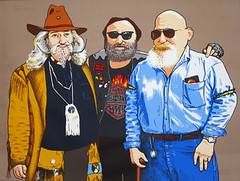
'Beard Competitor' - linocutboy on FlickrDo you find yourself having to explain to your family just what it is that you do, at every family get-together? In other words, "print education"?
No, my Dad's an artist too, and both my parents have been very supportive. I do sometimes find myself explaining how I made a print to friends. Some of my friends have been on the workshops I teach and this makes them appreciate all the effort that goes into making a print!

Describe your creative process.
I scour the internet, second-hand shops, markets and museums for images which interest me. These are usually things which are a bit unusual in some way. Pictures of bearded men, wrestlers and hunters in particular. I then make drawings in my sketchbook. Some time later I'll go back and look at the images that interest me the most and develop them into prints. The nature of the image usually suggests which print process would be most suitable. For instance, if it's got lots of detail I'll make an etching, or if I want it to be big and colourful I'll do a screenprint.

'Shut up and Ride' - linocutboy on FlickrWhat's your least favorite part of the process?
I actually love it all. Even the editioning! I get into a kind of a trance with it and it can very quite therapeutic, although that's not why I do it.

What inspires you?
I'm quite competitive, so if I see another artist's work I admire I'll want to do something as good if not better. I also find good movies inspiring, as well as good writing and music. In terms of what images inspire me, I'm really into old photos, wall charts and postcards. I collect educational and political posters so if I'm feeling bored I look through my collection for a boost of enthusiasm!

How has your work changed/evolved since you started?
It's constantly changing, although the longer I go on making things, the more I see connections in my work going way back to when I was a student. In each new piece I make, I try to challenge myself. For example, I might make the biggest etching I've ever done, or a screenprint with the most colours. I hope my work has improved, but
at the same time what I'm striving for is to recapture the sense of wonder I had as a kid. I use a lot of crayons and felt tip pens. In many ways I draw now the same way I did as a kid. I think it is so important to play. So many adults have lost the sense of what it is to play. You see that spark reignited in them when they are around a kid with a ball or whatever, but most of the time they're in this boring adult world. I'm lucky, I get to play and people sometimes end up buying the results of that!

How do you get past creative slumps?
The periods where I'm not feeling inspired are really tough. These can last from a few days to a few months! Whenever I think about giving it up I think about the alternatives and realise I've got it pretty good - I'm doing what I love and have immense freedom which you don't get in many other jobs!

'Man and Beast, book, front' - linocutboy on FlickrHow do you promote your work?
I exhibit in galleries, take part in craft fairs, try to improve my google ratings by posting my work in as many different places on the internet as possible. I always carry postcards to give to new people I meet and try to keep my mailing list up to date. One of the book cover illustrations I got was from someone I met at a Christmas fair and through Etsy I've got an exhibition in Germany as well as offers
from America. Basically, just putting it out there as much as possible!

Any long-term goals as a printmaker?
To make the perfect print. This is what I strive for every time I start a new one.

And anything else you'd like to add?

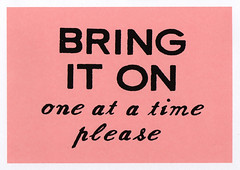
'Bring it On poster' - linocutboy on Flickr
Thanks!

Monday, July 7, 2008

Printsy Interview: Lapwing Printworks - spoonergregory on Etsy

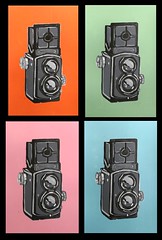
'Four Prints' - spoonergregory on FlickrInterviewed by: Amie Roman

Names: Sarah Spooner & Jon Gregory

Identity on Etsy: spoonergregory

Print studio name: Lapwing Printworks

Website: www.spoonergregory.plus.com

Etsy: spoonergregory.etsy.com

Flickr: flickr.com/photos/spoonergregory/

Blog: forwhatischatteris.blogspot.com/


What drew you into this (some would argue) esoteric art form? Especially wood engraving - perhaps it's more popular in the UK, but wood engravers are not so thick on the ground in my neck of the woods!

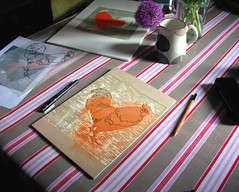
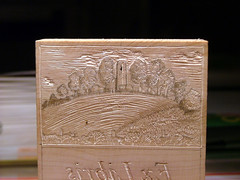
'Engraving St. Winifred's' - spoonergregory on FlickrWe were drawn to printmaking after spending all our hard-earned pennies on prints by local artists, which inspired us to have a go at it ourselves. Our interest in wood engraving was sparked by the engravings of artists like Clare Leighton, Eric Ravilious and Agnes Miller Parker who were working in the 1930s. It can be much more difficult and painstaking work than producing woodcuts or linocuts because of the hardness of the wood and the unusual way in which you hold the tools. But it’s a very relaxing and rewarding process. We’re still learning and experimenting, but hopefully in a few years we’ll be brave enough to submit something for the Society of Wood Engravers annual exhibition.

How long have you been printmaking?

We both did printmaking at school, and came back to it about three years ago.

Were you both printmakers or was it one of you that introduced the other to the art? Do you ever work collaboratively on pieces? If so, how do you co-ordinate that, or does it come naturally?


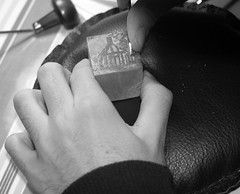
'Preparing to carve...' - spoonergregory on FlickrIt was Jon that decided to pick it up again first, and before long we were both at it, especially after we moved in together and had the space to spread out on a big table. [That sounds quite rude, but I’m not sure how to rephrase it!]

We nearly always help each other with the printing of each other’s blocks, but the designs are our own individual work, and of course we always discuss our ideas and designs with each other. I’m not sure we could work collaboratively on a project without tears and recriminations, but it would certainly be interesting to try…

I love your logo & Lapwing Printworks name; I read the reason on the Crafty Synergy blog, but I'd really appreciate if you could re-iterate your inspiration for the Printsy blog.

When we decided to set up an Etsy shop and re-do our website we decided to have a name that we could both work under. We both like lapwings, which are very common birds in Norfolk. They have jaunty little crests, and a very distinctive ‘peeewit’ call. It just seemed appropriate somehow.

You seem to use a lot of very bold, simple, bright colours & graphic shapes in your work. Is this something that's a product of printmaking & the media you use therein, or is it something that is within you and printmaking is just well suited to express it?

Woodcuts and linocuts are very well suited to bright colours and graphic shapes, which reflect our personal tastes perfectly. We’re always attracted to bright and shiny things, much like magpies. Our colourful and graphic prints are often done straight after a detailed black and white wood engraving – a fun way of recharging our printmaking batteries!

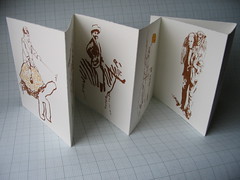
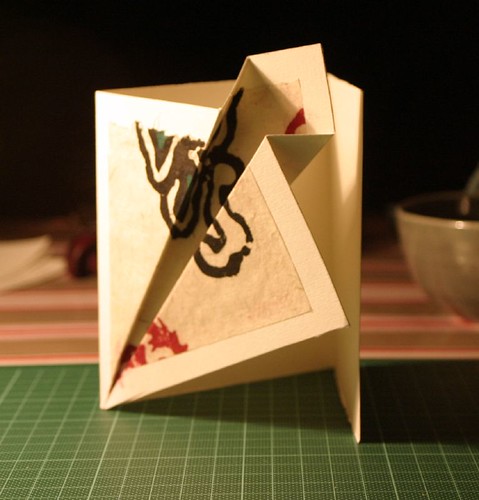
'Card' - spooonergregory on FlickrI'm very intrigued with your wedding invitation prototype referred to on your blog - have you done any more? What were your inspirations? Was it a specific commission or just a nifty idea?

The wedding invitations were actually for our own wedding in January. We knew that we wanted to make our own invitations, and saw a tutorial for these cards in a crafty book.'Confetti' - spoonergregory on Flickr They were quite fiddly to make, but we were pleased with how they turned out in the end. For our wedding we used a square of an old map on the front, with a letterpressed insert inside. We loved the striking folds on the front – much more interesting than a plain card! I’ve made more cards since our wedding, using our own block printed paper for the front. We love buying cards from other printmakers too – it can be an affordable way to buy a little piece of original artwork.

Can you talk a little about your Adana press? Please describe what is letterpress, and how it's different from just "relief printing". Do you have any interesting thoughts on letterpress lore, or what drew you to letterpress printing?

We’ve had our Adana 8x5 for almost a year, and we are still learning! We originally got it with the intention of using it to print wood engraving blocks, which are typically ‘type high’ (the same standard height as metal type). Inevitably we then became interested in letterpress and have gradually been building up a little collection of type and decorative blocks. We are slowly getting to grips with letterpress, and we’re looking forward to using it more in our work.

The principal of letterpress printing is similar to relief printmaking – only using metal type and blocks as well as hand carved blocks. There is lots of information about letterpress on the Briar Press website

Do you have trouble ever getting inspiration?


Sometimes, but a long walk in the countryside always sorts us out with plenty of ideas for several prints. Once you start looking for interesting patterns, shapes and colours in the most ordinary, everyday things around the house there are always dozens of ideas just waiting to be turned into a colourful print.

It seems wonderful that the two of you are so creative & love to work in the same medium - does it ever get competitive or challenging working together, or is it usually a pretty harmonious environment in the studio?

It can sometimes be challenging working together, but we are rarely competitive. When we are both working on our own prints at the same time we are usually too absorbed in our own work to worry about what the other one is doing (apart from getting each other another drink and a biscuit of course). We’re very supportive of each others work, and have learned to accept constructive criticism from each other!
'Bookplate - a closer look' - spoonergregory on Flickr
How do you manage to get commissions?


A combination of word of mouth and luck! We have a page on our website about commissions and were approached in this way for a few bookplate commissions. Since we’ve had our Etsy shop we’ve had our first international commission for a bookplate, which was very exciting.

What are some of the commissioned works you've done?

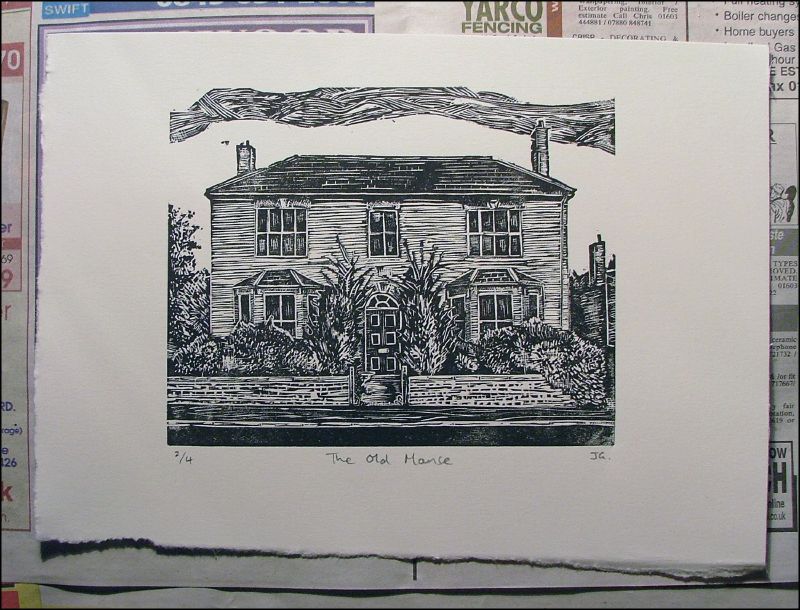
All the commissions we’ve done so far have been wood engravings. We’ve completed several bookplates, which are great fun to do because of the relationship you build up with the customer when creating something so personal and unique. We’ve also done an engraving of someone’s house and the Whippet Ale labels.

At the moment we in the early stages of another bookplate commission, roughing out ideas and sketches with our client before we come up with a final design. This particular one will be based around the landscape and poetry of the First World War – a challenging subject, but a rewarding commission so far!

'Final House Print' - spoonergregory on Flickr
Do you have any favourites? Personally, I love the Whippet Ale label you recently posted about on your blog!


We both chose different ones – Jon’s favourite is the house engraving because it was the first big engraving he did, and it has been one of the most enjoyable to work on. My favourite is the Whippet Ale labels, which is the first time that we have combined letterpress and wood engraving, and we were paid in beer.
'& with these pencils I shall do great things' - spoonergregory on Flickr
Finally, one of your recent prints "& with these pencils I shall do great things" - this image seems to capture the spirit of every artist as they sit down at their desk to work. Do you feel, for yourselves, that this is a motto, an inspiration, or a flog to get you on to work?


It is an inspiration for us – there’s nothing quite a pot of freshly sharpened pencils and a sketchbook to get the creative juices flowing!

Thanks Sarah & Jon - I was delighted at this opportunity to interview you and to get a little better insight into your work.