Friday, July 31, 2009




Monday, July 27, 2009
Printsy Interview - KG Crafts
 Etsy: kgcrafts.etsy.com
Web site: www.kiddergraphics.com
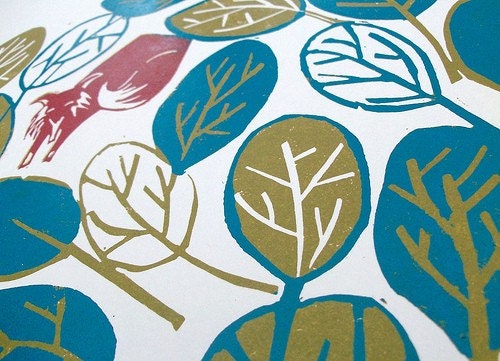
I first became fascinated with prints as a young person by reading illustrated books. I was introduced to the relief printmaking process in print shop class in junior high. I fiddled with it a bit on my own, then I dropped it as I went to graduate school to become a professional philosopher. I was teaching philosophy of art when I began to feel that I needed to develop a “studio side” of my work, so I wanted to return to printmaking. With two small children in the house and no studio space, I began carving small soft block prints at the kitchen table and printing them on a $30 Speedball hand press in the garage.
 To make the hobby pay for itself I put the prints on note cards and joined forces with my sister-in-law, Katie, to sell them in local stores in Seattle, at craft fairs, and online as “Paul Kidder Handmade Graphics.” We’ve been doing this now for twelve years, eventually combining sale of my cards with sale of her sewn creations to become “KG Crafts.” I have done more than a hundred designs and we have sold thousands of cards. We do a brisk business at the Christmas fairs and then I go into a creative slump until spring sunshine inspires me again.
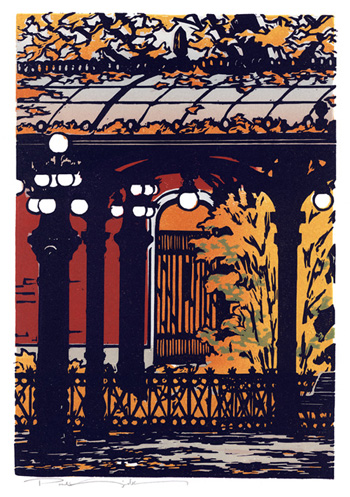
 I always thought that the card prints would function as sketches for larger prints. In a couple of cases that has happened (e.g. the “Pergola” card and print). But for several reasons the cards continue to be my focus. For one thing, retailers always want to see new card designs. For another, I keep finding new challenges just doing the small format with the soft blocks. These prints are all I need to keep being challenged to compose better, draw better, see better, and imagine better. As my little designs have become more detailed, I’ve acquired more of a miniaturist’s imagination. A 7x9-inch print now seems huge to me!
 My work in philosophy of art is complex and obscure; my work in art is simple and popular. I wanted to use my art to connect with people I don’t usually connect with, and to evoke an immediate, spontaneous response from them. I admire abstract and esoteric art, but I have no immediate plans to pursue those styles. I’ll stick with traditional influences of Arts and Crafts and Japonisme, since I am still a beginner in their techniques and vision.
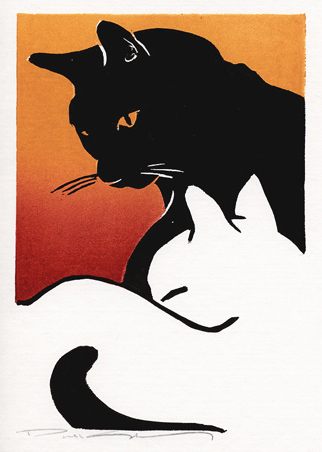
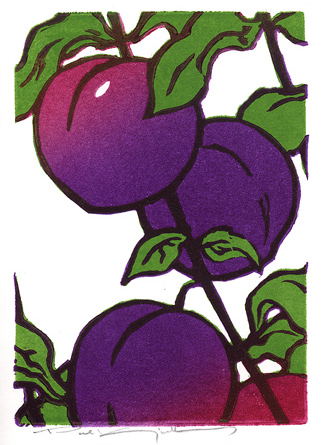
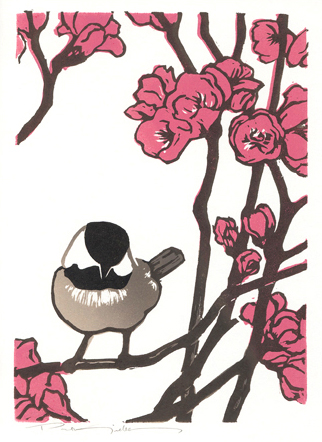
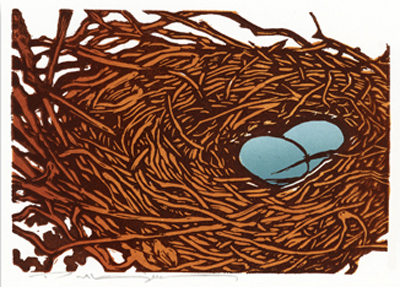
My rule in making the card prints is that I can use no more than two blocks. But I keep trying to get more effects out of the two by using gradients (e.g. “Companions”), multiple colors with small rollers (e.g. “Chickadee in Quince”), color blending with transparent inks (e.g. “Dark Plums”), and masking (e.g. “Nest”). I draw my design in pencil, then lay the drawing on a block and rub the back. After this, there’s still enough pencil on the drawing to transfer it again onto a second block, so I can carve the same picture differently on the two blocks. I register with three nails as a guide. I prefer Daniel Smith and Graphic Chemical Ink Co. water soluble inks.
 I am honored to share space with the wonderful printers of Printsy. Your work is inspiring and your dedication is encouraging. In an age when mechanical and digital reproduction has all but wiped out appreciation for handmade print arts, you keep alive the humanity of this ancient and venerable craft.
Who's Printsy This Week





Sunday, July 19, 2009
Printsy Interview - Lori Dean Dyment
Website: web.me.com/jfdyment/Lori
Etsy: DeanDymentStudios.etsy.com
Flickr: flickr.com/photos/ldeandyment
Artfire: http://DeanDymentstudios.artfire.com
Blog: ldeandyment-soiwasthinking.blogspot.com
How did you get started in printmaking?
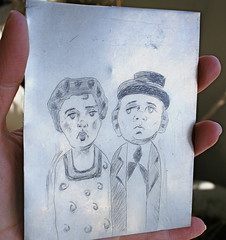
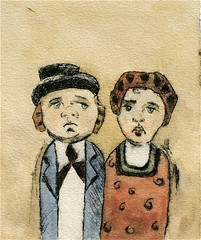
I attended Emily Carr Institute of Art and Design and saw a fourth year student demo silkscreening when I was in first year. I had planned to do graphic design when I entered (the profession that was the safest to pay the bills) and I ended up doing a painting and printmaking major. I was frustrated with the painting instruction I was getting and decided to make use of the printmaking equipment while I had it. A fellow printmaking student was doing reductive monotypes and showed me some techniques. I was hooked right away as it was a wonderful halfway medium between oil painting and the technically intense intaglio. I have been doing monotypes on the same steel plate for over sixteen years now.
Describe where you work:
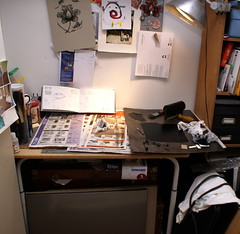
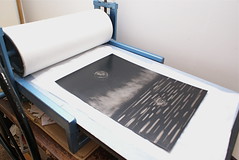
The extra bedroom in our apartment is the studio that I share with my husband who is a painter. I have a custom press that I keep on a sturdy desk. My mother in-law gave me the press as a wedding present and it has worked really well. Like most artists, I feel like it’s too small and cramped. My work table is stuffed in the closet and is way too low for me to work standing up which is what I need to do when working on a monotype. My studio wish list also includes proper lighting because I end up in the studio once the kids are asleep. However, I’m really glad that I can work in my pajamas if I want to and that I don’t have to commute to some industrial area while paying a fortune in studio rent. You take what you can.
What is your favorite printmaking process?
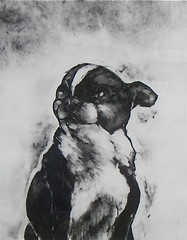
I have to say that reductive monotypes are my favorite although I also really enjoy linocuts, drypoints and collographs. I feel monotypes are closer to painting and so very immediate and spontaneous. I love all the happy accidents that happen when I start pulling away the ink. The beautiful and velvety blacks are a big draw too. I’m finding that I’m trying hard to leave larger areas of untouched ink just so I can see a fully printed black. I use Charbonelle intaglio ink and it’s just beautiful.
 What’s your creative process for any given print?
All my work is based on drawings in my sketchbook. I go through spurts of drawing and then I go through my images and decide if any are worth working on in a print format. If the drawing is not detailed enough then it won’t make a very good print. I used to rely heavily on reference material for inspiration but as of late, I’m creating images that just come to me and are more intuitive. I’m really enjoying the variety of work I’m doing.
What do you enjoy most about printmaking?
This is a tough one. I really like creating the image on the plate and coming up with a little story to go with it while I’m doing it. But I also really enjoy seeing what the monotype looks like once it has been printed. The paper is white and my plate is grey, so along with the oil content of the ink, the pressure of the press, and the dampness of the paper there are quite a few variables to make the final print a surprise.
What’s your least favorite part of the process?
Besides cleaning up I have to say that I don’t really enjoy inking up and wiping plates or hand rubbing linocuts.( I’m trying to figure out how to do that on my press)
What are your inspirations?
I’m inspired by so many different things but I seem to gravitate to animal and nature imagery and anything to do with children. I just love looking at children’s books and I would love to make a career of illustrating for children someday. I still remember some of the books I read when I was younger based on the images only. I’m finding plenty of inspiration from other artists work now that I’m more present online. Nothing makes me want to create than seeing wonderful artwork.
How has your work changed and evolved since you started?
I had a harder time coming up with imagery when I was in art school and was afraid of what people thought of my work and if it was “commercial” looking or not. Over time I have found that my list of goals, images and ideas surrounding my artwork has grown exponentially. Now that I have very little time to create I have so many ideas to work on. Now I’m starting to work on the same image but in different mediums to see how things turn out. I’m also trying to work on things as a series which is something I would never do before. It always seemed boring or obsessive compulsive to me.
How do you get past creative slumps?
Whenever I haven’t been in the studio for awhile I get really nervous and start finding other things to do, like the laundry. I find that if I just start drawing in my sketchbook without any expectations that I will loosen up and things will just start flowing. The flip-side is that once I start working regularly in the studio, other things like my job seem frivolous and a waste of valuable time. I end up craving to be in the studio even more.
How do you promote your work?
At the moment I’m trying to get more of an online presence because that seems to bring me the most viewers for the lowest cost. I recently had a gallery show and it cost me a mini-fortune in mats, frames, time off, etc. I’m showing my work on Etsy, Artfire, Indiepublic, RedBubble, Imagekind, HandmadeByMe, Fickr, my blog and a couple other artist community sites. It’s been great for connecting with other artists and so many people are willing to provide help or advice if you need it.
I hope to get involved in a local Etsy sale if it fits with my work. I’m still coming up with plans to provide my work in a way that’s affordable to my target market. Stay tuned for art pendants, digital prints, cards, magnets, and buttons.

Any other comments or advice for others who want to try making hand-pulled prints?
Experiment with low tech methods such as linocuts that are hand rubbed before investing in too many tools. I have a lovely mezzotint rocker that is just collecting dust. My other suggestion is to take a printmaking course at the local art school where you’d get a feel for the tools, equipment and techniques.
Friday, July 17, 2009
Who's Printsy This Week






Printsy Interview - Jennifer Mackie
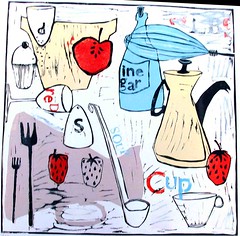
Flickr: flickr.com/photos/jenmackie/
Blog: verylittlebird.blogspot.com
Etsy: littlebirdesigns.etsy.com
Between 1998 and 2003 I studied an undergraduate degree in Illustration and Printmaking and then a Masters Degree in Design. Since graduating I have taught at both college and university level. I live in a small village at the mouth of the river Tay in Scotland.
Printmaking was embedded in the undergraduate degree I undertook and although it was the illustration side of the course which initially attracted me I quickly came to love printmaking and have never looked back.
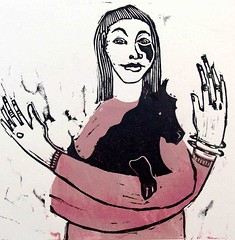
I am fortunate enough to have access to large printing presses through the local university so I can use them for the actual printing of my work and I have a (very) small space at home where I work also. I really enjoy that space, since it allows me to get up and walk away from my work when I need to but know that it is right there as I left it when I am ready to go back to it. Also I am lazy and hate clearing things away and this space means I can be messy and just claim that I am being creative.
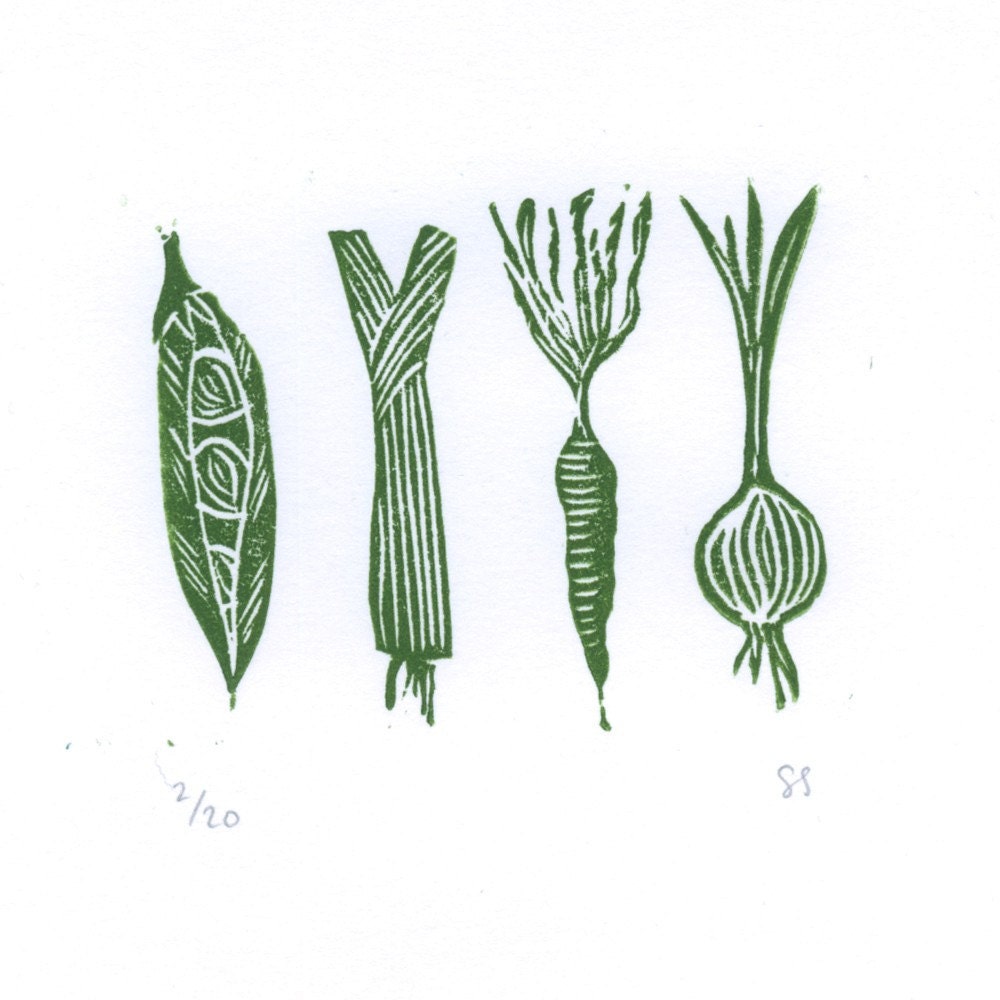
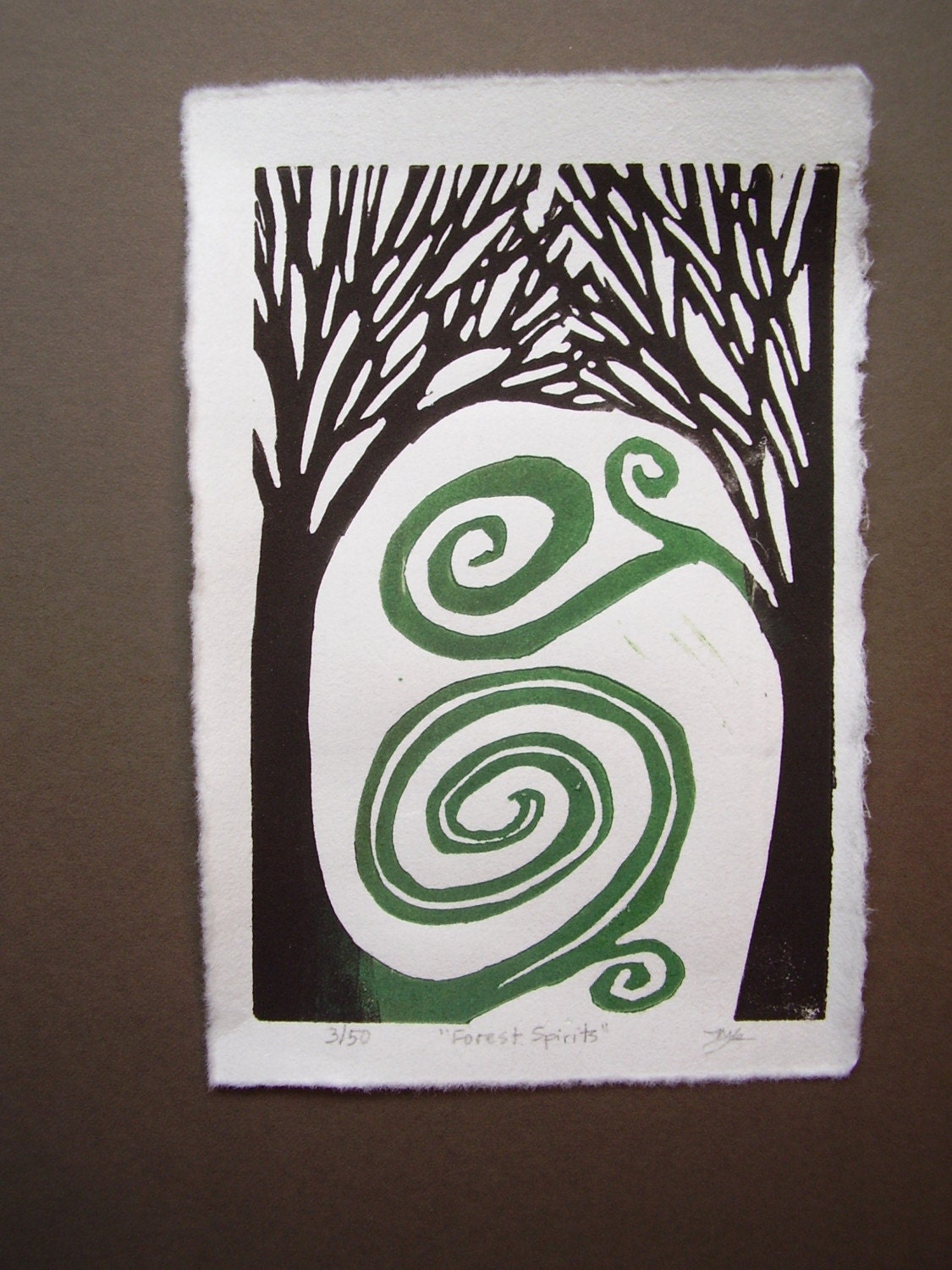
I love relief print making, the first time I felt the thrill of peeling back the paper from the linoleum to view the image that I had made, after it had gone through the press, was so addictive I knew I would never grow tired of it.
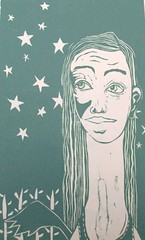
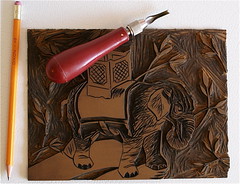
I keep a sketchbook to hand at all times and all of my ideas, inspirations and insights are recorded in it. From there I select the images that I think will work as prints and develop them further if necessary. I transfer them on to linoleum using old fashion carbon paper, I can rarely get the composition exactly right otherwise and then something of the essence of the original drawing is lost.
Then I cut the linoleum but often add details at this stage which were not in my original drawings simply because they suggest themselves to me when I am working with the linoleum.
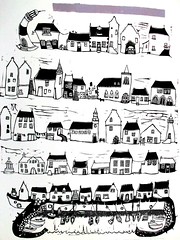
After all these years I still forget to reverse any lettering included in the print but I have learned to accept that it is all just part of my style
From there I ink up the piece of linoleum and print. Et Voila!
Well while I’m cutting I think that I love the cutting stage best. Then when I’m mixing inks or inking up I think that I love that stage best, and finally when I am doing the actual printing I think, oh no I love this bit best!
The truth is I love it all.
Except the cleaning up stage! Did I mention how messy I am?

I think that which inspires me most is story telling and narrative, both spoken and written. This probably stems from my love of stories, books and the types of illustrations, which accompany them. I love nothing better than finding a beautifully illustrated book or hearing a wonderful story.
I’d like to think that all of the time I am learning and advancing my craft. Occasionally I will finish a piece of work and feel that I did it to the best of my abilities and be very happy with it but usually I wonder if I had changed this or that would it have been more successful and this kind of questioning always propels me forward in my work.
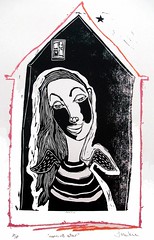
I just let time take it’s course and find that although there are times when I am not very creative it passes and I seem to have renewed vigour. I always think it is kind of like a fermentation process and that every now and again I need to let things stew.
In general I don’t promote my work much, I am really hopeless at it. It is a wonder I sell a thing!
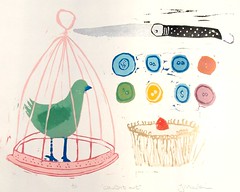
My advice to anyone who wants to try relief printmaking for the first time is have a go! It really is a very simple process and although you must be careful not to hurt yourself with the cutting tools (I have countless wee wounds on my fingers!) the results will be well worth it I assure you. There is something so immediate and rudimentary about relief print making it is very satisfactory.
Subscribe to:
Posts (Atom)