Showing posts with label graphic. Show all posts

Sunday, July 18, 2010

Printsy Interview - Shawna Munro

Etsy: etsy.com/shop/dinexdashed
Website: www.dinendashed.com
Flickr: flickr.com/photos/dinexdashed

Brief Bio
I recently graduated from the University of Windsor's Bachelor of Fine Arts program. I've applied to several graduate programs for Fall 2010 and am keeping my fingers crossed that I get in! I enjoy making all kinds of art and don't consider myself stuck in one particular field.

How did you get started in printmaking?
It started with making my own clothes. I always thought of interesting ideas for tshirts and thought "why doesn't anyone make that a shirt?" and since no one ever did, I thought "well, I'll just do it myself!"


I started making/selling stenciled t-shirts/hoodies for people on the internet, friends, etc. Eventually I got my own little silkscreening kit and started using that instead of freezer paper. When I started University, I began taking printmaking classes and learned about lithography, intaglio, embossing, etc.

Describe where you work.
Right now I am a professional note taker. I take my laptop to meetings and type the minutes. Its not very much fun, but it affords me a lot of time to work on my art.


What's your favourite printmaking process?
Definitely silkscreening. I appreciate the intricacies of all the other processes, but something about silkscreening and how clean it comes out is so nice. I think a part of it, for me, is my love of old concert posters. They were all silkscreened (by hand!) and they just remind me of a great history.

What's your creative process for any given print? (eg. sketch first? Pre-planned or free-form?)
Pulling the print of course! Printing is such a laborious process, but its all worth it when you roll out that ink and pull a sweet print.

What do you enjoy most about printmaking?
The process. Its not an easy one, it takes a lot of time and patience. If you're in a bad mood, the ritual of it helps take your mind off things.

What's your least favorite part of the process?
Cleaning up of course! Using kerosene to clean makes me a bit nauseous, so I try to avoid that.


What are your inspirations (other artists, people, places, events, etc.)?
Kelly Mark, Diane Borsato, Van Gogh, Goya, and so many more.

How has your work changed and evolved since you started?
I used to be very cautious, but at some point I kind of got past my nervousness about drawing and being perfect and just went with it. Now I feel the work is more of me and less hesitant.

How do you get past creative slumps?
I read various blogs, look at other people's work, listen to music, take a walk. There are so many things out there that give me little sparks of an idea. I try to put down those ideas as soon as I can so I don't forget and eventually something forms from them.


How do you promote your work?
Very badly, haha. I have an Etsy, a Flickr, and a blog with my Portfolio, but so far I haven't had much luck having my work seen or sold. I probably need to take better pictures of my stuff.

Any other comments or advice for others who want to try making hand-pulled prints?
Don't be discouraged if you pull 40 prints with not a single good one in the bunch. Roll out your ink evenly and just keep trying because eventually you'll pull an amazing print and it'll feel AMAZING.

Sunday, July 4, 2010

Printsy Interview - Dormain Geyer

Etsy: greenballoon.etsy.com
Blog: dormaingeyer.blogspot.com

Brief Bio:
I was born in San Francisco and grew up in the East Bay. After graduating UCLA, I moved back up to SF and have been there ever since. I work long hours at a boutique investment bank, so I'm happy to be able to do any printmaking at all!


How did you get started in printmaking?
I was fortunate enough to go to a high school that had a press and we had to do a unit on printmaking (monoprint, linocut and etching/aquatint) each year of AP Art. I didn't have access to a press in college, but as soon as I was settled in SF, I signed up for classes at City College.

Describe where you work:
I take classes through City College at Fort Mason, which has had printmaking facilities and classes for over 30 years. The Saturday class has a lot of working professionals like myself, so there's a lot of camaraderie.

What's your favourite printmaking process?
Lately, I've been really embracing linocut work, especially multiple-plate linocuts.


What's your creative process for any given print? (eg. sketch first? Pre-planned or free-form?)
I usually work from photos, tracing out the key shapes and allowing for some abstraction.

What do you enjoy most about printmaking?
I love the iterative process and being allowed to experiment as I "perfect" a piece.

What's your least favorite part of the process?
Needing access to a press will always be a limitation, but at the same time, being forced to go out and find common resources leads to joining a community. Also, taking classes forces me to stay consistent - I've never been productive at home!


What are your inspirations (other artists, people, places, events, etc.)?
I started getting into printing small books, which led me to take some classes in letterpress and bookbinding at the San Francisco Center for the Book. A project I really want to take on is creating a graphic novel- type book.

How has your work changed and evolved since you started?
I used to move from technique to technique and there wasn't a cohesive style and I'm focusing more on developing that signature look. I also used to do more portraits and I'm doing more buildings and scenes now.

How do you get past creative slumps?
If I'm not sure what to create, I focus on how to create. Spending a little time focusing on technique can often jump-start my imagination for a new project.


How do you promote your work?
Most of my sales are at the annual Holiday sale put on by the Fort Mason studios. I'm beginning to list some of my work on Etsy, but I've really only just started that. Almost a year ago, I started a blog to document some of my projects, but I do very limited promoting right now.

Any other comments or advice for others who want to try making hand-pulled prints?
Take a broad-based class and try a bunch of the techniques.

Sunday, June 27, 2010

Printsy Interview - Beside Herself

Name: Beside Herself, a collaboration between Toronto printmakers Alda Escareño and Carolyn Self


Website: www.besideherself.ca
Etsy: www.besideherself.etsy.com
Blog: www.beside-herself.blogspot.com
Flickr: www.flickr.com/photos/beside-herself


Brief Bio
While we’ve both had artsy inclinations from a very young age, Beside Herself is really only a few months old. We met each other in university when we were studying fine art with a focus on print media. In that time we became familiar with each other’s work and working habits. We started working in collaboration once we graduated. Beside Herself wasn’t something that we really planned, but rather something that slowly evolved on it’s own.


How did you get started in printmaking?
Carolyn: I have three brothers and grew up in a small town, which means I had to entertain myself while growing up. Most of the time this meant working with my hands to make paper dolls and games to play with. I spent a lot of time on my own filling sketchbooks and sewing clothes. In high school I taught myself to screen-print so that I could print my own fabrics, and became obsessed with my new potential for making multiples of all kinds.
Alda: I was born in Mexico and I feel that a lot of my draw towards art and crafts comes from being surrounded by traditional Mexican crafts when I was young. I discovered printmaking for the first time when I discovered the Mexican-revolution time woodcuts of José Guadalupe Posada. Inspired by his day of the dead prints, I taught myself relief printing in high school. I haven’t stopped printing since.


Describe where you work.
We work out of a tiny studio apartment that has been manipulated to meet our needs. Almost everything is done in this space including screen-printing. We store light sensitive screens in a linen closet, expose them with a hooded lamp under a worktable and wash them out with a garden hose in the bathtub. When we need a press we rely on public studios. We don’t have a lot at the moment, but we manage with what we have. While we do dream of the perfect studio set-up we are also motivated by the challenge to create large editions from limited means.


What's your favourite printmaking process?
It’s hard to pick a favourite… we’re working a lot with screen printing lately, but this has more to do with the set-up that we have in our studio and the flexibility it gives us for the work we want to make. We would really like to be able to do more relief and are working to get a press. For now, screen-printing definitely satisfys our creative impulses. We love that it lends itself to printing on nearly any surface: wood, fabric, paper, 3-d or 2-d. Screen-printing enables us to create almost any image or object. Everything can be printed.


What's your creative process for any given print? (eg. sketch first? Pre-planned or free-form?)

Our creative process begins with an idea. One of us will come up with something and throw it out for discussion. If the idea passes this test, we scribble it on a big white board on one of our studio walls and continue talking about it until we have time to begin a new project. Through discussions, the initial idea is molded into something mutual. Once we have a clear understanding of what our idea is, we move into an exploration of materials and the more practical brainstorming of logistics. From here things can go in different directions.


Both of us are capable to doing all aspects of the work we make so pieces develop intuitively. People always ask us what each of us contribute to a given work. I think it is safe to say that we feel like equal parents to all of our pieces even when one person's hands have touched it more than the other's.


What do you enjoy most about printmaking?
The multiples. There’s something incredibly satisfying about having a finished stack of prints you’ve been working on for a while. We usually find ourselves literally surrounded when we are waiting for a big edition to dry. It’s pretty magical.


What's your least favorite part of the process?
Printmaking has its challenges, but even those seem to stand in harmony with the overall process. As we’ve moved towards creating larger editions more frequently, however, we feel a little set back without the right equipment. Printmaking requires a lot of big expensive equipment.


What are your inspirations (other artists, people, places, events, etc.)?
We’re inspired by a lot of things… here’s a few.
Paper, printed ephemera, handcrafting traditions, fashion, interior and industrial design, packaging and merchandising, dancing, mass production, innovative installation, material potential, simulacra, diy, music, mortality, humor and more.


How has your work changed and evolved since you started?
We haven’t been at if for that long, but we feel that as we spend more time on Beside Herself we tend to incorporate a thoughtful consideration of how we hope to sell the work we make (where? To whom? etc.). We would love to be able to do this for a living and this requires some business considerations. This is all new to us.


How do you get past creative slumps?
It helps to be working with someone else to avoid any real slumps. We bounce ideas off each other constantly. Even if the ideas start off really bad, they do eventually become something good just through talking about them and exploring them.


How do you promote your work?
At the moment, we’re using the powers of the internet (website, etsy, blogspot, facebook etc.) and our own networking. It’s not much, but we haven’t gotten to the point where we can think about advertizing or anything like that.


Any other comments or advice for others who want to try making hand-pulled prints?
So often we have to explain what printmaking is, that we actually get giddy with excitement when we talk to someone who knows what it is and is interested in trying it out. If someone out there is curious about printmaking, they should look-up a local workshop which will provide all the basics in a given technique. When it comes time to setting up at home, look around the internet for guides on home studios or ask a print artist who is farther along.

Sunday, May 2, 2010

Printsy Interview - Ben Kafton

Etsy: delaflamant.etsy.com
Flickr: flickr.com/benkafton

Brief Bio
Ben Kafton is 20 years old and has taken a few college courses here and there. Most of his work combines color and graphic design elements including architecture, diagrams, and quite a bit of photography motifs. He currently lives in Northern Utah in a small rural town.

How did you get started in printmaking?
When I was about 5 years old both of my parents owned a printshop for a few years and they had an old letterpress that I was fond of. My father has been an offset printer for over 20 years, so it seems I have always had a love for paper and printing.

My personal start with printmaking came after a friend of mine in high school began screen printing, and I decided it was something I wanted to get into. Between learning from my friend I taught myself everything else by reading instructional books and watching various videos.

Describe where you work.
I currently work outside of my bedroom. I have built in cabinets with an added counter top. The counter doubles as a place to draw and design from as well as laying out all the paper and inks to create my prints.
What's your favourite printmaking process?
I have only tried linocuts and screen printing. Currently it is definitely screen printing, but would really like to learn other methods of the printmaking process.

What's your creative process for any given print? (eg. sketch first? Pre-planned or free-form?)
Almost everything is pre-planned with a sketch but I am also one who likes to experiment. At any given time, I usually have quite a few screens lying around that still have an image exposed in it. I will take that screen and a few others and just free hand a unique composition of some kind.

What do you enjoy most about printmaking?
I like how much of a solid color you can produce really quickly with just a swipe of ink. I like being able to produce the same image over and over, but still able to switch things up and add various things to each print to make each piece original. I really enjoy mixing inks and coming up with a interesting color pattern. Lastly, I enjoy how therapeutic it can be when printing and pulling the squeegee across over and over.
What's your least favorite part of the process?
It is definitely cleaning up, and washing the screens out!

What are your inspirations (other artists, people, places, events, etc.)?
I have quite a few inspirations. Lately I have been drawn to graphic design artwork found in old 1940 - 1960’s Art magazines namely Graphis as well as West Vaco Inspiration for Printers. In addition, I am very fond of gig posters that other artists have screen printed for a variety of different shows, I love looking at typography and its use in a given composition.

How has your work changed and evolved since you started?
At first I would just draw things and screen print them for no rhyme or reason. Now I like to draw things, decide whether I should keep it or not. If I end up keeping the drawing I will usually draw it again, and make it a lot more interesting and add more elements.
How do you get past creative slumps?
Lately I have not had as many creative slumps as it were. I have read quite a few things about productivity and creativity. One thing that has stuck with me has been to try and create a routine of some kind each day where I will draw or design something at a particular time. With that being said though there is still quite a bit of spontaneity in my work.

To answer the question though, I have quite a few art books that I will take a look at, go for a walk and take a few photographs or watch an episode of “Alfred Hitchcock Presents.”

How do you promote your work?
Mainly just through Etsy, but I try to add things daily on Flickr. I have also been to a few art and craft fairs. I am planning on selling my artwork at various events this year including Renegade Craft Fair. Other than that, I also screen print t-shirts and wear my designs almost on a daily basis.
Any other comments or advice for others who want to try making hand-pulled prints?
For me personally it is the single greatest thing that I have ever learned to do. If you have an itch to try, definitely try it out. Take a class and learn, learn, learn and then create away!

Sunday, April 25, 2010

Printsy Interview - Kelly O'Keefe


Blog: http://crumbsbutter.blogspot.com/
Etsy: kelokeefe.etsy.com

Brief bio:
Born in Plattsburg, New York in 1969, I moved to Northern California in 1976. and have called Berkeley home since 2002. I have a BA in English and Sociology from U.C. Davis. I have been cutting and pasting paper and words since my journalism days in high school and college. I discovered screen printing in 2008 and am thrilled by the possibilities of the medium.

My fondness for screen printing stems from being able to readily see the hand of the artist in the end result. Each print is unique with it’s variation in image placement, ink color and background. The story told by the piece can be altered by making small adjustments during the printmaking process. Ink splatters and image over lays only add to the quirkiness of the piece.


How did you get started in printmaking?
I took a screen printing class at Richmond Arts Center and was so taken with the process that I became instantly obsessed with screen printing. My teacher, Thilde Weems, has provided endless support, instruction and encouragement.

Describe where you work:
I have a micro-studio in my house where I print along with a darkroom for my exposure unit. It is a cramped space but I love being able to work at home whenever the urge strikes. I make a huge mess-- the wash out sink is in the laundry room so that room looks like a crime scene with drips and splatters on every surface.


What is your favorite printmaking process?
Old fashioned screen printing using a photo emulsion process and printing on paper.

What's your creative process?
I start with a rough sketch or a blocky collage of the image and refine the layers from there as I decide which portion can stand alone in the print.

I don't work digitally so it is pens, paper and rubylith!

What is your favorite part of the process?
I love the moment, post-burning, where the emulsion is being rinsed out of the screen and the image starts to peek out from the screen. The printing possibilities are just surfacing and all is new and fresh!


What is your least favorite part of the process?
I hate when I go one step too far- meaning that I keep adding layers to a print when I should leave it alone!

What are your inspirations (other artists, people, places, events, etc.)?
I am turned on by old junk, wrecked stuff and all matter of garbage. I usually hit on a composition and then make choices based on the possible overlaps of images within the composition. So much of my printing process is trial and error and then an "Aha" moment hits and I fall in love with the artwork.


How has your work changed and evolved since you started?
I seem to be slipping from an old-timey vibe into a more "street" or tough spirit. We'll see how it goes. Folks don't seem to respond as readily to the more mod stuff but I'm loving it!

How do you get past creative slumps?
I don't dwell on the down periods because they always lift and I am off and running again! Usually a little day trip somewhere cures the dry spell. I live in Berkeley so there is always something great happening that puts the spark back in my head.


How do you promote your work?
I use the internet, my blog and local venues for my promotional stuff. My New Year's resolution is to do more in that department.

Any other comments or advice for others who want to try making hand-pulled prints?
Jump in--the water's fine!

Sunday, April 11, 2010

Printsy Interview - Molly Bowman

Etsy: printsbymrb.etsy.com
Flickr: flickr.com/photos/printsbymrb

Brief Bio
I am a research assistant on a public health career path but spend most of my free time covered in block-printing ink. I spent a few perilous years in New York City trying to "realize" my love for art by settling for a publishing job that really just involved photoshopping celebrities. Last summer, I quit my job, packed my belongings into my car, and moved clear across the country to Portland, OR. Here I am finding a slower pace of life, a wonderful artistic community, and the understanding that art is a personal process, not a commercial one.

How did you get started in printmaking?
I started loving printmaking at age 3, when my father carefully dissected Mary Azarian's "Farmer's Alphabet," a beautiful book of rural woodcuts, and taped them all over the walls of my room. Like many American children, I was trusted with my first linocutting tools in elementary school art class. I remember it vividly: the activity we did while the teacher stood by with a first aid kit, warning us repeatedly to cut our little rubber block by motioning the blades away from ourselves, and finally kicking Tommy out of class for threatening to deface Rachie’s American Girl Doll. I remember gleefully lifting my paper from the block, and becoming crestfallen as I realized that the letters I had carved so perfectly were printed backwards. A few attempts later, I had figured out the reversal process couldn't stop printing.
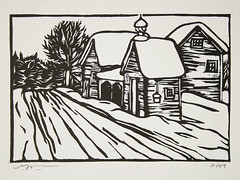
While trying to survive the bustle of NYC after years of printing abandonment, I decided to give it another shot. I bought some plastic carving tools, a couple of blocks, and discovered that it was just as rewarding as I remembered it.

Describe where you work.
I work all over my tiny apartment. I have a designated printing table in a small nook, but it's often overflowing with supplies and prep for art fairs. I print on the coffee table, the kitchen counter, the dining table, the floor, the desk, and sometimes actually on my printing table. Really whichever 2'x2' space is free and flat.

What's your favourite printmaking process?
I can't resist linocutting - it is such a smooth, cognitive process. I often find that I marry whatever I've been listening to - radio stories, song lyrics, etc., with a particular part of a carving. For instance, I recently carved an anatomical heart, and can still hear the NPR Talk of the Nation discussion I was listening to as I carved the pulmonary arteries. I have plans to build up the courage to venture into woodcutting, but so far am so satisfied with linocutting that I can't seem to make the switch.
What's your creative process for any given print? (eg. sketch first? Pre-planned or free-form?)
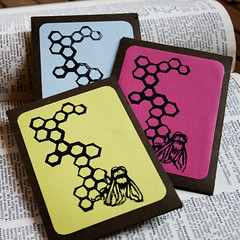
After my sad experience in grade school where I forgot to reverse the letters in my carving, I developed a technique to make sure that all my prints are printed as originally envisioned: I sketch in pencil on tracing paper, then press the tracing paper - graphite down - on linoleum and bare down with a pencil to transfer the drawing to the block. My carving is based on the transferred pencil marks (with some liberties taken). My prints are usually hand-pressed (as in, with my fingers) - though I have a baren (a pressing tool) in an attempt to reduce wrist strain, I just love the feel of the block under the paper and usually the baren stays in a drawer.

What do you enjoy most about printmaking?
I love it all, but I think my favorite part is inking a block for the first time. I absolutely adore the tacky sound a brayer makes rolling in ink (I've been known to roll it back and forth much longer than necessary). When the brayer rolls across the ridges of the linoleum for the first time, I get giddy to see what used to be a flat drawing realized in three dimensions.
What's your least favorite part of the process?
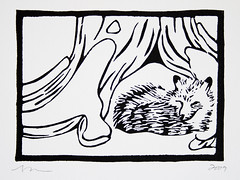
I wish that I could keep calm while carving. When I carve too quickly, I inevitably slip and take off a piece that then takes forever to glue back into place and recarve. Carving is such an exciting process that I can't help but get a little over-zealous. Kind of like when you have something wonderful to drink, can't contain your excitement, and spill some on your shirt.

What are your inspirations (other artists, people, places, events, etc.)?
As a kid, I was stunned and inspired by the printed political posters made Bread & Puppet-style artists. Their simple sylvan designs were screen printed onto linen in vibrant colors with few well chosen words expressing disgust with politicians, hope for change, and love for the simple pleasures. Mary Azarian, a woodcutter from Vermont, has been formative for me with her intricate, hand-colored images that reflect much of my rural childhood. Sabra Field, also a woodcutter from Vermont, has reminded me that simplicity is key in communicating sweeping emotions. And lastly, despite my recent move to the Northwest, I can't help but draw continued inspiration from the "clean dirt" feel of rural Vermont, where I was born and raised.
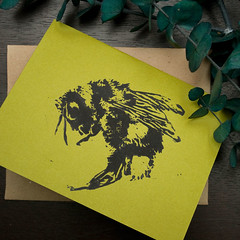
How has your work changed and evolved since you started?
It hasn't been long since I decided to embrace the term "printmaker," but I have recently noticed a sense of confidence in my designs that wasn't necessarily there before. At first, I relied a lot on the unexpected elements of printmaking to make my carvings interesting - maybe I had pressed the paper with different weights which lent a mottled effect, or I forgot to carve some areas deeply enough and the resulting print had a darker feel than I had planned. Now I have a better idea of what works and what doesn't, and most of my prints are quite purposeful.

How do you get past creative slumps?
I am guilty of long slumps. Eventually, though, I'll start feeling anxious that I haven't printed lately, and begin to reconsider my surroundings. I'll try to see everything as a carving - the trees and dogs in a park, my kitchen, a lamp. I enjoy working in series, so if I find one possible carving, I'll often be able to extrapolate that to other similar carvings in content or style.

How do you promote your work?
Most of my promotion is online - the usual social networking sites and Etsy, primarily. I've attempted a blog but put it aside due to lack of inspiration - I felt inspiration was better spent carving. I'm working up the courage to contact local commercial establishments to carry my more marketable products - greeting cards, for instance. And lastly, I'm working on a set of prints that could be sewn into a children's book. I'm hoping that venturing into publishing might expand my scope a bit.

Any other comments or advice for others who want to try making hand-pulled prints?
Any artist who has ever felt a pull to work with his or her hands will feel completely at home with some carving tools and a block. The tactile elements of block printing are wonderful, and the serial nature of the work allows an immense satisfaction. Just make sure to have plenty of band-aids handy!

Sunday, April 4, 2010

Printsy Interview - Anna See

Website: www.annasee.com
Etsy: www.annasee.etsy.com
Blog: www.annasee.blogspot.com
Flickr: www.flickr.com/photos/anna_see

Brief Bio
For as long as I can remember, I have always turned to art as a means of therapy, entertainment, expression, and an outlet for creativity. After a brief stint studying art history, I realized I missed actually doing art and enrolled and recently graduated from Art Center College of Design. I am now currently embarking on a career as an illustrator and designer.

How did you get started in printmaking?
I discovered it by accident actually. After completing a very small run of a linocut image on a Vandercook press for an assignment my final term at school, I realized that I really liked the result and sought to replicate that post-graduation without access to a letterpress. Thus, I experimented and taught myself how to achieve that result via printmaking without a letterpress.

Describe where you work.
I work on my kitchen table, at my drafting table and at my computer in my small cozy apartment....eventually taking over the whole place with prints at various stages of drying!


What's your favourite printmaking process?
Given my limited experience with more formal printmaking techniques, my favorite would have to be my self-taught method with linocut blocks in which I roll the ink on the block and transfer it to paper via burnishing with a large metal spoon.

What's your creative process for any given print? (eg. sketch first? Pre-planned or free-form?)
I usually have a vague idea beforehand of what I want to create. What I have seen, like a particular kind of bird for example, inspires what I will make. I sketch an image first, working from reference as to ensure accuracy, then scan it into Adobe Illustrator, using the sketch as a template. I then refine and simplify the shapes, play with color, then resize and print it out. I use this to transfer the image onto the linoleum block with graphite (Saral paper). I carve away! Once I'm done carving all the blocks, I mix the colors using my Illustrator printout as a guide and roll out the colors and burnish to transfer onto paper.


What do you enjoy most about printmaking?
The satisfaction of a beautiful finished print is what I may enjoy most but I really enjoy the whole process. I enjoy the patience, concentration, diligence, and often caution it requires as it forces you to slow down and think ahead yet be thoroughly involved in the moment so as to ensure a good print. It's thoroughly therapeutic, like knitting!

What's your least favorite part of the process?
Cleaning up!

What are your inspirations (other artists, people, places, events, etc.)?
I am greatly inspired by nature, specifically what I see in nature, the colors, the shapes, everything, including all kinds of animals, people and the human form. I also am inspired by artists too numerous to name all but I love Mucha, Gaudi, all Art Nouveau, Da Vinci, Poiret, Erte, fashion illustration, Hokusai, Hiroshige, Japanese wood block prints, Charley Harper and the vintage graphic aesthetic. But, honestly, anything and everything can be a source of inspiration!


How has your work changed and evolved since you started?
I think my work is always continually evolving but I've definitely become less timid with my color palette and shape design. I'm relying less on my digital skills and more on my traditional skills and letting that show through. I'm including more texture and pattern and am becoming more intentional with the placement of color and other elements.

How do you get past creative slumps?
I let it rest or "sleep on it" and work on something else or start something new, often in a non-printmaking medium. Hopefully, when I've taken enough of a break from the piece, I am able to come back to it with a fresh set of eyes and get past that slump. There are always simultaneous art and non-art projects going on.


How do you promote your work?
Networking, word-of-mouth, passing out business cards and postcards, participating in competitions as annuals are great advertising and exposure, selling my work at art fairs and Etsy, giving my work as gifts, and having a web presence with my website and blog so people interested in your work can easily find you.

Any other comments or advice for others who want to try making hand-pulled prints?
Just have patience and persevere as it's a lot of trial and error, but the end results are well worth it! And just have fun with it!

Sunday, March 21, 2010

Printsy Interview - Stacey Bradley

WEBSITE: www.perlaanne.com
BLOG: www.perlaanne.blogspot.com
ETSY: www.perlaanne.etsy.com

BRIEF BIO: Studied printmaking at Dallas School of Art and Design, as well as various independent art studios in New Olreans and Mississippi. I originated my hand block printing company in 1997 under the name Me and C, when I began creating custom cards inspired by my then three-year-old daughter, Cierah. After I developed an obsession with bolder design elements around 2003 and renamed the company Perla Anne, in honor of my mother. She was a constant force behind any and all of my creative pursuits! I now live in Charleston, SC and run Perla Anne from home.

HOW DID I GET STARTED IN PRINTMAKING: Printmaking was introduced to me by my high school art teacher, and I've been obsessed ever since!

DESCRIBE WHERE YOU WORK: I work daily from my sunny home studio, which is perfect for me as I am constantly mastering the art of balancing Perla Anne with life at home!


WHAT'S YOUR FAVORITE PRINTMAKING PROCESS: Always has been wood and linocut carving, due to it's tactile nature. I love the process of using my hands the entire time.

WHAT'S YOUR CREATIVE PROCESS FOR ANY GIVEN PRINT: Mostly pre sketched. All the images have to be carved in reverse and this helps me to be certain that my words and designs are facing the correct way when printed! That being said, I do love to occasionally
just begin carving without an image already drawn onto the block, just to get that beautiful element of surprise!


WHAT DO YOU ENJOY MOST ABOUT PRINTMAKING: I truly love the timeless art of printmaking, and the involvement from beginning to end. Drawing then carving the design, rolling the ink, pressing the back of the paper to transfer the reversed image, then finally pulling up the paper to get the surprise you can only get from hand printing! Each piece unique and different.

WHAT'S YOUR LEAST FAVORITE PART OF THE PROCESS: The clean up! I make an enormous mess even if I'm just doing one print run!

WHAT ARE YOUR INSPIRATIONS: It changes, but mostly the simple life that surrounds me. My amazing family, nature of course and it's endless wonders.


HOW HAS YOUR WORK CHANGED AND EVOLVED SINCE YOU STARTED: When the business began I was enchanted with busy design and color. These days I find myself in love with the simplicity of design and black ink on white paper.

HOW DO YOU GET PAST CREATIVE SLUMPS: I enjoy the time away from my studio as much as my time in it, but I tend to find inspiration everywhere...it's the time to act on it that I'm lacking!!


HOW DO YOU PROMOTE YOUR WORK: This is where I fail miserably. My sites are grossly outdated. I don't enjoy the promotion side of things, and I hope daily that somehow it takes care of itself. Word or mouth, blog mentions...etc.

Sunday, March 14, 2010

Printsy Interview - Liv Rainey-Smith


Website: www.livraineysmith.com
Etsy: raineysmith.etsy.com, lovecraftian.etsy.com

Brief Bio
Printmaker Liv Rainey-Smith works with woodblocks to create richly colored prints. Her process incorporates a mixture of traditional and modern tools as well as a blend of European and Japanese printmaking technique. She draws upon history, nature, religion, dream, and vision for inspiration.

How did you get started in printmaking?
I needed some more "secondary craft" credits as part of my degree requirements. Printmaking caught my eye because it was taught by Brian Shannon and I was curious about the process. Little did I know I'd be lured away from my primary craft (metals) and into the world of print.

Describe where you work.
I do my sketching anywhere and everywhere, I make sure to take my sketchbook whenever I might have some quiet time. Most of my carving is done in my home office on a small desk. I prefer solitude for carving and need to take periodic stretch breaks, being at home gives me plenty of other small tasks to break up the work and still feel productive. My office is a bit cluttered, with a full bookshelf, CD rack, two computers and desks, a rolling steel rack loaded with supplies, and a tank housing our pet mice. For the actual printing I'm a member of Atelier Meridian. The Atelier offers plenty of work space, several presses to chose from, and good company.

What's your favorite printmaking process?
Woodblock with oil-based ink. I'm particularly fond of reduction printing, though I've primarily focused on single-color prints this year. I enjoy strong solid colors and thick papers that take embossing.

What's your creative process for any given print? (eg. sketch first? Pre-planned or free-form?)
My process varies. My thesis, The Four Portlanders of the Apocalypse, was highly planned. I spent months developing the concept, taking photos of locations around Portland, drawing, and testing out the sizes of various elements on photocopiers. The finished designs were transferred to the blocks using carbon paper, and then I carved all four concurrently.

My current series, the Iunges, has been much more free-flowing. I start directly on the block, spending time looking at the grain, then sketching the outline of the Iunge. I make a few guidelines as the carving progresses, but for the most part the details are not drawn out first. I've found this technique very liberating since woodblock tends to be a very rigid medium.

What do you enjoy most about printmaking?
I love being able to make two-dimensional art using three dimensional means. I've always been more comfortable with mediums that require a certain amount of force and control. Metalsmithing was actually the focus of my education and taught me a great deal about precision. Ultimately though, I found the prospect of making the same pieces of jewelry over and over again unappealing. Printmaking has the advantage of allowing the production of editions without the same level of tedium.

What's your least favorite part of the process?
Cutting paper and mats. It is exacting and not very exciting work. I also have trouble photographing my own work as well as I'd like to, and job that out whenever possible.

What are your inspirations (other artists, people, places, events, etc.)?
As a child I went through the period of fascination with dinosaurs most kids seem to go through, but then I also got into ancient Egypt, the Aztecs, Hopi and Zuni lore, and natural history. My interest in historical art and cultures has continued on through adulthood, so it can be a bit difficult to pinpoint my influences. Some of my earliest print works are clearly influenced by particular cultures, but as my work has continued the connections have become less apparent.

Dream has also been a very large part of my creative life. I remember my dreams from every night, so the often non-sensible scenarios and beings I encounter within them are to me, normal. As important as rational thought is, I believe it is important to maintain a sense of wonder and awe. This will be a sad world indeed if we ever succeed in banishing all of the angels, devils, and bogeys from our minds.

How has your work changed and evolved since you started?
My first prints as a student were technical exercises. Not terribly creative, but very exciting to me as I could see the door to a new world of art opening up. Technically I see great improvement in my carving, even from the work I did a year ago. Familiarity with the tools and techniques of woodblock has allowed me to start experimenting more. I've been letting go of some of my rigid notions of how things "must" be, and allowed myself to work more freely.


How do you get past creative slumps?
When my cup of ideas runneth over, I lament my lack of time to pursue each idea fully, and sketch them out for future dry spots. When concept begins to weigh me down, I let myself just have some fun. Not every piece needs to have a deep meaning behind it. When I'm feeling a bit lost, trying out different block sizes has also proved fruitful. I followed up the largest blocks I've ever carved with the smallest I've yet carved. The transition from large to small was a fantastic mental exercise.

How do you promote your work?
I keep my business card in my wallet and car so I've got it to hand out any time I run into someone interested or interesting. I also apply for juried shows and send show announcements to my alma mater. Art and craft events can be good for creating visibility, and conferences have proven excellent for making professional contacts.

I use Etsy, Facebook (via a fanpage and a personal page for friends), and my website. I also have a blog but I've not really set it up yet. I'm not fond of sitting down to write long entries. I much prefer sharing photos with little bites of info.

Any other comments or advice for others who want to try making hand-pulled prints?
Take a survey class if you can. You never know what technique you might fall in love with until you try it, and a bit of hands-on guidance can make intimidating processes more approachable. Be prepared for some failures, but don't let them stop you.