Showing posts with label illustration. Show all posts

Sunday, August 1, 2010

Printsy Interview - Charolotte Cooke

Website: www.charlottecookeillustration.com
Blog: www.charlottecookeillustration.blogspot.com
Etsy: www.etsy.com/shop/charlottecooke

Brief Bio
I got married at 21, decided I wanted to go back to university 2 years after that and that I should do it then or it'd be too late and I'd have kids running everywhere. Currently living in Bristol, UK with my wonderful husband of 5 years in August.

I love making things, cards, pictures, prints, drawing, chocolate brownies...and I sing. Preferably while involving all of those things.

How did you get started in printmaking?
I fell in love with printing at university - I went as a slightly mature student (at 23!) and almost immediately was attracted to silkscreen, although I enjoyed learning a bit of litho. However, being ever so logical in my thinking, litho confused me, so I fell into a cozy home in screenprinting.


Describe where you work:
I finished my degree at the university of the west of England in Bristol in June, so I was lucky to be able to use the facilities there. However I am about to make the leap into owning my own screenprinting equipment, which makes me very very excited!
So once I have it all, I'll be in my garage with the spiders!

What's your favourite printmaking process?
Well I do really love lithography, but as I said, I just didn't have the head for it, and all those chemicals too. I love love love silkscreen printing. It soothes me and it is so therapeutic. Others may disagree, but I think it helps my brain to function properly...

What's your creative process for any given print? (eg. sketch first? Pre-planned or free-form?)
I always make my prints from sketches, I can't really just draw onto the mark resist (transparency), I need to know what marks I'm going to make first. Then, depending on what I am printing, it will either become block shapes on my stencils or hand drawn lines - depending on the outcome. I always end up with at least 5 layers! The cupcake limited edition print I finished recently contained 24 hand pulled colours... that was a lot of layers! I often use adobe illustrator in planning out work too.

What do you enjoy most about printmaking?
I just love the process of it. It's logical and instant and there is so much potential. I quite like cleaning too so it's a great satisfaction in that respect!


What's your least favorite part of the process?
it can be a lengthy process if the piece has many layers to it. If a job is a longer term project it can be frustrating to wait for it all to come together. You never really know until the end how it will look and that can frustrate me (maybe I'm far too uptight!). Also I mainly use layers of stencils and using block colours as opposed to colour separations. I just like a slightly mis-registered look, but this can be tricky too!

Also, backache from pulling the screen around... I suppose it works out the arms though!

What are your inspirations (other artists, people, places, events, etc.)?
My artistic inspirations aren't necessary reflected in my work. I love Quentin Blake's work, Sara Fanelli and Oliver Jeffers is my illustrative hero... as far as printmakers, I have a book of french illustrator Blex Bolex, which is absolutely gorgeous - he overlaps colours in exactly the right way to create another, without muddy horrid tones coming through. Love it.

My imagination is pretty good, and I love colour. Colour makes me happy.


How has your work changed and evolved since you started?
I think as you keep doing something, you get better at it consistently. I feel the same way about my work. Often in my sketchbook work I will do something and like it, but then a few hours later, will hate it. I actually think it's a good thing because it means I am constantly questioning my work. I have a high level of criticism for it, almost to the point I am too protective over it - until a friend comes over and comments on it, and I think, 'yeah, it's okay that!'... I like end results too. A nicely tied up outcome is all I need. Preferably in pastel shades.

How do you get past creative slumps?
Argh! The dreaded question. I guess like anyone else. You just have to accept it, keep on pushing through and hope you'll come out the other side with better ideas! I've just come out of a slump actually, about a year's worth of it! I still worked through, and it's paid off now. It's always good to have more than one thing on the go - that way your brain is always working on something. Then if you get stuck on one thing, you can try the other for a while, and see if that helps.


How do you promote your work?
I rely heavily on my blog and word of mouth at the moment. I have set up my etsy shop, and only just recently put on items to sell. I also have a website which I refer people to. I have business cards and give them out where I can, put them in cafes (where you're allowed to) and that sort of thing. I hope to be represented by an agent at some point, so that will help... My main aim is to graduate and then strike!! I also have a great network of creative friends who aren't afraid to recommend me to people - which is handy!

Any other comments or advice for others who want to try making hand-pulled prints?
It's so rewarding, but there is definitely a knack to it. You'll never know if you don't try... a lot of universities or art centers run courses for introduction in screen printing or the like, if you like logic, processes and the quality of a proper hand made artwork, then printing is for you.

Sunday, July 25, 2010

Printsy Interview - Mark Long

Etsy: marklong.etsy.com
Website: marklongillustration.co.uk

Brief Bio
I live/work in London where I was born. I graduated with a BA illustration 2005, then I did a PGCE and worked as a secondary school Art teacher for 3 years. I left full time teaching to do a part time MA at Camberwell College of Art while pursuing a career as a freelance illustrator. I still do occasional workshop teaching.

How did you get started in printmaking?
I started an MA a couple of years ago, I wanted to learn some skills as I felt I hadn't learned any tangible skills at all in my 3 years at university first time around. I'm really just a beginner at printmaking.


Describe where you work.
At home in my bedroom; it has its pros and cons. Sometimes it's lovely to work at home, it's a nice room, gets lots of light you have all your comforts with you.

I'd like to move out to a studio though, as occasionally I realise that I haven't left the house for two days and I've gone a bit mental.

What's your favourite printmaking process?
I guess screen printing, but it depends. I think lino/woodcuts are more impressive when done well.


What's your creative process for any given print? (eg. sketch first? Pre-planned or free-form?)
Always sketch first, I have it planned, but not 100% as I like to be surprised by the outcome. A lot of my lino prints are made to get a certain effect, and I scan the layers in separately, then I can tweak the colours and clean up any mistakes.

I've only just come around to the idea of selling my prints. Before I just did them for fun.

I wish I could go back in time and take more care, and do them on nice paper etc.

What do you enjoy most about printmaking?
Being surprised by the outcome, the colours are bolder and brighter than digital printing.


What's your least favorite part of the process?
Obviously they can be very time consuming and sometimes, at the end of it, they look crap. And you think "I've spent all day doing that".

That's why I tend not to make images that take longer than a day, I've got very little patience.

What are your inspirations (other artists, people, places, events, etc.)?
In terms of printmakers: Edward Bawden, David Gentleman, Keith Haring, Christopher Brown, the German Expressionists, Yann Brien.

How has your work changed and evolved since you started?
I've only been seriously printmaking for a couple of years, so perhaps just a bit neater and tidier, and a little bit better all round.

How do you get past creative slumps?
Getting briefs/projects from other people. I'm an illustrator so I rely often on other people for inspiration. I also look at illustrators/artists that I admire.


How do you promote your work?
Website, mail outs. I hate promoting myself, I feel uncomfortable blowing my own trumpet, but you have to get over that if you want to get work/sell anything.

Any other comments or advice for others who want to try making hand-pulled prints?
I make my lino and screenprints at home in my bedroom. You can still get very professional results on a super low budget, it's just much harder. Have lots of clean rags to wipe your hands on!

Sunday, July 11, 2010

Printsy Interview - Anne Nydam


Website: www.nydamprints.com
Blog:
nydamprintsblackandwhite.blogspot.com
Etsy: www.etsy.com/shop/NydamPrints

Brief Bio
I’ve been fooling around with arts and crafts my whole life. I majored in linguistics in college, then taught middle school art for ten years until the birth of my children. Since then I’ve been a stay-at-home mother, artist, writer, and very negligent housekeeper.

How did you get started in printmaking?
I’d made a few linoleum blocks for my family’s Christmas cards when I was in high school, but didn’t really fall in love with block printing until the carving rubber came out. One of the companies sent me a sample (because I was an art teacher) and it was so much more fun to carve than the old hard, dry linoleum I’d done before that it was a revelation. (That free sample was probably their best advertising dollar ever!) Besides, block printing can be done in a small space with relatively inexpensive materials, and in small chunks of time, all factors that were necessary for me if I was going to be able to do any art.

Describe where you work.
I have the luxury of a table dedicated to projects, in a room with lovely sunny windows. When my children were babies I did all my work during naptime and bedtime. Now that they’re older I work while they’re at school.

What's your favourite printmaking process?
Mostly I do rubber block relief prints. I enjoy wood blocks, too, but the rubber is probably my favorite.

What's your creative process for any given print? (eg. sketch first? Pre-planned or free-form?)
I always start by sketching. Often I use photographs for research and reference, while other things come straight from my imagination. With the rubber I can transfer a pencil sketch onto the block, which gives me a lot of flexibility in getting the design the way I want it. (With wood I have to sketch directly on the block, and backwards.) I don’t necessarily draw out every detail, but I’ve developed a sort of shorthand in my sketches so that it’s like making notes for myself about how I want to carve different areas. Then, of course, comes the carving. When I’m nearly finished I use a regular stamp pad to print a rough version so I can see what I need to tweak before the real printing. I have a small press, but most of the time I just use the back of a wooden spoon to press with.

What do you enjoy most about printmaking?
I love that the finished print isn’t the same as what I drew. There’s always suspense and then a surprise when I pull that first one. I also appreciate that I get multiples, so I can give one of everything to my parents, and still sell the others. My favorite part of the process is the carving.

What's your least favorite part of the process?
Printing an entire edition. I never make editions of more than about 15 because I get bored after the first few.

What are your inspirations (other artists, people, places, events, etc.)?
I love plants and animals, industrial sites, fairy tales and nursery rhymes… Actually I’m interested in all kinds of things, so inspiration can come from anywhere. (I enjoy other artists’ work, and often envy it, but it seldom translates into making something of my own.)

How has your work changed and evolved since you started?
I’ve been a bit more willing to experiment; I’ve done both much simpler designs and much more detailed designs. My sketches have gotten less detailed. But in many ways I’m still coming back over and over to a lot of the same ideas and inspirations I’ve been interested in all along.

How do you get past creative slumps?
Sometimes I just wait them out – I’m also a writer, so I can immerse myself in that for a while. Other times I set myself an assignment. For example, I’ve just finished an animal for every letter of the alphabet, which got me making all sorts of things I never would have come up with otherwise – a yapok, for example.

How do you promote your work?
Not very well. Every year I do about two Open Studio shows and try to have at least one show in a local venue such as a library. These are a lot of fun and I see tons of people, but the rest of the time I don’t do much of anything. I really do not have the right personality for self-promotion.

Any other comments or advice for others who want to try making hand-pulled prints?
You can start by carving a plain white rubber art eraser and printing with a stamp pad. If you cut yourself a square to work with, then you can carve almost anything - no matter how random or “messed up” - and if you print in a sort of tile pattern it’s guaranteed to look cool. It’s so easy to get started, what have you got to lose? Just sit down and give it a try!

Sunday, May 16, 2010

Printsy Interview - Kyoko Imazu

Etsy: kyokoimazu.etsy.com, rachelscabinet.etsy.com
Blog: rachelscabinet.blogspot.com
Flickr: flickr.com/photos/kyokoimazu

Brief Bio
I’m originally from Japan and arrived in Melbourne, Australia in 2002. I studied Bachelor of Fine Art, majoring in printmaking. After graduating from uni at the end of 2007, I was completely broke so I worked in an office for 4 days a week and made works at night or on Friday – Sunday. At the end of 2009, I quit my job to become a full-time printmaker. I’m still a bit freaked out but mostly enjoying every minute!


How did you get started in printmaking?
At first I was planning to study oil painting but somehow it didn’t connect with me. Then I met the world of printmaking. I really liked how it’s all technique-based discipline and craftsmanship is very much appreciated.

Describe where you work.
I work in a little studio space at home next to kitchen. It’s probably not a good idea in terms of OH&S... I have a press borrowed from my friend/adviser Bridget Farmer while she is in Belfast. I do not have access to process room for etching etc at the moment as our Print Workshop is closed for renovation so I’m mostly doing engravings on copper and woodblock.


What's your favourite printmaking process?
I love engravings. I like to play with the idea of old and new so engraving is a perfect medium for me.

What's your creative process for any given print? (eg. sketch first? Pre-planned or free-form?)
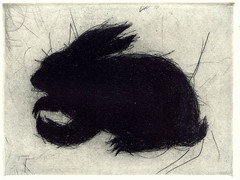
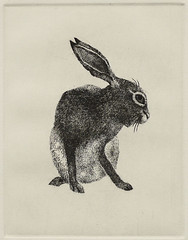
I always do sketch first – either pencil drawing or collage. For my rabbit series, I made collage from 18-19th century illustration books and cartoons or comic books.


I’m always doodling in my sketchbooks so I often use bits and pieces of images from those doodles to create prints too.

What do you enjoy most about printmaking?
I think what I enjoy the most is the process. I love the act of engraving small lines for animal fur or dots for texture by a graver or a needle.

What's your least favorite part of the process?
Filing the edge of cooper plates! I’ve cut my fingers many times doing that. Please let me know if you have a special tip for making edges look nice and clean!


What are your inspirations (other artists, people, places, events, etc.)?
Generally I am inspired by lots of different things in everyday life. Some of those are:
  • Old illustration books on science or animal study
  • Museum / gallery
  • Shrines and forests in Japan (Sadly I can’t do this often)
  • Japanese prints, comics and cartoons
  • My cat
  • Movies especially Hayao Miyazaki films
  • Books especially by Margaret Atwood, Mayumi Nagano, Clive Ponting’s A Green History of the World is something I’d always keep in mind
  • My childhood memories
  • Silent space
How has your work changed and evolved since you started?
I appreciate Japanese prints 100 times more than before.

I used to avoid Japanese prints or Japanese art works as I felt uncomfortable people telling me the relationship between my work and Japanese art so I consciously didn’t look at them. Now it is one of the main inspirations of my work. I think it’s because I’ve become an “outsider” being in Australia for a while. That’s why I can better appreciate my own culture and arts, so it reflects on my own work too.


How do you get past creative slumps?
Read books, watch movies, going to museum and gallery, play with my cat and have a good night’s sleep with inspiring dreams.

How do you promote your work?
This is something I’m still learning how. I try to enter as many awards as possible to get more exposure. Regardless of the result, at least judges would have seen my work.


Any other comments or advice for others who want to try making hand-pulled prints?
Sign up for community print workshop to get basic skills, and the rest will just come with experience. And stay curious about medium you haven’t tried, as printmaking offers endless possibilities.

My encounter with printmaking technique few years ago is one of the best things in my life. This beautiful discipline with deep history is certainly something worth diving for!

Sunday, May 9, 2010

Printsy Interview - Bridget Farmer

Website: www.bridgetfarmer.com
Etsy: bridgetfarmerprints.etsy.com, bridgetfarmerbooks.etsy.com
Blog: bridgetfarmer.blogspot.com

Brief Bio
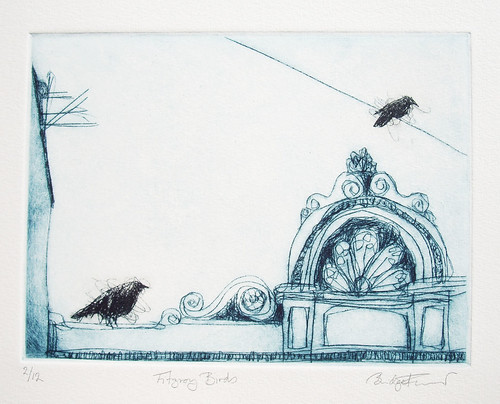
I grew up in Belfast in Northern Ireland, studied Design and Applied Art in Edinburgh, Scotland, then went traveling and ended up discovering printmaking and meeting my partner in Australia. This led to staying in Melbourne, Australia for four years longer than I meant, studying an MFA in printmaking at RMIT and getting a scholarship at the Australian Print Workshop. I have now moved back to Belfast with my partner for a couple of years.

How did you get started in printmaking?
While at art college I learnt how to make monoprints, but the extent of the printmaking world was still unknown to me at this stage as I was studying jewellery and silversmithing, not printmaking. During my degree I realised I wasn't really a jeweller, but I loved all the portfolio work we had to do, so I decided to take that further.
When I arrived in Melbourne I found the Australian Print Workshop and enrolled on a weekend course. I loved it! and from then on I was hooked. It was like a whole new world of possibilities had been opened to me. I had always liked drawing and this was a perfect way to take my drawings further.

Describe where you work.
At the moment since I've just moved back home I'm working where ever I can. It's not ideal, but I keep an image in my head of the studio I'm longing to one day build when I get back to Australia! It's going to be huge and light and lots of shelves and a lovely big old printing press!
What's your favourite printmaking process?
I feel I'm still a novice really, I know there is so much more to learn, so I'm not really sure what my favourite process is. I do love the fine lines achieved with acid etching and the other possibilities such as aquatint and sugarlift using the same form of technique. I want to look more into these, play around a bit, experiment.

I feel I should also explore non toxic printmaking. I've always turned my nose up at it, yet my dream is to build an eco house and live as green as possible. This doesn't make sense! How could I live in an eco house with a toxic studio? So I think I need to readdress this!

What's your creative process for any given print? (eg. sketch first? Pre-planned or free-form?)
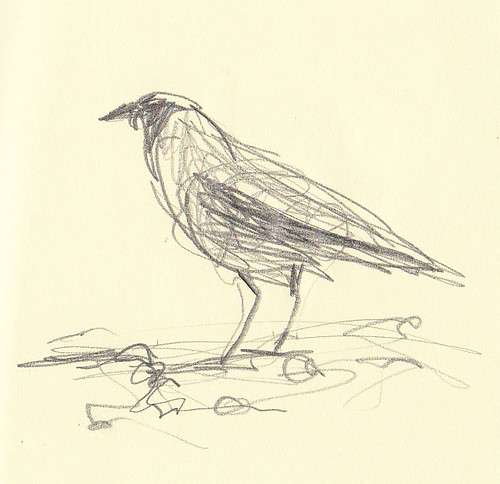
I find it very important to go out drawing first. I have to draw from life, although often 'life' is in the form of a dead stuffed bird in the museum. I also like drawing live birds and dogs down at the beach or in a park. Drawing from life (even a stuffed bird) gives your drawings life. I don't think you can quite get the same sense from a photo.
I then use my sketches as a basis for my prints. I have an outline of an idea of what I might want the print to look like but I'm always open for happy accidents. I'm not too precious about the results, sometimes I wish it was slightly more out of my control!

What do you enjoy most about printmaking?
I think it's got to be that moment, just after rolling the press, pulling back the blankets and peeling off your print and seeing it for the first time. Even if editioning, each time I lift the paper it's exciting.

What's your least favorite part of the process?
Sometimes I get frustrated at how long the process takes. I don't experiment as much as I should as a result. Also, of course, the cleaning up.
What are your inspirations (other artists, people, places, events, etc.)?
When I started printmaking I'd just arrived in Australia and I just couldn't get enough of all the birds. They were all so foreign and exotic looking to me and I hadn't a clue what they all were even though I knew most common birds in the UK. So in the beginning I used printmaking as a way to get to know these birds, you'll see all my earliest work depicts Australian birdlife. I looked at how others depicted these subjects and I love looking through links on other peoples blogs and finding new artists and printmakers dealing with similar subjects.

How has your work changed and evolved since you started?
I've only really been printmaking for 4 years and most of that time was learning different techniques, so I don't feel I've evolved a great deal, except in the number of different techniques achieved.
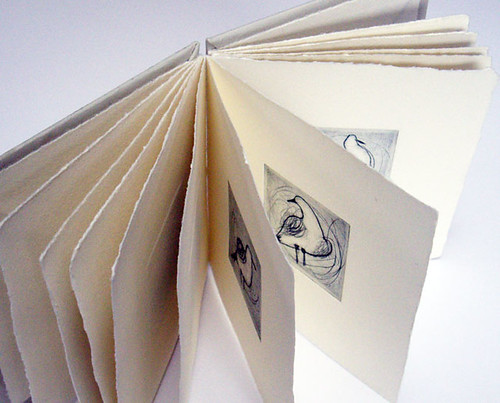
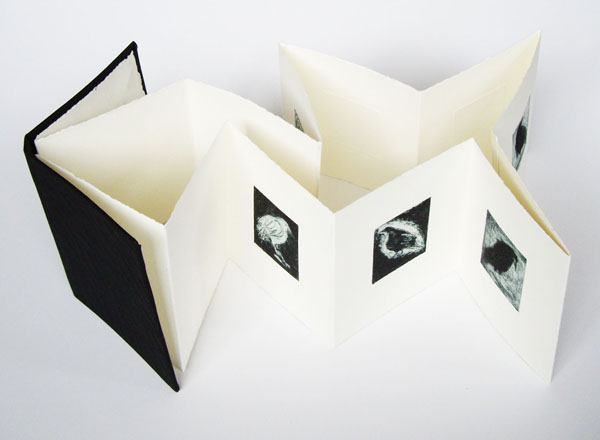
I have however started to really get into making books. I like the craft aspect of this, constructing, thinking in 3D, learning book binding, thinking about cover as well as the content. I find it challenging in a different way. I love ending up with a precious object, rather than an image for a wall.

How do you get past creative slumps?
I hate that feeling, sitting at your desk, knowing there should be something you could do, but nothing happening. I think the best thing to do is leave your desk. Go out. Look at exhibitions. Read peoples' blogs. GO DRAWING!
How do you promote your work?
I have a blog that I try and post on regularly, I take part in the etsy forums, and occasionally I twitter. But I find the best ways are normally through exhibitions and word of mouth. I was part of a few exhibitions in Melbourne before I left and as a result had some local newspaper articles written about my work. This led to people phoning me up and coming round to my house to see my prints and buying. I think it all just takes time to get known. I don't help it by moving countries every 4 or 5 years!

Any other comments or advice for others who want to try making hand-pulled prints?
There are lots of print workshops around, find out if there is one near you and see if they have any courses. They may seem expensive but it is well worth it and most of the time the price includes all the materials. Once you have a basic knowledge of how the process works there are lots of things you can do at home. I've just bought a mini press for about £300 and I intend to make collagraphs, which are non toxic and made of many materials you'd find at a local DIY store. Don't feel daunted by all the chemicals and acid, they are not necessary!
Also by working at a print workshop there will always be other people around. I learnt mostly from other workshop users. It's good to feel part of a little printmaking community, everyone helping each other. For me, enrolling on that printmaking course back in 2006 was the best thing I ever did!

Sunday, April 11, 2010

Printsy Interview - Molly Bowman

Etsy: printsbymrb.etsy.com
Flickr: flickr.com/photos/printsbymrb

Brief Bio
I am a research assistant on a public health career path but spend most of my free time covered in block-printing ink. I spent a few perilous years in New York City trying to "realize" my love for art by settling for a publishing job that really just involved photoshopping celebrities. Last summer, I quit my job, packed my belongings into my car, and moved clear across the country to Portland, OR. Here I am finding a slower pace of life, a wonderful artistic community, and the understanding that art is a personal process, not a commercial one.

How did you get started in printmaking?
I started loving printmaking at age 3, when my father carefully dissected Mary Azarian's "Farmer's Alphabet," a beautiful book of rural woodcuts, and taped them all over the walls of my room. Like many American children, I was trusted with my first linocutting tools in elementary school art class. I remember it vividly: the activity we did while the teacher stood by with a first aid kit, warning us repeatedly to cut our little rubber block by motioning the blades away from ourselves, and finally kicking Tommy out of class for threatening to deface Rachie’s American Girl Doll. I remember gleefully lifting my paper from the block, and becoming crestfallen as I realized that the letters I had carved so perfectly were printed backwards. A few attempts later, I had figured out the reversal process couldn't stop printing.

While trying to survive the bustle of NYC after years of printing abandonment, I decided to give it another shot. I bought some plastic carving tools, a couple of blocks, and discovered that it was just as rewarding as I remembered it.

Describe where you work.
I work all over my tiny apartment. I have a designated printing table in a small nook, but it's often overflowing with supplies and prep for art fairs. I print on the coffee table, the kitchen counter, the dining table, the floor, the desk, and sometimes actually on my printing table. Really whichever 2'x2' space is free and flat.

What's your favourite printmaking process?
I can't resist linocutting - it is such a smooth, cognitive process. I often find that I marry whatever I've been listening to - radio stories, song lyrics, etc., with a particular part of a carving. For instance, I recently carved an anatomical heart, and can still hear the NPR Talk of the Nation discussion I was listening to as I carved the pulmonary arteries. I have plans to build up the courage to venture into woodcutting, but so far am so satisfied with linocutting that I can't seem to make the switch.

What's your creative process for any given print? (eg. sketch first? Pre-planned or free-form?)
After my sad experience in grade school where I forgot to reverse the letters in my carving, I developed a technique to make sure that all my prints are printed as originally envisioned: I sketch in pencil on tracing paper, then press the tracing paper - graphite down - on linoleum and bare down with a pencil to transfer the drawing to the block. My carving is based on the transferred pencil marks (with some liberties taken). My prints are usually hand-pressed (as in, with my fingers) - though I have a baren (a pressing tool) in an attempt to reduce wrist strain, I just love the feel of the block under the paper and usually the baren stays in a drawer.

What do you enjoy most about printmaking?
I love it all, but I think my favorite part is inking a block for the first time. I absolutely adore the tacky sound a brayer makes rolling in ink (I've been known to roll it back and forth much longer than necessary). When the brayer rolls across the ridges of the linoleum for the first time, I get giddy to see what used to be a flat drawing realized in three dimensions.

What's your least favorite part of the process?
I wish that I could keep calm while carving. When I carve too quickly, I inevitably slip and take off a piece that then takes forever to glue back into place and recarve. Carving is such an exciting process that I can't help but get a little over-zealous. Kind of like when you have something wonderful to drink, can't contain your excitement, and spill some on your shirt.

What are your inspirations (other artists, people, places, events, etc.)?
As a kid, I was stunned and inspired by the printed political posters made Bread & Puppet-style artists. Their simple sylvan designs were screen printed onto linen in vibrant colors with few well chosen words expressing disgust with politicians, hope for change, and love for the simple pleasures. Mary Azarian, a woodcutter from Vermont, has been formative for me with her intricate, hand-colored images that reflect much of my rural childhood. Sabra Field, also a woodcutter from Vermont, has reminded me that simplicity is key in communicating sweeping emotions. And lastly, despite my recent move to the Northwest, I can't help but draw continued inspiration from the "clean dirt" feel of rural Vermont, where I was born and raised.

How has your work changed and evolved since you started?
It hasn't been long since I decided to embrace the term "printmaker," but I have recently noticed a sense of confidence in my designs that wasn't necessarily there before. At first, I relied a lot on the unexpected elements of printmaking to make my carvings interesting - maybe I had pressed the paper with different weights which lent a mottled effect, or I forgot to carve some areas deeply enough and the resulting print had a darker feel than I had planned. Now I have a better idea of what works and what doesn't, and most of my prints are quite purposeful.

How do you get past creative slumps?
I am guilty of long slumps. Eventually, though, I'll start feeling anxious that I haven't printed lately, and begin to reconsider my surroundings. I'll try to see everything as a carving - the trees and dogs in a park, my kitchen, a lamp. I enjoy working in series, so if I find one possible carving, I'll often be able to extrapolate that to other similar carvings in content or style.

How do you promote your work?
Most of my promotion is online - the usual social networking sites and Etsy, primarily. I've attempted a blog but put it aside due to lack of inspiration - I felt inspiration was better spent carving. I'm working up the courage to contact local commercial establishments to carry my more marketable products - greeting cards, for instance. And lastly, I'm working on a set of prints that could be sewn into a children's book. I'm hoping that venturing into publishing might expand my scope a bit.

Any other comments or advice for others who want to try making hand-pulled prints?
Any artist who has ever felt a pull to work with his or her hands will feel completely at home with some carving tools and a block. The tactile elements of block printing are wonderful, and the serial nature of the work allows an immense satisfaction. Just make sure to have plenty of band-aids handy!

Sunday, April 4, 2010

Printsy Interview - Anna See

Website: www.annasee.com
Etsy: www.annasee.etsy.com
Blog: www.annasee.blogspot.com
Flickr: www.flickr.com/photos/anna_see

Brief Bio
For as long as I can remember, I have always turned to art as a means of therapy, entertainment, expression, and an outlet for creativity. After a brief stint studying art history, I realized I missed actually doing art and enrolled and recently graduated from Art Center College of Design. I am now currently embarking on a career as an illustrator and designer.

How did you get started in printmaking?
I discovered it by accident actually. After completing a very small run of a linocut image on a Vandercook press for an assignment my final term at school, I realized that I really liked the result and sought to replicate that post-graduation without access to a letterpress. Thus, I experimented and taught myself how to achieve that result via printmaking without a letterpress.

Describe where you work.
I work on my kitchen table, at my drafting table and at my computer in my small cozy apartment....eventually taking over the whole place with prints at various stages of drying!


What's your favourite printmaking process?
Given my limited experience with more formal printmaking techniques, my favorite would have to be my self-taught method with linocut blocks in which I roll the ink on the block and transfer it to paper via burnishing with a large metal spoon.

What's your creative process for any given print? (eg. sketch first? Pre-planned or free-form?)
I usually have a vague idea beforehand of what I want to create. What I have seen, like a particular kind of bird for example, inspires what I will make. I sketch an image first, working from reference as to ensure accuracy, then scan it into Adobe Illustrator, using the sketch as a template. I then refine and simplify the shapes, play with color, then resize and print it out. I use this to transfer the image onto the linoleum block with graphite (Saral paper). I carve away! Once I'm done carving all the blocks, I mix the colors using my Illustrator printout as a guide and roll out the colors and burnish to transfer onto paper.


What do you enjoy most about printmaking?
The satisfaction of a beautiful finished print is what I may enjoy most but I really enjoy the whole process. I enjoy the patience, concentration, diligence, and often caution it requires as it forces you to slow down and think ahead yet be thoroughly involved in the moment so as to ensure a good print. It's thoroughly therapeutic, like knitting!

What's your least favorite part of the process?
Cleaning up!

What are your inspirations (other artists, people, places, events, etc.)?
I am greatly inspired by nature, specifically what I see in nature, the colors, the shapes, everything, including all kinds of animals, people and the human form. I also am inspired by artists too numerous to name all but I love Mucha, Gaudi, all Art Nouveau, Da Vinci, Poiret, Erte, fashion illustration, Hokusai, Hiroshige, Japanese wood block prints, Charley Harper and the vintage graphic aesthetic. But, honestly, anything and everything can be a source of inspiration!


How has your work changed and evolved since you started?
I think my work is always continually evolving but I've definitely become less timid with my color palette and shape design. I'm relying less on my digital skills and more on my traditional skills and letting that show through. I'm including more texture and pattern and am becoming more intentional with the placement of color and other elements.

How do you get past creative slumps?
I let it rest or "sleep on it" and work on something else or start something new, often in a non-printmaking medium. Hopefully, when I've taken enough of a break from the piece, I am able to come back to it with a fresh set of eyes and get past that slump. There are always simultaneous art and non-art projects going on.


How do you promote your work?
Networking, word-of-mouth, passing out business cards and postcards, participating in competitions as annuals are great advertising and exposure, selling my work at art fairs and Etsy, giving my work as gifts, and having a web presence with my website and blog so people interested in your work can easily find you.

Any other comments or advice for others who want to try making hand-pulled prints?
Just have patience and persevere as it's a lot of trial and error, but the end results are well worth it! And just have fun with it!

Sunday, March 14, 2010

Printsy Interview - Liv Rainey-Smith


Website: www.livraineysmith.com
Etsy: raineysmith.etsy.com, lovecraftian.etsy.com

Brief Bio
Printmaker Liv Rainey-Smith works with woodblocks to create richly colored prints. Her process incorporates a mixture of traditional and modern tools as well as a blend of European and Japanese printmaking technique. She draws upon history, nature, religion, dream, and vision for inspiration.

How did you get started in printmaking?
I needed some more "secondary craft" credits as part of my degree requirements. Printmaking caught my eye because it was taught by Brian Shannon and I was curious about the process. Little did I know I'd be lured away from my primary craft (metals) and into the world of print.

Describe where you work.
I do my sketching anywhere and everywhere, I make sure to take my sketchbook whenever I might have some quiet time. Most of my carving is done in my home office on a small desk. I prefer solitude for carving and need to take periodic stretch breaks, being at home gives me plenty of other small tasks to break up the work and still feel productive. My office is a bit cluttered, with a full bookshelf, CD rack, two computers and desks, a rolling steel rack loaded with supplies, and a tank housing our pet mice. For the actual printing I'm a member of Atelier Meridian. The Atelier offers plenty of work space, several presses to chose from, and good company.

What's your favorite printmaking process?
Woodblock with oil-based ink. I'm particularly fond of reduction printing, though I've primarily focused on single-color prints this year. I enjoy strong solid colors and thick papers that take embossing.

What's your creative process for any given print? (eg. sketch first? Pre-planned or free-form?)
My process varies. My thesis, The Four Portlanders of the Apocalypse, was highly planned. I spent months developing the concept, taking photos of locations around Portland, drawing, and testing out the sizes of various elements on photocopiers. The finished designs were transferred to the blocks using carbon paper, and then I carved all four concurrently.

My current series, the Iunges, has been much more free-flowing. I start directly on the block, spending time looking at the grain, then sketching the outline of the Iunge. I make a few guidelines as the carving progresses, but for the most part the details are not drawn out first. I've found this technique very liberating since woodblock tends to be a very rigid medium.

What do you enjoy most about printmaking?
I love being able to make two-dimensional art using three dimensional means. I've always been more comfortable with mediums that require a certain amount of force and control. Metalsmithing was actually the focus of my education and taught me a great deal about precision. Ultimately though, I found the prospect of making the same pieces of jewelry over and over again unappealing. Printmaking has the advantage of allowing the production of editions without the same level of tedium.

What's your least favorite part of the process?
Cutting paper and mats. It is exacting and not very exciting work. I also have trouble photographing my own work as well as I'd like to, and job that out whenever possible.

What are your inspirations (other artists, people, places, events, etc.)?
As a child I went through the period of fascination with dinosaurs most kids seem to go through, but then I also got into ancient Egypt, the Aztecs, Hopi and Zuni lore, and natural history. My interest in historical art and cultures has continued on through adulthood, so it can be a bit difficult to pinpoint my influences. Some of my earliest print works are clearly influenced by particular cultures, but as my work has continued the connections have become less apparent.

Dream has also been a very large part of my creative life. I remember my dreams from every night, so the often non-sensible scenarios and beings I encounter within them are to me, normal. As important as rational thought is, I believe it is important to maintain a sense of wonder and awe. This will be a sad world indeed if we ever succeed in banishing all of the angels, devils, and bogeys from our minds.

How has your work changed and evolved since you started?
My first prints as a student were technical exercises. Not terribly creative, but very exciting to me as I could see the door to a new world of art opening up. Technically I see great improvement in my carving, even from the work I did a year ago. Familiarity with the tools and techniques of woodblock has allowed me to start experimenting more. I've been letting go of some of my rigid notions of how things "must" be, and allowed myself to work more freely.


How do you get past creative slumps?
When my cup of ideas runneth over, I lament my lack of time to pursue each idea fully, and sketch them out for future dry spots. When concept begins to weigh me down, I let myself just have some fun. Not every piece needs to have a deep meaning behind it. When I'm feeling a bit lost, trying out different block sizes has also proved fruitful. I followed up the largest blocks I've ever carved with the smallest I've yet carved. The transition from large to small was a fantastic mental exercise.

How do you promote your work?
I keep my business card in my wallet and car so I've got it to hand out any time I run into someone interested or interesting. I also apply for juried shows and send show announcements to my alma mater. Art and craft events can be good for creating visibility, and conferences have proven excellent for making professional contacts.

I use Etsy, Facebook (via a fanpage and a personal page for friends), and my website. I also have a blog but I've not really set it up yet. I'm not fond of sitting down to write long entries. I much prefer sharing photos with little bites of info.

Any other comments or advice for others who want to try making hand-pulled prints?
Take a survey class if you can. You never know what technique you might fall in love with until you try it, and a bit of hands-on guidance can make intimidating processes more approachable. Be prepared for some failures, but don't let them stop you.

Sunday, February 21, 2010

Printsy Interview - Frank Pappas

Website: frankpappas.com

Etsy: notoriousfcp.etsy.com

Flickr: flickr.com/photos/notoriousFCP


BRIEF BIO

I’ve spent the better part of two decades helping companies develop powerful brands, products, and services. I’ve worked with companies like Marriott, Swissair, Land Rover, the Smithsonian, and Seventeen Magazine, helping to grow market share, increase revenue, and adapt to the ever-changing realities of the digital age.


But we all know what they say about "all work and no play..."
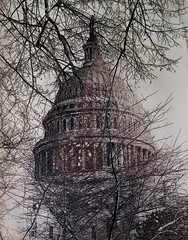

In my spare time, I explore a variety of creative pursuits, including cooking, writing, photography, and printmaking. For more than three years, I assisted classically-trained chefs in teaching recreational cooking classes at L'academie de Cuisine in Bethesda, MD. I’ve also co-authored a number of books and articles on topics ranging from online pricing and distribution models in the music industry to business use of technology, contemporary American politics, travel, and product development. For the past few years I’ve worked with artists at Washington's Corcoran College of Art + Design to explore photography, typography and graphic design, printmaking, and drawing.


I’ve earned a BA in Political Science and Spanish Language/Literature from the George Washington University and an MA in Communications from Georgetown University.


HOW DID YOU GET STARTED IN PRINTMAKING?

Almost completely by chance, actually. I’ve worked in advertising for a long time and have been fortunate to work with extremely talented copywriters, designers, producers, and programmers. The bulk of my experience is in creating interactive and print campaigns and products for hospitality, travel, automotive, and consumer products companies in the US and Europe. And while I’ve always been comfortable collaborating with brand managers and market researchers and account executives, I’ve often felt that working with my design teams was harder than it needed to be. I’m not sure if this was due to my lack of hands-on design experience, not sharing the same vocabulary, some fundamental gap between left-brain and right-brain personalities. But as the guy ultimately responsible for the quality of our work, I was determined to find a way to improve my interaction with my designers. My approach was to take classes at the Corcoran College of Art + Design, everything from Photoshop and InDesign to drawing, photography, lighting design for interiors, and graphic design. A few years back I replaced a canceled class with screenprinting and was absolutely amazed by the powerful emotional and physical connection I felt in the studio. The physicality of the process, infinite opportunities to follow traditional techniques or to experiment with new approaches, the joy of creating multiples, it all had me hooked right from the start.

DESCRIBE WHERE YOU WORK

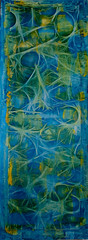
The bulk of my printing happens in the print studio at the Corcoran, which is in the basement of a really old, former public school building in DC. It’s a great space to learn the basics. It’s on the smaller side, so you learn quickly how to work in close quarters with other printers, how to move carefully between printers as you carry your prints to the rack, how to be aware of those moving around you with prints or pots of ink or the random sharp, pointy object. Our equipment is anything but fancy – wood and aluminum screens clamped to work tables – no cool vacuum tables or anything like that. And it certainly isn’t new – our racks and floors and tables and washout room are layered with spots and smears of ink, scratches, rust, dents – a subtle reminder that there’s history all around us, the collective creativity and sweat and effort of all the students and masters who’ve printed before us. That makes the space inspiring, and as cramped and frustrating as it can be, it feels like home.


WHAT IS YOUR FAVORITE PRINTMAKING PROCESS?

Screenprinting, definitely. I studied intaglio many years ago with master printer Scip Barnhart, which was really a great experience. But as much as I enjoyed the process, it's so much slower than screenprinting. And much more dependent on my ability to draw, which is probably one of my least-developed skills. So while I enjoy it, most of my intaglio work would probably be stick figures interacting with other stick figures.

Screenprinting, on the other hand, well, that’s a whole different ballgame. My creative process for screenprinting is fueled in so many ways by my photography, through abstract designs or compositions in Photoshop or Illustrator, or more traditionally through non-digital processes. I’m able to envision and create much more effectively – and I think at a higher level – through screenprinting than I would with any other process.


WHAT'S YOUR CREATIVE PROCESS FOR ANY GIVEN PRINT? (EG. SKETCH FIRST? PRE-PLANNED OR FREE-FORM?)

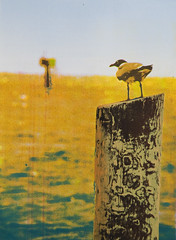
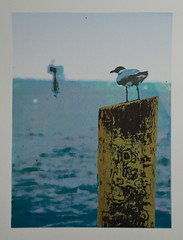
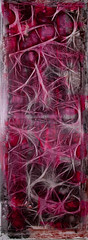
My best prints - or at least the ones I feel are the most successful - start out from my photographs. I try to travel to interesting places, though recently (thanks, economy!) those places have been much closer to home. Places like Philadelphia, shooting well-known but very interesting places like Eastern State Penitentiary or Smith Island, Maryland, which is home of the many-layered Smith Island Cake. I’ll even drive for hours and hours to places like Centralia, PA, which is what’s left of an entire town destroyed by a coal mine fire. Places with history, with a unique story, with some kind of beauty and meaning. I then pull everything into Photoshop or Illustrator to experiment with texture, tone, balance, all the little tweaks needed to pull together an exciting composition. Sometimes there’s a lot of manipulation involved, as with my print “El Gran Gallo,” where the original photograph is substantially transformed into a graphic print. Other times the digital work is very minimal, as with “Gull, where Photoshop was used merely to create CMYK separations, the print clearly reflecting its photographic origins. Finally, it's into the studio, where I try to challenge myself with each new project, working with new color palettes, techniques that are new and unusual, or sizes or aspect ratios that I haven't worked with before.

WHAT DO YOU ENJOY MOST ABOUT PRINTMAKING?

The night before I go into the studio I'll spend some time doing a mental walk-through of my battle plan, about everything that needs to be done, about the best timing, order, where things can go wrong. I try to anticipate problems and how to keep them from happening. So by the time I get into the studio, I have a fairly good idea of what needs to happen, when, and how I can act and react if anything funky happens.

What I love about printmaking, then, is when I get into the studio and the day unfolds much like I've visualized it. I'm in the zone, everything is breaking my way. My film looks just like I want it, the emulsion isn't too old and is holding the detail of my images nicely. There's plenty of room to work, I'm getting my inks together without much hassle. And when the printing begins, it's almost on automatic, pour, flood, drop, pull, lift, flood, repeat. I spin gingerly on one foot and carry my prints to the rack, the other printers in the studio moving deftly aside as I scoot by. There's a harmony, a synchronicity between us. My head's down, I'm doing good work, the rhythm and pacing are spot on. Can’t get enough of that feeling.


WHAT'S YOUR LEAST FAVORITE PART OF THE PROCESS?

I hate picking colors for my prints. I am woefully unschooled in color theory, though I do generally know a good color combination when I see one. But my knowledge and skill in this area are very rough, unrefined. I’m certainly not delicate when it comes to color, and often default to bold colors because I just don’t trust myself outside of this comfort zone. I've been aching to take a color theory class for years, but haven’t had any luck so far. Fortunately my instructors Manuel Navarette and Carolyn Hartmann have been extremely gracious in sharing little color theory insights with me, suggesting better combinations or directions for particular projects. But I'd very much like to take color theory so I can embrace this part of the process more fully, make it more my own.

WHAT ARE YOUR INSPIRATIONS (OTHER ARTISTS, PEOPLE, PLACES, EVENTS, ETC.)?

In the last 15 years or so, there are three artists who have really inspired me to embrace artistic pursuits. First is Scip Barnhart, my intaglio instructor, who gave me my first taste of the technical skill and creative processes required to create something meaningful, beautiful, fulfilling. More recently are two New Orleans artists, Matt Rinard and Robert Guthrie. I've been collecting their work for years and have been surrounded at home by their prints and originals and bits of sculpture. Each time I catch a glimpse of their work, some little emotional part of me thinks fondly of New Orleans and an overwhelming sense of happiness washes over me. Let me make it clear that I'm absolutely in no way comparing my work to the awesomeness these guys create, but knowing how happy their art makes me, I thought it would be really, amazingly cool to see if I could find something within me, some creativity, some passion, that could give a bit of that happiness to others. And it goes without saying that I’d be absolutely nowhere in any of this without the attention, support, and dedication of my instructors Carolyn and Manuel.


HOW HAS YOUR WORK CHANGED AND EVOLVED SINCE YOU STARTED?

It’s important to understand that when I walked into the studio that very first day, I had absolutely no idea what I was getting into. None. Yeah, I’d had that intaglio experience with Scip years earlier, but wow, such a different process, different tools, different mindset. So I was really starting from scratch. My first year or so was spent focused on the basics, developing the muscle memory of the right way to pull the squeegee across my screen, developing a fluidity of movement in my personal printing process, becoming familiar with the temperament of the inks and acrylic base, how they change based on environmental circumstances, how to coax them into doing what I want them to do with a little bit of airbrush cleaner. My prints in this time were very traditional, straightforward examples, pretty much just ink on paper.

But throughout that first year, I did two important things. First, I asked questions, a lot of questions. I’m sure I drove my instructors a little nuts. Second, I searched bookstores and galleries and the internet for more information on screenprinting, but also generally about all types of printmaking. So over the course of that year, I learned, for example, about metallic powders and glass beads and mecoflock and the use of adhesives. I learned about very interesting techniques using wax and oil paint to add depth and dimension to my prints. I discovered how important it can be to pick the right paper for an edition, because some papers simply won’t accommodate an artist’s vision for a particular project.

I also developed a sense of the projects I should (and shouldn’t) be tackling. My dad was an artist, and I thought it would be a neat homage to his work to create a print of one of his paintings. It was hard as hell, to be honest. Not only technically, because perhaps my skills with Photoshop and as a printmaker weren’t quite yet up to that level of reproduction, but also emotionally because I was putting lots of pressure on myself to do justice to the original piece. Add to that some difficulties with new inks that I was using, and a few other hiccups, and we had the recipe for one spectacular, colossal failure. I still think it’s a good idea to challenge yourself, obviously, but perhaps I’d piled on too many expectations, too much pressure. I’ve found that I work better and am much more satisfied when I’m focused on my personal vision for my pieces, with their genesis in my photography or drawing or whatnot, because I only need to be true to myself, my vision, my creativity.


In the past few years, all of this learning, experimentation, successes and failures have definitely influenced my work, changed it – I think – for the better. As much as I still love the straightforward ink-on-paper approach, I’ve also embraced some less traditional processes. Images that are concealed by 15 or more layers of multi-colored inks, then sanded to carefully reveal parts of the obscured subject. Images printed in clear acrylic base, with acrylic glazes or wax and oil paints used to provide color, depth, dimension. All this experimentation comes at a price, though. If I’d been sticking to simpler projects using more basic skills, I’d have a much broader, deeper portfolio by now. Instead, I have a handful of finished editions that I love, combined with drawers and portfolios full of pieces in various stages of completion: waiting to be sanded, waiting for an epiphany to recover from an experimental misstep, pieces that I’m just not sure how to finish. I’m okay with that trade-off, because it’s my belief that I need to spend a whole bunch of years up front working on technique so that later on I can print larger editions, more complicated editions flawlessly and with (relative) ease.


HOW DO YOU GET PAST CREATIVE SLUMPS?

Check back with me in a few years, I’m still trying to figure that out! I've definitely hit a few walls so far. One way I’ve attacked the problem of becoming frustrated with my skills development is by changing instructors. Which is absolutely not a knock on one instructor or another, but I think it's important to learn from different people, to be pushed and encouraged and challenged by people with unique perspectives, paths, approaches. When I get stuck creatively, in terms of what I am going to do next, it’s sometimes good to just be in the studio printing, even if I’m not working on my next masterpiece. Because I have a day job, my studio time is very limited. And I often find myself trying to maximize my productivity by printing complicated pieces, sometimes with funky techniques or levels of detail that maybe, maybe I shouldn’t be embracing quite yet. And when things don't work out exactly as I'd planned, I'm especially hard on myself. So lots of practice, especially with less meaningful subject matter, is key. Get in the studio and just print some squares or squiggles, but aim to make all the right choices: paper, composition, colors, technique, bringing everything together so you print the best darn squiggles you can.

HOW DO YOU PROMOTE YOUR WORK?

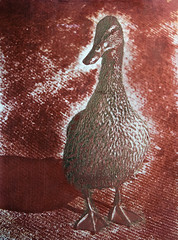
I'm just starting to figure that out. Like I said, most of my best prints start out as my photographs. "El Gran Gallo" is an interpretation of a picture I made of a rooster at the Great Frederick Fair in Frederick, MD, which lent itself to a particularly cool transformation into a graphic print. But sometimes my photos just need to live as photos. So if you visit my Etsy shop or flickr photostream, you'll see I have photos as well as prints available. My approach so far has been very basic: have a bit of a presence on my personal site, post photos and prints to flickr and to lots of flickr groups, and try selling some pieces on Etsy. It's frustrating, I don't yet have a good sense of where best to promote my work, or how to best price my photos and prints. I don't want to overcharge, but I also don't want to low-ball. After all, camera lenses and studio time don't come cheap. Other printmakers at my studio say they've had good success on eBay, but honestly, a 12% cut of a sale seems a little excessive to me. Maybe that’s penny-wise and pound-foolish, I don’t know. I'm also starting to explore print exchanges and submitting my work to shows, but I don't yet have a sense of the return that will have for me. Right now I’m just throwing everything against the wall to see what sticks.

ANY OTHER COMMENTS OR ADVICE FOR OTHERS WHO WANT TO TRY MAKING HAND-PULLED PRINTS?

Trust your gut. Whether it’s screenprinting or intaglio or litho, you’re going to know when you’ve found a process that’s a good fit for you. Struggling is part of the technical and creative learning process, so you shouldn’t use a little difficulty up front as an excuse to give up. But there’s certainly a difference between becoming proficient with a particular process and discovering you have a passion for it.